The Philadelphia-born Chinese American who tested the limits of birthright citizenship
If you are born in the United States, you are a citizen. But the history of Chinese Americans shows that this hasn’t always been enough.
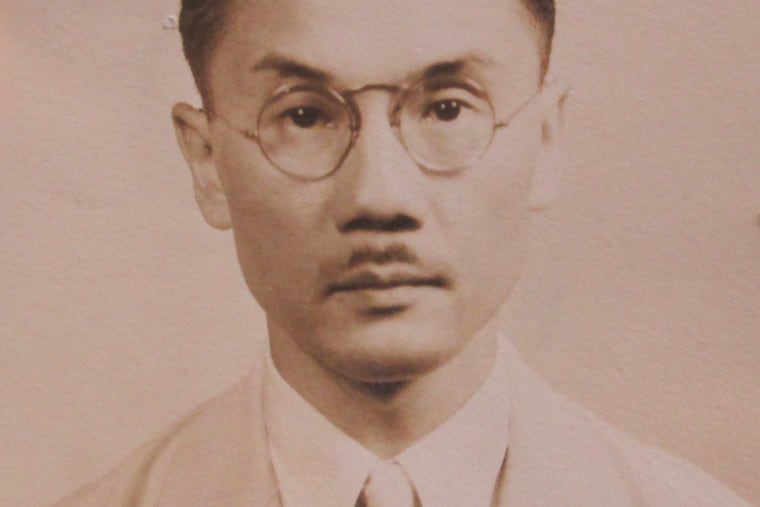
In 1950, Ernest Moy was trying desperately to return to the United States after spending the previous 20 years working in China. Since he had reentered the U.S. twice before, immigration officials already possessed thick files of evidence attesting to his U.S. citizenship, including his birth certificate from Philadelphia. This unquestionably established his status because of the Fourteenth Amendment’s birthright citizenship clause and an 1898 U.S. Supreme Court decision that had affirmed this: if you are born in the United States, you are a citizen.
But more than 50 years of settled law meant less to the Immigration Service than the fact that Moy was Chinese American. Because of his race, officials considered him both undesirable and unassimilable. When he finally did get permission to reenter the United States, it was only as a temporary immigrant who required further investigation. Moy bristled at such treatment but had learned to expect no better.
In 2026, as the Supreme Court considers Trump v. Barbara, many Americans have learned for the first time about the Supreme Court ruling that should have guaranteed Moy’s reentry: U.S. v. Wong Kim Ark. The aftermath of that case — and the story of Ernest Moy — show how the constitutional guarantee of birthright citizenship has on its own never been sufficient to protect the rights of many Americans. When those in power define citizenship as whiteness, they enable and encourage immigration officials to do the same.
The landmark case began in 1895, when immigration officials barred Wong Kim Ark, a native of San Francisco, from reentering the United States after a trip to China. Authorities argued that because Wong’s parents were Chinese immigrants — a group barred from naturalizing because of their race — the birthright citizenship clause of the Fourteenth Amendment did not apply to their son. What did cover him, officials claimed, was the Chinese Exclusion Act. This 1882 law prohibited the entry of Chinese laborers, and because Wong was a cook, he fit into that category. As the government succinctly put it, “although he is native born, he is not entitled to come into the United States because he is a laborer and of the Mongolian race.” Wong responded by taking his case all the way to the Supreme Court, which in 1898 clearly and unambiguously affirmed his U.S. citizenship.
Yet in the years that followed, the Immigration Service found plenty of ways to thwart the spirit of the ruling, all while claiming to recognize birthright citizenship as settled law. Wong Kim Ark, now back home in El Paso, discovered this firsthand in 1901. Three years after the Supreme Court decided his case, authorities in Texas briefly detained him, charging him with violating the Chinese Exclusion Act for living and working in America, the land of his birth.
Hoping to head off reentry problems, other Chinese American citizens planning to travel abroad learned to gather substantial evidence of their birth in the United States and ask white acquaintances to vouch for them at local courts or Immigration Service offices. Those with enough money hired attorneys to help navigate the haphazard process more effectively, though one such lawyer warned his client that even the most thoroughly documented travelers often faced “considerable trouble” reentering. In such cases, attorneys needed to sue for writs of habeas corpus, just as Wong Kim Ark had done in 1895.
In 1909, U.S. officials rolled out a new procedure for Chinese American citizens, unsurprisingly modeled on the way the government vetted China-born temporary residents. The entire process reflected authorities’ continued hostility toward the very idea of Chinese American citizenship as a legitimate concept — and their eagerness to deny or at least constrain it in any way possible. Even the official name of the Immigration Service’s new form broadcast this attitude: “Application of Alleged American-Born Chinese for Preinvestigation of Status.”
Resentful of the word “alleged,” most Chinese American citizens chose to refer to the application by its official number: Form 430. No matter how they felt, those planning to travel abroad had little choice but to fill out the form and submit it together with copious additional documentation, including birth certificates, school records, photographs, selective service certificates, and the citizenship identity cards that only Chinese American citizens had to carry. By the 1920s, when passports became common for all U.S. citizens traveling abroad, Chinese Americans included those, too. But while a passport could guarantee reentry for other American citizen travelers, officials considered it inadequate evidence of citizenship for Chinese Americans who did not also carry an endorsed Form 430.
In addition to gathering documents, Chinese American citizens also had to testify at the closest Immigration Service office, answering detailed questions about their lives and families to establish their birth in the United States. Many brought in friends, relatives, and community members to undergo similarly detailed interrogations on their behalf. Immigration Service agents tended to view the testimony of white acquaintances, including family doctors, teachers, and local Christian leaders, as particularly valuable.
Even after the Immigration Service “conceded” (in its words) an applicant’s birthright citizenship and endorsed the person’s Form 430, obstacles remained. For instance, returning travelers, including those with U.S. passports, had to sit for further interrogation when reentering the United States. And the Immigration Service required Chinese American citizens to undergo a new preinvestigation each time they left the U.S., even for brief trips to Canada or Mexico. In other words, officials “conceded” citizenship only temporarily, so U.S.-born Chinese Americans became “alleged” citizens before every new departure. No other group of U.S. citizen travelers endured such treatment in the pre-World War II years. While Congress finally repealed Chinese exclusion in 1943, official attitudes barely changed over the next decade, as Ernest Moy’s experience shows.
By the 1910s, large numbers of Chinese Americans started to undergo preinvestigation, but not for the kinds of short trips Wong Kim Ark had taken. Many began to relocate to China, a struggling young republic that offered Western-educated people career opportunities unconstrained by American racial discrimination. Eventually, close to half the Chinese Americans born in the United States, including Ernest Moy, moved to China. Before departing, almost all these U.S. citizens underwent preinvestigation — Moy did so three times — to ensure that they could retain the right to return to the country of their birth, the United States.
Eventually, Wong Kim Ark returned to China, too. The citizenship rights that officials “conceded” to him came with restrictions that didn’t apply to other Americans, and at 61, he was both lonely and fed up. For years, Wong had supported his family from afar because Chinese exclusion laws prevented him from bringing his China-born wife to the United States. In 1931, he retired and joined her in the village where she had raised their sons. But unwilling to relinquish the rights for which he had fought 35 years earlier, Wong submitted to preinvestigation one last time before making that final trip.
The institutionalized harassment of Chinese Americans is just one example of the way the U.S. government for decades equated citizenship with whiteness — and nonwhiteness with alien status. President Donald Trump’s attempt to end birthright citizenship is rooted in this same idea, and the Supreme Court must and should reject the president’s deeply unconstitutional executive order. But as the lives of Wong Kim Ark, Ernest Moy, and so many of their peers show, such a ruling, though essential, will be incomplete without a larger challenge to the pernicious idea that whiteness and Americanness are the same.
A professor of history at Baruch College and the CUNY Graduate Center, Charlotte Brooks has written several books about Asian American history, including the newly published The Moys of New York and Shanghai: One Family’s Extraordinary Journey Through War and Revolution.
Made by History takes readers beyond the headlines with articles written and edited by professional historians. Opinions expressed do not necessarily reflect the views of Inquirer editors.