Liberals spent a century building the federal government. Now Trump is using it against them.
Dating back to the New Deal, liberals saw enhanced federal power as the primary engine for social change. They never foresaw how the machinery they built could be wielded against their priorities.
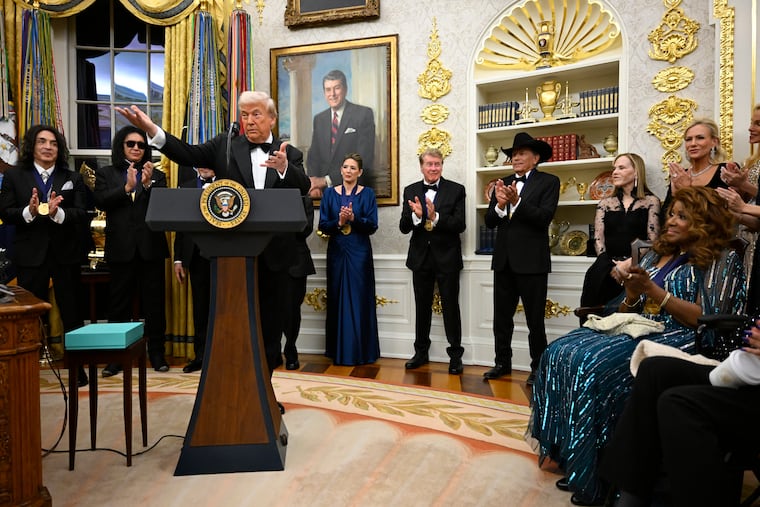
President Donald Trump is on a mission. Since the start of his second term, he has unleashed the awesome machinery of the federal government to refashion America’s political, economic and cultural foundations. In little more than a year, he has dispatched federal agents to impose his will on a host of cities, pressed universities to redesign their diversity initiatives and curricula, and intimidated the press through retaliatory regulatory actions and multimillion dollar lawsuits.
While some of his targets — namely mega-sized law firms and tech titans — succumbed to Trump’s threats, his detractors have searched for ways to fight back. Alongside widespread protests, state and local governments have established sanctuary cities and invoked their sovereignty, educators have stressed the importance of academic freedom, and the media has called upon the First Amendment to resist the president.
Yet, short of a victory at the polls their options are limited. That’s because Trump has harnessed the vast federal power forged and strengthened by Democrats over the last century to advance liberal goals. In doing so, his presidency has laid bare a key oversight by Democrats. As they built up the federal government, they cast aside the Founders’ concern about too much centralized power, never imagining that this massive federal state might one day be turned against their priorities.
By the time Franklin D. Roosevelt entered the White House in 1933, it was clear that the states lacked the wherewithal to resuscitate key economic sectors crushed by the Great Depression like banking, agriculture and manufacturing. Through a litany of “alphabet” agencies and social programs, most significantly Social Security, Roosevelt ushered in a new age that fundamentally increased the federal government’s role in American life. With Democratic super majorities in Congress, only the Supreme Court stood in the way of the New Deal’s reconstituted federalism. While the justices initially resisted, in 1937 they capitulated to this new reality, granting the central government oversight of nearly every facet of the economy.
While this period rarely witnessed sustained pushback from the states, that changed with the dawn of the Civil Rights era. “Massive resistance” to the 1954 Brown vs. Board of Education decision as it came to be known, included strident calls for defiance, legislative and administrative moves intended to impede desegregation and explosive rhetoric epitomized by Alabama Gov. George Wallace.
Southerners resurrected an antebellum era notion of states’ rights in their fight. In requiring schools to integrate, wrote James Kilpatrick, an influential newspaper columnist who went on to become a regular on 60 Minutes, the Supreme Court “seized from the states a power plainly reserved to the states.” Kilpatrick unearthed interposition — a defunct 18th century concept empowering states to nullify federal edicts — to give the region’s resistance a gloss of legitimacy. Southern legislators latched onto the doctrine, passing hundreds of bills invalidating the Court’s decree in the mid-1950s. “All of us stand figuratively on the ramparts together,” Kilpatrick wrote of the region’s steadfast opposition to what the South considered federal tyranny.
This constitutional showdown proved to be short-lived. The Supreme Court resoundingly rejected interposition during the desegregation standoff in Little Rock in 1958.
Even so, southerners remained intransigent; many school districts elected to shut down rather than integrate.
This resistance to integration prompted Congress and the executive branch to take more aggressive action in the 1960s. The 1964 Civil Rights and 1965 Voting Rights acts granted Washington new oversight powers over a broad swath of government bodies and private enterprises. Having witnessed the varied and ingenious machinations concocted to uphold Jim Crow, Congress constructed an elaborate regime to ensure compliance with the laws’ anti-discriminatory measures. Alongside this legislation stood a slew of executive orders instituting affirmative action and increased enforcement actions by the Kennedy and Johnson administrations.
The civil rights struggle reaffirmed to liberals that the federal government, not the states, was the primary engine for social change. This realization made them more inclined to concede immense power to Washington, while granting states little recourse to resist.
Additionally, the period of liberal dominance between the 1930s and 1960s ushered in a revolution in spending that deepened the imbalance of power between the federal government and states and localities. In 1930, state and local budgets nearly tripled federal outlays. By 1960, however, the federal government outspent its state and local counterparts by a nearly two-to-one margin. From dams to interstate highways, no major infrastructure project could operate without federal stewardship. The same was true for major entitlement programs.
Building atop this foundation, Lyndon Johnson’s Great Society established Medicare and Medicaid, the “war on poverty” and nearly 200 pieces of environmental, educational, cultural and social legislation. These bills significantly increased the federal government’s supervision over a broad swath of areas formerly left to the states. Just as importantly, the dramatic rise in federal grants to state and local governments as well as countless educational and cultural institutions created a dependence on federal largess.
By the 1970s, Democrats had expanded the federal government’s reach in ways that would have been unrecognizable decades earlier. Few at the time could have imagined that these powers would ever be harnessed to push conservative causes.
That partly stemmed from the fact that, at the time, the right was more interested in weakening the federal government than in harnessing its power. When Ronald Reagan ushered in a conservative revolution in 1980, he and his Republican successors set out to reduce the scope of federal authority and hand power back to the states. Reagan declared that “government is not the solution to our problem; government is the problem” in his first inaugural address. He promised to “curb the size and influence of the Federal establishment … and to demand recognition of the distinction between the powers granted to the Federal Government and those reserved to the States.”
Yet, while Republicans succeeded in the 1980s and 1990s in reducing welfare programs and other liberal initiatives, none of their actions truly undermined the contours of federal power, or the capacity of the federal government to use funding to sway state and local officials. All 50 states, for example, quickly acquiesced to a 1984 law cutting off highway funding to any state that didn’t raise the drinking age to 21.
After decades of conservatives decrying federal power and promising to restore authority to the states, liberals never fathomed that the federal leviathan might be turned against them.
Then came Trump.
Unlike his Republican predecessors, he has enthusiastically deployed the wide-ranging powers of the federal government to bend adversaries to his will. His administration threatened to withhold grants to cajole state governments into submission, while sending law enforcement agents into Democratically-controlled cities. Media titans like ABC and CBS buckled to Trump out of fear of antagonizing the Federal Communications Commission, one of the New Deal’s alphabet agencies. Though some of Trump’s targets have occasionally prevailed in the courts, the judiciary remained ill-equipped to consistently restrain the administration.
And the very system that Democrats spent a century assiduously constructing has left states and localities, as well as private institutions like universities, ill-equipped to resist Trump’s edicts. Liberals built the federal government to be strong enough to respond to enormous crises, including the Great Depression and Southern resistance to desegregation, as well as the imperatives of the Cold War. Their moves proved to be largely popular and reinforced their sense of federal power as the best way to improve the lives of Americans.
Yet, building this state required overlooking a primary tenet of the founding generation. Terrified of the concentration of power, the Founders developed a system of checks and balances to create a federal government that eclipsed yet still shared power with the states. Democrats smashed this system, consolidating power at the federal level. While their reliance on ever-expanding federal authority enabled them to enact sweeping liberal reforms over the past century, it has also left the nation susceptible to a president who is willing to exploit these same levers of power to push an illiberal agenda. That’s what Trump has done, and it has left Democrats feeling helpless as they relearn the lessons that motivated the Founders to limit federal power in the first place.
Michael Bobelian is a journalist who has written about the Supreme Court, legal affairs, and history for the Washington Post, Los Angeles Times, Forbes.com, and other publications. His most recent book is Battle for the Marble Palace: Abe Fortas, Earl Warren, Lyndon Johnson, Richard Nixon, and the Forging of the Modern Supreme Court.
Made by History takes readers beyond the headlines with articles written and edited by professional historians. Opinions expressed do not necessarily reflect the views of the Inquirer.