Black voters have long been politically pragmatic
Black voters have long chosen mainstream Democrats over more radical options that might promise better policy — but struggle to deliver.
Fierce primary fights throughout the spring and summer have exposed deep ideological fractures within the Democratic Party. They’ve also reopened an internal party debate about whether African Americans — one of the pillars of the Democratic Party — will support “progressive” or left-wing candidates in primaries against moderate opposition.
In Michigan’s contentious Senate primary, upstart candidate Abdul El-Sayed narrowly beat establishment candidate Haley Stevens, despite the latter performing better overall with African American voters. In Wisconsin, however, African American voters proved decisive, as David Crowley eked out a narrow victory over Democratic Socialist Francesca Hong. In both campaigns, perceptions of electability in November became a key issue and a key indicator of whether a candidate could win Black support.
This fight isn’t new. The Democratic Party has long featured debates over electability, and whether it ought to prioritize finding candidates who can excite base voters or identifying candidates who have crossover appeal in November.
This question has unique importance for African American voters. They take a deeply pragmatic approach, one that has been shaped by the fraught racial environment that is, sadly, a key part of American electoral history. For close to a century, that has translated into a reluctance to back political causes or campaigns that make broad promises, but will have difficulty delivering results. While African Americans have been a stalwart Democratic constituency for more than 60 years, they have not automatically gravitated toward left-wing causes.
The 1948 presidential campaign took place at the height of the Cold War abroad and the Second Red Scare at home. It also had a critical civil rights dimension.
Many Black soldiers had fought in World War II for a “Double V” — victory against fascism abroad and victory over racism at home. Yet, returning after the war, they discovered that many of their white counterparts did not want to eliminate Jim Crow segregation in the South, or other forms of white supremacy and discrimination elsewhere in the country. Lynchings and racial violence dramatically increased after the war, most memorably, the beating and blinding of Pacific War veteran Sergeant Isaac Woodard in South Carolina in 1946.
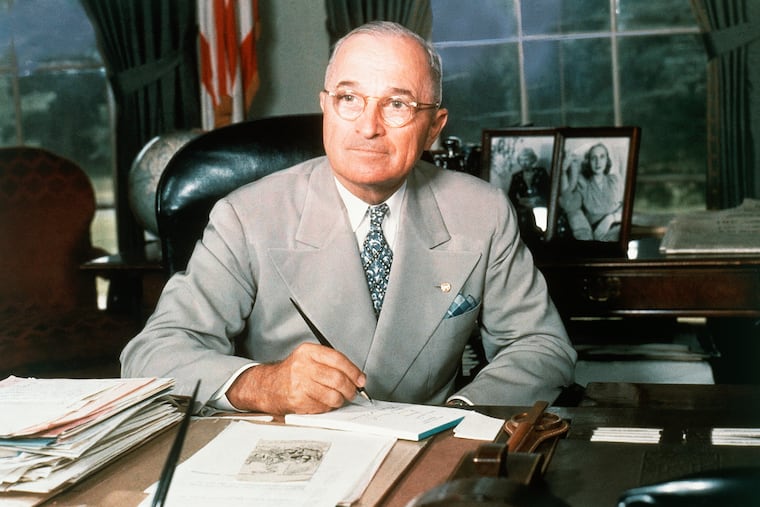
Black Americans demanded that embattled President Harry Truman embrace new civil rights protections. Truman was aghast at the treatment of returning veterans and believed in fairness. He also realized that he’d need the votes of African Americans to have any chance of winning reelection.
In 1947, Truman began making a concerted effort to advance the civil rights cause. He became the first president to speak at the National Association for the Advancement of Colored People’s annual convention. The White House also released To Secure These Rights, a book detailing how the Truman administration both acknowledged the problems facing African Americans and the steps it would take to ameliorate them. Additionally, Truman desegregated the armed forces, a critical step in showing he was serious about embracing civil rights.
Truman made these moves to showcase American freedom and democracy and juxtapose it with Soviet communism, while also trying to shore up the African American vote. That was especially critical because of a political insurgency that threatened Truman’s hope for reelection: the rise of Henry Wallace and the Progressive Party.
Wallace had served as agriculture secretary during Franklin Roosevelt’s first two terms as president and as vice president during Roosevelt’s third term. He had also served as Truman’s secretary of commerce. Many on the left saw Wallace as the only hope for achieving their main goals: preventing a full-blown war with the Soviets, and securing greater labor, civil and human rights at home.
Wallace’s backers included prominent African Americans like Paul Robeson and W.E.B. Du Bois, who distrusted Truman. Both men supported Wallace due to the former’s strong stance in favor of civil rights at home and deep-seated opposition to the brewing Cold War abroad. Their support helped catalyze a debate in the Black community over which candidate to back.
Forums like The Crisis, the official magazine of the NAACP, became spaces for African American voters to debate Wallace vs. Truman. In early 1948, The Crisis editors declared “Wallace is straight on our question,” referring to his unabashed support for civil rights. They refrained, however, from outright endorsing him, noting his mixed record as secretary of agriculture.
Readers remained divided over this support for Wallace. Some felt the editorial was too harsh about his policies as secretary, while others believed he had not done enough for Black Americans in the federal government. “I challenge you to name another American of equal stature,” Robert and Selma Singer from Chicago wrote to The Crisis offices after its April 1948 issue, “who has mass support, who has given such impetus toward solving the ‘Negro Problem.’”
Yet, others, such as Max Womack of Iowa City, argued that Wallace had no chance as a third-party candidate, and would merely split the votes of people who’d otherwise back Truman. He also wondered why the editors hadn’t given “President Truman any credit at all?”
This last question hinted at the prevailing sentiment in the Black community: most African American voters backed Truman that November. They preferred trusting the incumbent — a proven commodity — rather than taking a chance on what turned out to be a quixotic campaign.
Their overwhelming support delivered key margins in battleground states in the North and Midwest, like Michigan, a testament to the maturing power of the African American vote. “Negro leaders pointed out,” proclaimed the front page of the Black-owned and operated Detroit Tribune, “that the Michigan Republican party seemed to go out of its way to avoid the Detroit population and its political desires.”
Black voters siding with mainstream, liberal Democrats over more radical ideas proved to be no anomaly. Twenty-four years later, in 1972, Black voters again engaged in an ideological skirmish. Activists debated the best way forward after the heyday of the Civil Rights Movement and the election of Republican Richard Nixon in 1968 against a deeply divided Democratic Party.
At the National Black Political Convention, held in Gary, Indiana, African American liberals, moderates, socialists, nationalists, and even conservatives gathered to map out a strategy for adjusting the politics of Black America to a new normal. Nixon’s administration had largely practiced “benign neglect” on racial issues, while suppressing the Black Power Movement. Attendees grappled with an overall backlash to the Great Society programs spearheaded by the liberal wing of the Democratic Party.
The Convention’s “Gary Declaration” gave voice to the frustration of many Black Americans, arguing, “Both parties have betrayed us whenever their interests conflicted with ours (which was most of the time), and whenever our forces were unorganized and dependent, quiescent and compliant.”
Still, despite the critique of both Nixonian conservatism and Great Society liberalism, the members of the Gary Convention disagreed over a radical proposal to create an all-Black political party that could, in theory, broker deals with both major parties on behalf of Black America. Later that year, most Black Americans stuck with the Democrats — one of the few constituencies to back the doomed campaign of George McGovern.
The primary that year had illustrated Black political pragmatism at work. Ebony magazine journalist Alex Poinsett acknowledged that McGovern was far from perfect and that Black voters lacked a truly satisfactory option. Yet, he argued that the candidate’s support for elements of the Gary Declaration — and a competing “Black Bill of Rights” proposed by the Congressional Black Caucus — made him a sensible option over several longer shots, including African American congresswoman Shirley Chisholm.
The choice of McGovern over Chisholm reflected how Black voters’ wariness about progressivism that did not seem to be electorally viable even applied to Black candidates. The same was true three decades later: Barack Obama struggled with Black voters in polling until his victory in Iowa in January 2008 made it clear he was a candidate who could win.
These cases epitomize how, over time, Black voters have stuck with liberals in the Democratic Party who demonstrate a genuine chance of victory over more radical options that might promise better policy. They aren’t always happy with their choices, but they know what to expect from mainstream Democrats.
This choice reflects how, ultimately, for African American voters, a pragmatic view of politics overrules almost everything else. The old saying that “politics is the art of the possible” is, often, the rueful outlook on politics by African Americans.
Robert Greene II is associate professor of history at Claflin University. He is also managing editor of “Global Black Thought” and co-host of the award-winning podcast, “Our New South.”
Made by History takes readers beyond the headlines with articles written and edited by professional historians. Opinions expressed do not necessarily reflect the views of The Inquirer.