House passes Ukraine aid, opposing Republican leaders
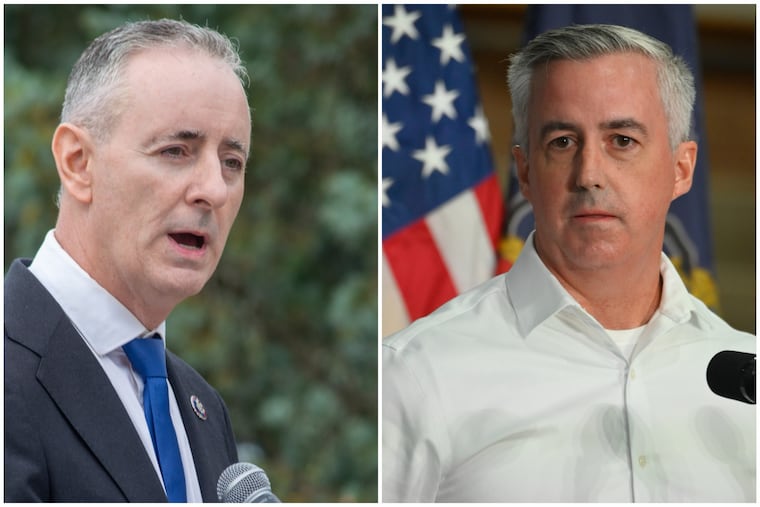
Republican Rep. Brian Fitzpatrick was already on board, having broken with his party months ago to support the effort.

WASHINGTON — The House voted Thursday to approve new aid for Ukraine and impose a fresh round of sanctions targeting the industries fueling Russia’s war economy, after 18 Republicans defied their leaders to join Democrats in support of a bill that runs counter to President Donald Trump’s agenda.
The legislation, which passed 226-195, would provide $8 billion in loans to Ukraine and $1.8 billion in aid for military and security assistance. In addition to putting new sanctions on Russian-affiliated businesses and officials, it would also punish foreign companies, organizations and individuals that attempt to evade sanctions in an effort to support Moscow.
It now heads to the Senate, where Trump’s opposition has stopped similar attempts at new penalties on Russia and its allies. And even if it were to clear both chambers, it would likely be vetoed by the president, who has repeatedly balked at legislation that seeks to constrain his ability to negotiate on foreign policy matters.
Still, backers of the measure said the vote Thursday sent a strong bipartisan message to the president that significant support remains in Congress for Ukraine. It was the second time this week that Republicans have broken with Trump over foreign conflicts, after a handful of them joined Democrats on Wednesday to push through a war powers resolution that seeks to require the president to seek congressional approval to continue the war in Iran.
The Ukraine bill, led by Rep. Gregory Meeks of New York, the top Democrat on the Foreign Affairs Committee, was introduced in April 2025 but languished after Republican leaders refused to take it up in committee and House Speaker Mike Johnson blocked it from coming to the floor.
Meeks turned to a discharge petition, a procedural move that allows lawmakers to circumvent the leadership and speed a bill to the floor if they collect signatures from a majority of House members. That required the backing of all Democrats and a small group of Republicans, a threshold reached last month when Rep. Kevin Kiley, I-Calif., who caucuses with Republicans, signed onto the petition. Two Republicans, Reps. Don Bacon of Nebraska and Brian Fitzpatrick of Pennsylvania, were already on board, having broken with their party months earlier to back the effort.
The vote Thursday drew even broader Republican support.
Before the vote, Meeks told reporters that support for the measure signaled to the people of Ukraine that “the United States and Congress will stand and fight and work with you so that you preserve your democracy, your freedom and justice until Vladimir Putin is declared a war criminal and put away.”
The vote was the first time the House had approved significant financial support for Ukraine in more than two years. The last aid package, which Johnson put his job on the line to shepherd through the House, included $60 billion in security assistance for Ukraine.
Backers of the latest tranche of funding for the Ukrainians emphasized that an overwhelming majority of the funding was in the form of direct loans, something that Trump has said he favors over security assistance that would not require being paid back.
“Are we going to stand with good, or are we going to stand with evil?” Bacon said before the vote. “That’s what this is about tonight.”
Republican leaders suggested that the move could undermine the president’s ability to negotiate an end to the war.
“If you support this bill, then clearly you are not interested in peace because the consequences would tie the hands of this president and could lead to future hostilities that would bleed over into Europe,” Rep. Keith Self, R-Texas, said in a speech on the House floor opposing the legislation.
Rep. Zach Nunn, R-Iowa, whose sanctions legislation passed out of the Financial Services Committee last summer, voted against Meeks’ bill and called it “a tactical error.” He pointed to provisions in the bill that called for NATO allies to spend 2% of their gross domestic product on defense and security, a dated figure that does not reflect the commitment by member states to invest 5% of their GDP on defense by 2035.
“We have a better option,” Nunn argued, though he and others worried that their opposition to the legislation would be perceived as retreat in the commitment to Ukraine that lawmakers have expressed since the war began.
Speaking in the Oval Office on Thursday afternoon, Trump said he was “glad” that Ukrainian President Volodymyr Zelenskyy had issued an open letter calling for direct talks with Russian President Vladimir Putin.
“We’ve had a lot to do with it,” Trump told reporters.
This article originally appeared in The New York Times.