Lindsey Graham was facing reelection in November. What happens now?
The senator's sudden death comes less than four months before he was set to appear on the ballot as a strong favorite to win a fifth term.
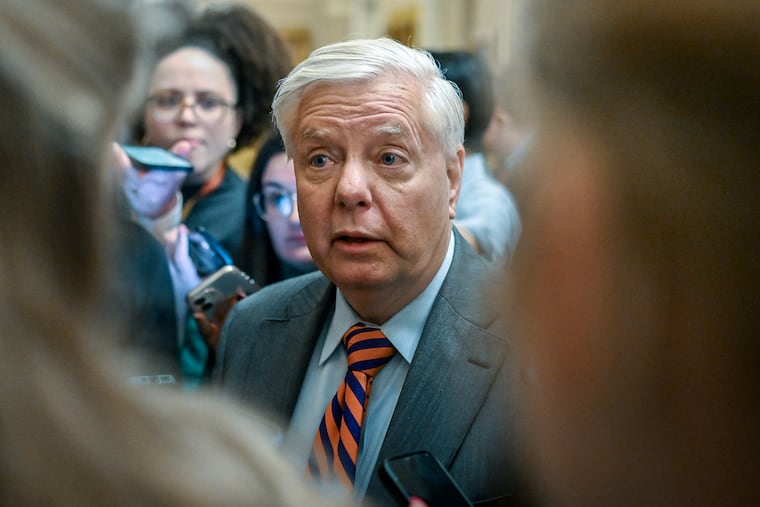
The sudden death of Sen. Lindsey Graham (R., S.C.) comes less than four months before he was set to appear on the ballot as a strong favorite to win a fifth term.
Now, South Carolina Republicans are facing a fast-paced scramble to replace him on the general election ballot. (Graham won the Republican primary by a wide margin this year.)
South Carolina law sets out a timeline for replacing him on the ballot. Its provisions suggest a special primary election will take place Aug. 11, according to the schedule set out in the law.
Candidates can file for the seat as soon as July 21, the second Tuesday after Graham’s death, and the filing period will close on July 28. State law says that the election must happen on the second Tuesday after that deadline. If no candidate secures a majority, a runoff between the top two finishers would take place two weeks later, on Aug. 25.
Gov. Henry McMaster, a Republican, can appoint a replacement to serve out the rest of Graham’s Senate term, through Jan. 3, 2027, under state law. The replacement could choose to compete for the Republican nomination in the special primary.
Graham, 71, died of “a brief and sudden illness” Saturday evening, his office said in a statement just after 2 a.m. ET Sunday.
Rep. Nancy Mace is looking at a potential run for the seat, according to four people familiar with her thinking, who spoke on condition of anonymity to describe private talks. Mace ran for governor this year, finishing a distant fifth in the Republican primary.
While Graham drew Republican primary challengers this year, he won the nomination by a wide margin, avoiding a runoff. President Donald Trump supported Graham, a onetime critic of the president who had shifted to a supportive posture in recent years.
One of Graham’s opponents in the primary was businessperson Mark Lynch, who finished second with nearly 29% of the vote. He said on social media Sunday morning that “while we had our political disagreements, today is not a day for politics.”
Previously, Lynch had strongly criticized Graham for his support of U.S. military intervention abroad, seeking to appeal to more isolationist members of Trump’s MAGA base.
The third-place finisher was Thomas Keith Dismukes, a motivational speaker who campaigned on “faith, family, limited government, and the restoration of principles that make America great.” Other Republican contenders included Pat Herrmann, a county Republican Party chair and small-business owner, and Calvin Cowen, an engineer and city council member.
The Democratic nominee for Senate is Annie Andrews, a pediatrician who has been a strong fundraiser in the race.
“I hope that South Carolinians will join me in setting partisanship aside and offering gratitude to Senator Lindsey Graham for his service to the great state of South Carolina,” Andrews said Sunday morning, praising him as a “man of great faith who proudly served our nation as a JAG officer and Air Force colonel.”
This article originally appeared in the New York Times.