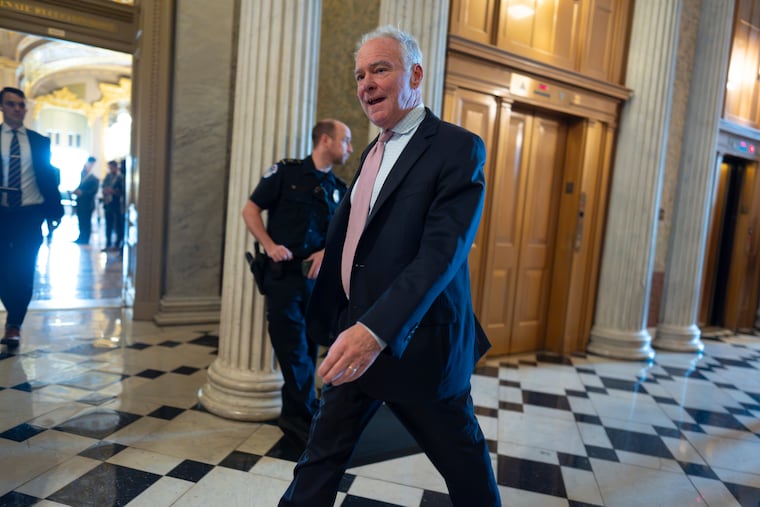
Sen. Andy Kim spent his career in national security. He’s ‘really worried about what comes next’ in Iran.
The New Jersey senator returned to the U.S. Capitol Tuesday night while other lawmakers were on break. He was there to draw attention to the war.
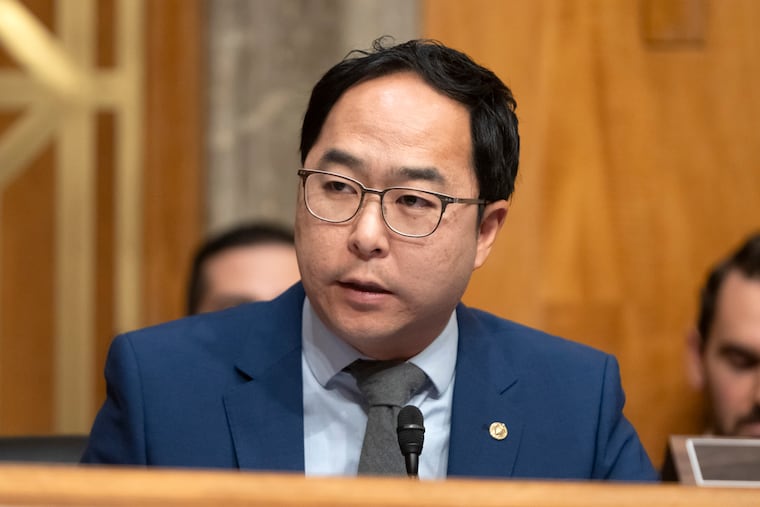
WASHINGTON — In an unusually quiet U.S. Capitol, where lawmakers were not set to return from an extended break for another five days, U.S. Sen. Andy Kim was practically alone.
He had spoken out the day before, like other Democrats, calling President Donald Trump “unhinged” for threatening to eliminate the “whole civilization” of Iran if his demands were not met. Congress, many Democrats said, should immediately reconvene to put restrictions on the president.
Despite the unlikeliness of Republican leaders heeding that call and Trump backing down from the threat on Tuesday night, Kim by Wednesday afternoon appeared to be the only senator — aside from a Democrat from nearby Virginia — to actually travel back to Washington to make the case in person.
“When your president is threatening civilizational destruction, when he’s talking about just blowing up all this civilian infrastructure — things that would be tantamount to war crimes — how have we not had a single public hearing in this building about this war?” Kim told The Inquirer during an interview in his Capitol Hill office. “I wanted to draw attention to that.”
The New Jersey senator from Burlington County said he was back in Washington to take his duties seriously, to demand information on a war he believes has not been conducted transparently or strategically.
He was also there, he said, because it was personal.
Kim is known as the only career diplomat among the 100 current senators, having worked on national security issues in the Middle East before entering Congress in 2019. He held roles at the Departments of State and Defense from 2009 to 2013 and at the National Security Council from 2013 to 2016, and previously spent time at the United States Agency for International Development (USAID).
Since Trump launched the attack on Iran in February, Kim has frequently referred to his work in the administrations of former Presidents George W. Bush and Barack Obama, including as a civilian adviser to Gens. David Petraeus and John Allen in Afghanistan.
He has leaned on that training over the last six weeks, he said, giving him a particular insight and a range of sources to tap in order to understand the developing situation and the risks involved.
“I’ve spent years trying to counter Iranian violence and terror, so this is not like an extracurricular to me. This is so personal to me, having spent time on the ground in the Middle East, having lost people that I know to Iranian militia groups,” Kim said. “I’m really worried about what comes next.”
After a tentative ceasefire agreement was reached this week, those next steps are filled with questions around how much control Iran will maintain over the Strait of Hormuz, what will happen to its stockpile of enriched uranium, and if it will be able to rebuild its ability to launch missile attacks.
Trump, who killed a deal to limit Iran’s nuclear capabilities struck by Obama when Kim was in his administration, has said banning Iran from enriching uranium is a key goal.
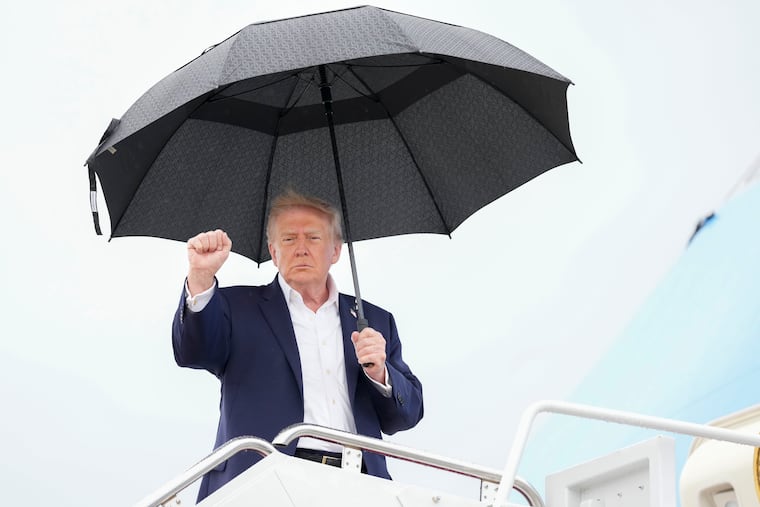
He declared victory this week and said a 10-point plan proposed by Iran, whose leaders also claimed victory, was a “workable basis on which to negotiate” in a social media post Tuesday night. The president said Thursday that U.S. forces remain in the region and that if negotiations are not productive, the attacks will begin “stronger than anyone has ever seen before.”
Pa. senators back Trump’s war in contrast to Kim
U.S. Sen. Dave McCormick (R., Pa.), an Army veteran who served in the Gulf War, has applauded Trump’s intense military pressure, saying in a Fox Business interview Wednesday that “there’s been nothing like it in the history of the world in terms of a military campaign that’s been so effective.”
“We’ve made real progress, but we must stay focused until the job is done: No nuclear weapon. No threats to Americans & our allies. No leverage over the Strait of Hormuz,” McCormick added on social media.
His counterpart in Pennsylvania, Democratic U.S. Sen. John Fetterman, has also enthusiastically praised the mission. He continued to defend Trump and criticize members of his own party this week as they claimed the president should be forcibly removed from office because of the threat to kill civilians.
That stance, in turn, elicited criticism from Pennsylvania Democrats who have increasingly said Fetterman is abandoning the promises he ran on four years ago.
In a Fox News interview Wednesday night, Fetterman said he would once again reject a war powers resolution that other Democrats said they will introduce to restrict Trump. He also mocked his party for calls to invoke the 25th Amendment — the process for the president’s cabinet and vice president to remove him — and for using the term TACO, or “Trump Always Chickens Out,” to describe when he abandons his goals but claims victory anyway.
“Every single thing Iran [has] done, and is, is a war crime,” Fetterman said. “Now, we are the force of good in the world.”
Kim, like other fellow Democrats whom Fetterman has criticized, has made a point to say that Iran’s regime has long been brutal and that it should never be permitted to obtain a nuclear weapon.
But the way Trump launched and conducted the mission has now led to some of the worst-case scenarios that Kim said he and his former colleagues in the national security apparatus had always prepared for.
He said they spent years discussing how Iran might close the Strait of Hormuz to important oil and other shipping traffic if faced with military pressure. It turned out to be easier than he imagined it would be, requiring not mines in the water but threats of missile attacks and other efforts. (Some reports this week suggested Iranian forces might have now mined the waterway.) Any form of continued Iranian control over the strait could keep gas prices high globally, Kim said.
Kim said he agrees with supporters of the war that U.S. forces have done significant damage to Iran’s ballistic missile capabilities and its plans to develop nuclear weapons. But he has seen no evidence to suggest Iran will emerge from the conflict unable or unwilling to rebuild on both of those fronts.
“I spent a lot of time gaming this out, and what we’ve seen is that Iran has shown their resilience,” Kim said. “Yes, they’ve lost a lot of missiles. They lost a lot of leaders. But they show, still show, the capacity that they have to be able to wreak a lot of havoc around the world.”
Kim said his return to Washington had allowed him to review classified information available to him in a secure facility at the Capitol. He had been holding meetings with top experts on international law and Middle East diplomacy. And he put in a request for a briefing at the Pentagon, though he said he was under no illusions that Defense Secretary Pete Hegseth would accommodate that this week.
“But that’s what we should be doing here. We should be demanding information,” Kim said. “If it wasn’t just me — if it was 10 senators, 20 senators, 30 senators that are here demanding — I think we could get more traction.”
Will Congress restrain Trump before the ceasefire ends?
Republican leaders in control of Congress, set to return to the Capitol on Monday, have been unwilling to restrict Trump’s military movements abroad.
With a few House Democrats at the Capitol for an informal, pro forma session on Thursday, their request for consideration of a war powers resolution was quickly rejected. U.S. Rep. Chris Smith, the New Jersey Republican presiding over the session, did not acknowledge the Democrats’ request and forcefully banged the gavel to adjourn the chamber until Monday afternoon.
It was not immediately clear if Democrats would have the votes to pass the resolutions next week, though a few Republicans raised concerns after Trump’s latest threats.
“The President’s threat that ‘a whole civilization will die tonight’ cannot be excused away as an attempt to gain leverage in negotiations with Iran,” U.S. Sen. Lisa Murkowski (R., Alaska) said in a statement Tuesday. “This type of rhetoric is an affront to the ideals our nation has sought to uphold and promote around the world for nearly 250 years.”
Kim, who delivered a previously scheduled speech on foreign policy at Princeton University in the hours after Trump’s threat on Tuesday, was also stressing a long view of U.S. policy abroad.
His 18 pages of prepared remarks — titled “The Anxious Era” — at Princeton began with an anecdote about how his last foreign policy speech on the campus was 30 years earlier, when he was a high school freshman participating in Model U.N. and America “was the lone superpower at the height of our power.”
But as the world tried to make sense of Trump’s social media threats, Kim opened instead by denouncing the president’s words and saying Congress should be in Washington.
He was on the train later that day. But first, he warned the students that any progress on America’s standing in the world might take a while.
“I believe we now are at a moment where a future American president cannot stand at the Capitol on Inauguration Day and utter the words ‘America is back.’ No one would believe us, whether here at home or abroad,” Kim said. “We need to chart a way forward that is grounded in reality. The window to act is narrowing, and the cost of complacency has never been higher.”