New acting intel czar Bill Pulte starts trimming staff as Trump urged
Current and former intelligence officials say the efforts to shrink the office that coordinates the nation’s 18 spy services are haphazard and threaten its mission.
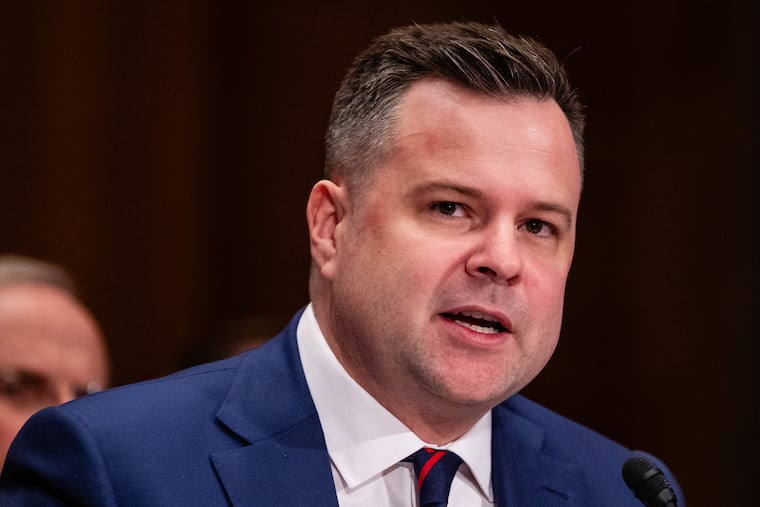
Acting director of national intelligence Bill Pulte, installed Friday by President Donald Trump, has at Trump’s urging begun trimming his organization, which coordinates the nation’s 18 spy agencies.
This week Pulte fired a half-dozen political appointees and notified several dozen career officers on loan to the Office of the Director of National Intelligence that they were being sent back to their home agencies.
Pulte’s immediate predecessor, Tulsi Gabbard, had already culled hundreds of personnel, boasting that she had slashed the staff by 40%. Trump has long been distrustful of what he calls the “deep state” intelligence community, and the cuts by Pulte are the latest in a series of shocks that have roiled the ODNI.
Gabbard, who left office last week, had a stormy tenure, falling in and out of favor with Trump’s White House. Current and former officials criticized as ham-handed her release of files related to President John F. Kennedy’s assassination. She selectively declassified data on Russia’s interference in the 2016 U.S. election and other matters that supported Trump’s views.
In recent months, the ODNI has seen a number of high-level resignations and a roller coaster of leadership announcements by Trump.
The agency “is being so hollowed out that its new name might become DNR — do not resuscitate. It’s on life support already,” said Beth Sanner, a former ODNI deputy director who served as Trump’s intelligence briefer in his first administration.
While a number of current and former intelligence officials note that there are merits to shrinking the ODNI, the Trump administration, they say, has gone about it in a haphazard way that could undermine the intelligence coordination that Congress created the agency to do.
“Reasonable people can debate ODNI’s size and mission, but sacking dozens of seasoned officers in your first week isn’t reform — it’s performative firing to please a president who treats his own intelligence community as the enemy within,” said Julia Curlee, who served as a director for intelligence programs in Trump’s White House until last year and recently resigned from the CIA after 20 years as an analyst.
Pulte asked program heads for a rank-ordered list of personnel to guide decisions on who could be let go, according to former intelligence officials, who spoke on the condition of anonymity for fear of retribution.
One apparent casualty of the personnel moves that began under Gabbard is the National Intelligence Council, which was staffed primarily by career officers on loan from other agencies, such as the CIA. The NIC is considered the most authoritative intelligence analysis unit, producing in-depth reports on key topics for top government officials using information gathered by multiple spy agencies.
About 20 NIC personnel have been removed or have chosen to leave, including several senior officers who oversaw the production of analysis on Russia, China, and Europe.
The deputy director for mission integration, Will Ruger, who effectively led the council, was placed on administrative leave, according to three former intelligence officials.
It is unclear whether and to what extent the vacancies will be filled. When the principal deputy intelligence officer for Russia left last year, the position was kept open.
Trump told the Wall Street Journal this month that he’d like to see a “smaller” ODNI. “I think there are a lot of people in there that shouldn’t be there,” Trump said, noting that he was referring to holdovers from the Biden and Obama administrations.
Senate Intelligence Committee Chairman Tom Cotton said on the Senate floor Wednesday that “mass firings” were not taking place. He said Pulte told him that “a small handful of front-office personnel” were leaving, “which is not at all uncommon when a senior leader leaves an agency or one comes into an agency.” He added that “around 45 or 50 career officers” were returning to their home agencies.
“I think that’s a step in the right direction,” said Cotton, who has long called for shrinking the ODNI and last year proposed legislation that would cap its full-time staff at 650.
Some agency insiders have heard that there could be subsequent rounds of cuts and that keeping each round relatively small will help avoid congressional blowback, according to one former intelligence official.
Trump’s appointment of Pulte, who has no intelligence or national security experience, has alarmed Democratic lawmakers, as well as some Republicans. Some current and former intelligence officials fear he will use the post to further Trump’s agenda, including weaponizing intelligence against the president’s enemies.
As head of a federal mortgage regulation agency, Pulte has launched mortgage fraud probes of people Trump considers adversaries, including Sen. Adam Schiff (D., Calif.) and Federal Reserve Board member Lisa Cook.
Government reorganization efforts under Trump have been marked by chaos and missteps, such as when Elon Musk’s Department of Government Efficiency last year dismantled the U.S. Agency for International Development and conducted mass firings at the State Department and other agencies.
The Office of the Director of National Intelligence was created by Congress in the wake of the September 2001 terrorist attacks, after investigations found that the CIA, the FBI and other agencies had failed to share critical information about al-Qaeda plots.
The ODNI had a little more than 2,000 employees at the start of Trump’s second term. By the time Gabbard left last week, the number had shrunk to 1,300, according to congressional aides.
Morale was shaken last year when Gabbard dismissed the chair and vice chair of the NIC after it produced a report that found that the Venezuelan government was most likely not directing the activities of Tren de Aragua, a criminal gang that Trump has vilified. The finding contradicted his rationale for invoking the Alien Enemies Act and deporting alleged Venezuelan gang members without due process.
“Getting [the agency] smaller makes sense, but this isn’t the way to do it,” said John Sipher, a 28-year veteran CIA operations officer and former Moscow station chief, who has argued that the ODNI should be dismantled.
Sipher said the ODNI’s problem is that it suffers not just from bureaucratic bloat, but from political interference. “The office that was meant to safeguard intelligence from fragmentation has become another perch from which intelligence can be politicized and bent toward partisan narratives,” he wrote in the Bulwark.
This week’s cuts do not appear to have significantly affected the agency’s largest component, the National Counterterrorism Center, which was set up by Congress to be the government’s primary organization for analyzing international terrorism and which in its heyday had more than 1,000 personnel, according to former senior intelligence officials.
Trump has nominated Jay Clayton, U.S. attorney and former Securities and Exchange Commission chairman, to be the permanent director of national intelligence.
But last week, Trump abruptly froze Clayton’s nomination, prompting the Senate to postpone a confirmation hearing, in a fit of pique over lawmakers’ failure to pass unrelated election legislation.