China sanctions 11 from U.S., including Pennsylvania Sen. Pat Toomey
Toomey recently sponsored a bill that would impose sanctions on entities that violate Hong Kong’s independence.
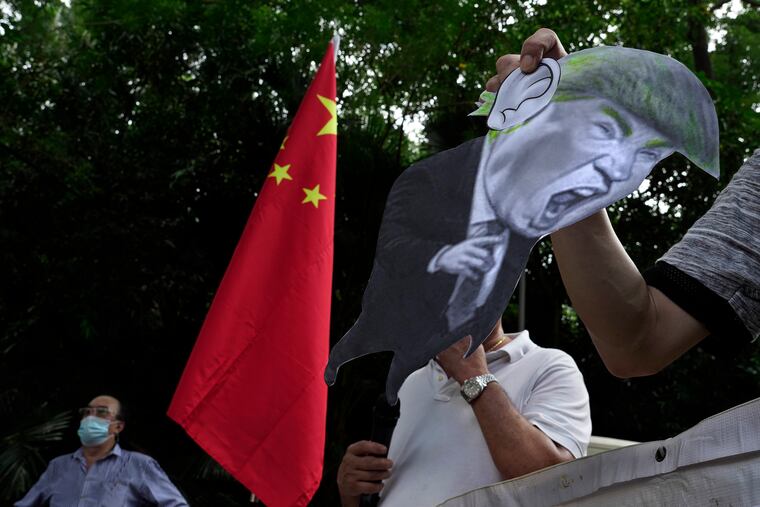
BEIJING — China on Monday announced unspecified sanctions against 11 U.S. politicians and heads of organizations promoting democratic causes, including Republican Sens. Marco Rubio of Florida and Ted Cruz of Texas as well as Rep. Chris Smith of New Jersey, who had already been singled out by Beijing.
Also named was Republican Sen. Pat Toomey of Pennsylvania.
Foreign Ministry spokesperson Zhao Lijian said the 11 had “performed badly” on issues concerning Hong Kong, where China has cracked down on opposition voices following its imposition of a national security law in the semi-autonomous territory last month.
The number of Americans named by the ministry equals the number of Hong Kong and Chinese officials placed on a sanctions list by the United States last week over the crackdown.
China showed its determination to defy such pressure on Monday by arresting leading Hong Kong independent media tycoon Jimmy Lai and raiding his headquarters.
“The relevant actions of the U.S. blatantly intervened in Hong Kong affairs, grossly interfered in China’s internal affairs, and seriously violated international law and the basic norms of international relations,” Zhao said at a daily briefing on Monday. “China urges the U.S. to have a clear understanding of the situation, correct mistakes, and immediately stop interfering in Hong Kong affairs and interfering in China’s internal affairs.”
Two other lawmakers were named by the Foreign Ministry: Republican Missouri Sen. Josh Hawley and Arkansas Sen. Tom Cotton.
Toomey recently sponsored a bill that would impose sanctions on entities that violate Hong Kong’s independence. The measure was signed into law in July.
“From jailing newspaper publishers to rigging elections to dramatically expanding surveillance of Hongkongers, the recent actions of China’s communist leaders prove just how determined they are to stamp out democracy and fundamental freedoms in Hong Kong,” Toomey said in a statement. “My response to being sanctioned is simple: I stand with the people of Hong Kong.”
Cotton said he was sanctioned for defending the victims of Communist Party rule, including Hong Kong students fighting for democracy.
“Chinese communism is the most dangerous threat to freedom in the world, and I will never back down from fighting it,” he said in a statement.
The others sanctioned were National Endowment for Democracy president Carl Gershman, National Democratic Institute president Derek Mitchell, International Republican Institute president Daniel Twining, Human Rights Watch executive director Kenneth Roth, and Freedom House president Michael Abramowitz.
Beijing had placed a travel ban on Rubio, Cruz, and Smith last month after Washington announced similar measures against Chinese officials linked to measures taken against Muslims in the northwestern Chinese region of Xinjiang.
The standing committee of China’s legislature passed the National Security Law last month, bypassing the Hong Kong Legislative Council and the public, where such legislation has faced stiff opposition for years.
The move came in response to months of sometimes violent anti-government protests last year that Beijing said were encouraged by foreign forces in a bid to overthrow Chinese rule over the former British colony, which was handed over to Chinese rule in 1997 under a “one country, two systems” framework meant to last until 2047.