Appeals court clears way for U.S. to reopen border for asylum seekers
A federal appeals court found Trump’s declaration of an “invasion” at the U.S.-Mexico border was illegal, effectively reopening the U.S. to migrants seeking asylum.
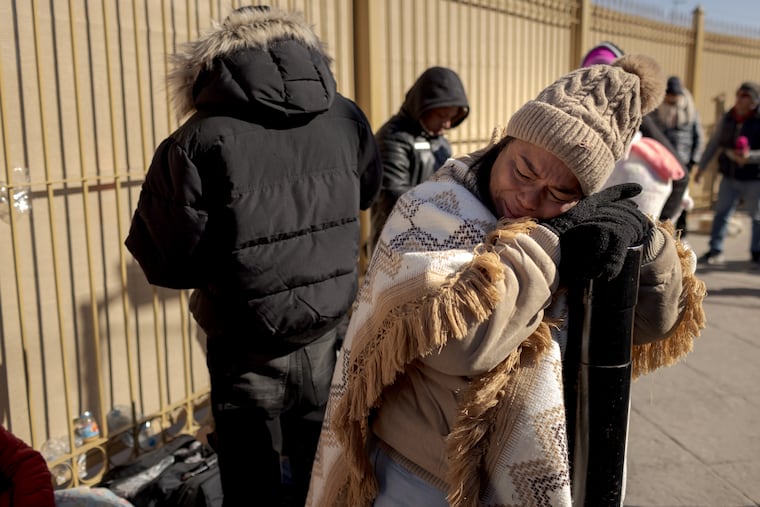
A federal appeals court ruled Friday that President Donald Trump’s declaration of an “invasion” at the U.S.-Mexico border was illegal, effectively clearing the way to reopen the United States to migrants seeking asylum.
It was not clear when asylum processing would resume, and the Trump administration quickly indicated its intent to challenge the decision. White House spokeswoman Abigail Jackson said Trump had utilized his “lawful authority” to end the “egregious exploitation” of the U.S. asylum system.
The Justice Department “will seek further review of this badly flawed decision and we are confident we will be vindicated,” she said in a statement.
The department did not immediately respond to a request for comment.
Trump issued the proclamation, “Guaranteeing the States Protection Against Invasion,” on the first day of his second term, barring entry to asylum seekers for public safety, health, and economic reasons “until I issue a finding that the invasion at the southern border has ceased.” Since then, Border Patrol apprehensions have fallen to the lowest levels in decades after spiking to record highs under the Biden administration.
Advocates for immigrants sued, however, arguing that the administration was violating federal law by rejecting people’s right to seek asylum because they fear persecution based on their political opinion, race, or other reasons detailed in federal law. A lower-court judge had ruled in their favor, but the border has remained largely closed to asylum seekers as the case made its way through the courts.
In its opinion, a three-judge panel on the U.S. Court of Appeals for the District of Columbia Circuit said Trump’s proclamation was “an unprecedented decision” that brushed off long-standing federal laws outlined by Congress and probably endangered migrants’ lives.
“Denying asylum in one stroke, without any information about the affected individuals, necessarily ignores every risk of persecution they face when forced back to where they came from,” the court wrote in a lengthy opinion. “The challenged decision thus necessarily denies asylum even to foreign individuals who are sure to face persecution without it.”
The decision was handed down by Judge J. Michelle Childs, a Biden appointee who wrote the decision; Judge Cornelia T.L. Pillard, an Obama nominee; and Judge Justin R. Walker, a Trump appointee who wrote a partial dissent.
Advocates for immigrants cheered the ruling, saying officials have turned away people in fear for their lives.
“The court’s opinion does not mean there are now open borders, but only that the United States will no longer be one of the few countries in the world who after World War II does not provide a hearing for those fleeing persecution,” said Lee Gelernt, the American Civil Liberties Union attorney who argued the appeal. “The court properly made clear that the president cannot simply waive away the laws enacted by Congress.”
The decision comes weeks after the Supreme Court appeared poised to uphold birthright citizenship for the children of undocumented immigrants, and as the Trump administration faces dozens of legal challenges to the president’s efforts to discourage illegal immigration and deport undocumented immigrants.
Federal laws have allowed migrants to seek asylum for decades, but the Trump administration contends that asylum is a “loophole” that has allowed thousands of migrants to gain entry into the United States and obtain work permits while they await a hearing that can take years in the backlogged immigration courts. During his second term, Trump officials have imposed restrictions that have allowed them to expel asylum seekers without a hearing and detain immigrants indefinitely inside the United States.
Border Patrol apprehensions have fallen from more than 2 million in 2023 to fewer than 240,000 last fiscal year, which ran from Oct. 1, 2024, to Sept. 30.
If asylum processing resumes, advocates for immigrants say, migrants would have to balance safety in Mexico or other nations against the threat of being detained in U.S. detention centers, where dozens have died since Trump took office amid concerns about inadequate medical care.
Federal officers have also carried out often violent raids across the United States to detain immigrants, though they have pulled back on those in recent weeks.
“The fact that the system is back open is really critical and important,” said Keren Zwick, co-counsel in the case and director of litigation at the National Immigrant Justice Center. But she added, the invalidated proclamation is “just one of many tools in the government’s arsenal to harm and restrict asylum seekers.”
The appeals court ruling upheld a July decision by U.S. District Judge Randolph D. Moss, who ruled that the Trump administration lacked the authority to expel asylum seekers. Moss said Trump could not invoke emergency presidential powers to deport migrants without allowing them to follow proper procedures to apply for asylum, including undergoing interviews about threats of persecution or torture and, potentially, a hearing in immigration court.
Migrants and advocacy groups filed the lawsuit in February 2025 shortly after Trump issued the proclamation, saying federal law allows people to apply for asylum as long as they are on U.S. soil, even if they entered illegally.