Democrats’ draft autopsy report on 2024 loss puts blame on Biden and beyond
The release was an extraordinary turn of events for the party, which all but trashed its own report as incomplete and inaccurate, releasing the document only after months of secrecy and headaches.
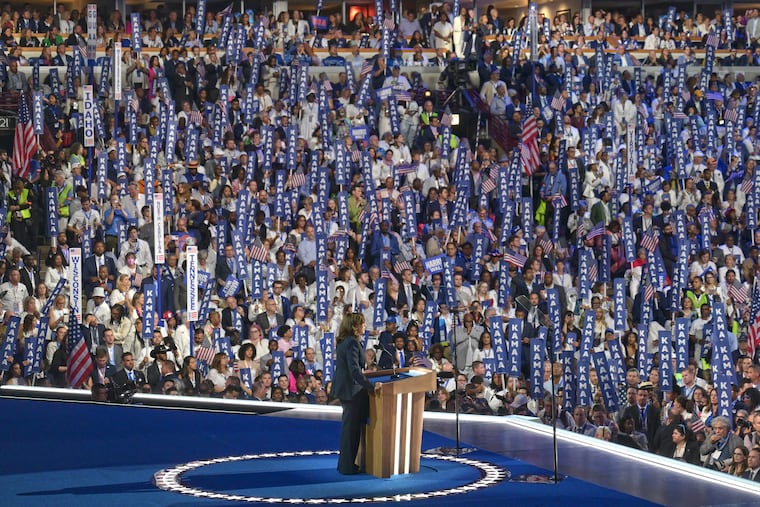
The Democratic National Committee on Thursday released a nearly 200-page draft of an internal autopsy of what went wrong in the 2024 campaign, ending months of speculation that had emerged as an embarrassing public spectacle for the party as it seeks to regain control of Congress.
The report places blame for Kamala Harris’ defeat partly on former President Joe Biden’s political operation, arguing that it failed to position her for success in the race after he dropped out. It also critiques the Harris campaign for failing to distance itself from Biden and for failing to mount an effective strategy to make a dent in Donald Trump’s rising approval ratings.
The release was an extraordinary turn of events for the party, which all but trashed its own report as incomplete and inaccurate, releasing the document only after months of mounting headaches from keeping it secret.
Atop each page was a bright red disclaimer that the DNC “was not provided with the underlying sourcing, interviews, or supporting data for many of the assertions contained herein.” A page with the title “Executive Summary” was blank except for a note in red reading: “This section was not provided by author.”
Particular facts included in the version that the DNC released were highlighted in yellow and annotated as either unverified and inaccurate. The party first provided the annotated copy to CNN and then released the document itself.
For months, Ken Martin, the party’s embattled chair, had resisted calls to release the report because, he said, he did not wish it to be a distraction from efforts to win seats in the midterm elections. But in recent weeks, the discourse about the autopsy itself — combined with the party’s pallid financial state — ballooned into a sideshow that threatened to upend the national committee’s electoral priorities and prompted public and private calls for Martin to leave his post.
“In short, I didn’t want to create a distraction,” he wrote in a long Substack post Thursday. “Ironically, in doing so, I ended up creating an even bigger distraction. And for that, I sincerely apologize.”
Many Democrats are alarmed at the poor financial state of the party. On Wednesday, the DNC’s latest financial report showed it had $3 million more in debts than cash on hand. The Republican National Committee, in contrast, had $123.9 million on hand and no debts.
Martin had entrusted a longtime ally, Paul Rivera, to oversee the autopsy, but Rivera’s final product “wasn’t ready for prime time. Not even close,” Martin wrote Thursday.
The document is disorganized and leaves empty entire sections, including those devoted to conclusions. But it does include a number of revelations, such as the fact that before the 2022 midterms the Biden team had directed the party to poll on how first lady Jill Biden could help the president, and what issues and messages to emphasize. No similar polling was undertaken on Harris.
It also describes sobering polling data that showed how pro-Trump advertising criticizing Harris for past comments defending transgender rights had been highly effective, with no answer offered by her campaign to counter it or change the subject.
A person familiar with the process of the autopsy said that there was no list of who was interviewed, no transcriptions and no notes, which made determining the veracity of the draft all but impossible.
Rivera declined to comment.
The report blames both the Biden and Harris campaigns for failing to successfully drive a negative view of Trump, writing that Democrats chose not to “engage in negative advertising at the scale required.”
“It was essential to prosecute a more effective case as to why Trump should have been disqualified from ever again taking office,” the report says. “The grounds were there, but the messaging did not make the case.”
For the most part, however, the report’s conclusions are limited, often veering into political cliches and hard-to-follow explanations.
“Democrats must organize everywhere to win anywhere through Majority Party Strategy focused on everywhere, cohesively, strategically, and decisively,” concludes one section.
The report notes the success of an ad run by the Trump campaign attacking Harris for past statements in support of transgender rights. The ad was “very effective,” and “the campaign was boxed,” the report states, because the spot drove an economic attack that was effectively unanswerable barring a change of position on the issue by Harris. In the aftermath of the 2024 election, the ad — which used the tagline, “Kamala is for they/them, President Trump is for you” — became emblematic of Democratic failures.
In several places, the report urges Democrats to eschew “identity politics” in favor of economic issues and cost-of-living concerns, praising the party’s candidates in battleground states, including North Carolina and Arizona, who won Senate seats in 2024 with such a strategy.
The report makes no mention of Israel or the Gaza Strip, an issue that has fractured the party and prompted some liberal voters to boycott Biden during the primary campaign.
Martin’s handling of the episode, meanwhile — promising a report, saying he wouldn’t release it and then putting out a draft version with undermining annotations — has raised new questions about the leadership of the party.
“When you’re in a hole you have to stop digging,” said Devin Remiker, the chair of the Democratic Party of Wisconsin. “Now that Ken Martin has put down the shovel, he has to dig out of the hole and climb out. There are a lot of folks that have to have trust rebuilt with Ken and the DNC.”
Martin seemed to acknowledge the imperative to restore faith among grassroots supporters and major donors alike.
“Now we need to repair trust,” he wrote. “I hope this is a start.”
This article originally appeared in The New York Times.