Army is investigating soldiers who appeared in Democratic convention video
The Army is investigating how a pair of soldiers ended up in a Democratic convention delegate video, the service said.
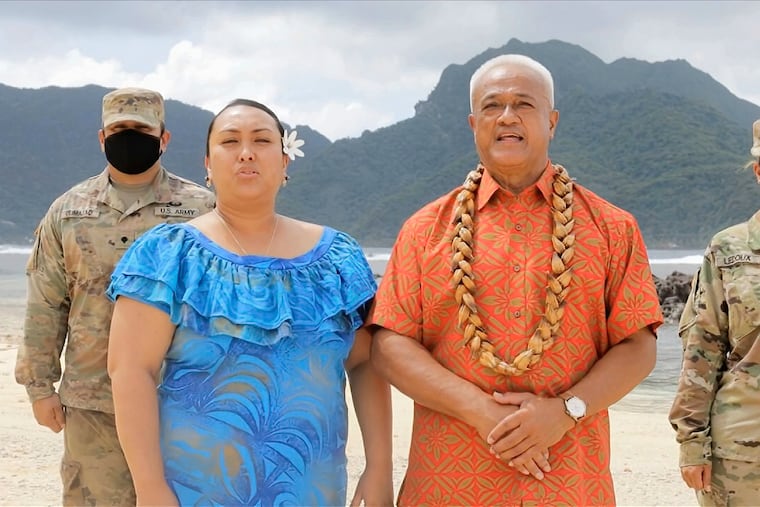
The Army is investigating how a pair of soldiers ended up in a Democratic convention delegate video, the service said.
In the announcement for American Samoa on Tuesday, two delegates from the U.S. territory declared their vote for Democratic presidential candidate Joe Biden. They were flanked by two soldiers in camouflage wearing black facial masks. This may have run afoul of Pentagon guidelines that regulate political activity, which draws a line between the military and appearances of political influence.
The soldiers, assigned to the Army Reserve's 9th Mission Support Command, are now under investigation, Army spokesperson Lt. Col. Emanuel Ortiz said Wednesday.
"Wearing a uniform to a partisan political event like this is prohibited," Ortiz said in a statement. "The Army follows the Department of Defense's long-standing and well-defined policy regarding political campaigns and elections to avoid the perception of DoD sponsorship, approval or endorsement of any political candidate, campaign or cause."
A Democratic convention official told Politico that the inclusion of soldiers in uniform was an "oversight" and meant to highlight the contributions of American Samoans serving in the military.
The Pacific Island territory has for years contributed more U.S. soldiers per capita than any of the U.S. states, according to Army data provided to The Washington Post in January.
Pentagon polices outline how service members can and cannot participate in political events. Typically, the uniform itself is the deciding factor.
"Examples of prohibited political activities include campaigning for a candidate, soliciting contributions, marching in a partisan parade and wearing the uniform to a partisan event," Ortiz said.
It is unclear if the soldiers involved understood the ramification of appearing in the video. Both soldiers are specialists, a lower enlisted rank that does not often flirt with the political world, which is dotted with retired senior officers.
The military under the Trump administration has sometimes struggled with navigating political faultlines.
Gen. Mark A. Milley, the chairman of the Joint Chiefs of Staff, was roundly criticized in June for appearing in uniform with President Donald Trump in uniform as officials walked to a church near the White House after protesters, demonstrating in reaction to the death of George Floyd and other Black Americans, were subdued for Trump to take a photo op there.
Milley later apologized: "I should not have been there. My presence in that moment, and in that environment, created the perception of the military involved in domestic politics."
The White House last year asked the Navy to minimize the name of the USS John S. McCain during Trump’s visit to Japan. The Navy did not meet the request for the ship, named after the father and grandfather of the late Sen. John McCain, a political foe of the president.