Philly federal court judge Emil Bove attended Trump’s Poconos rally. Now he faces an ethics complaint.
The complaint alleges Bove, who serves on the U.S. Court of Appeals for the Third Circuit in Philadelphia, violated the code of conduct for U.S. judges.
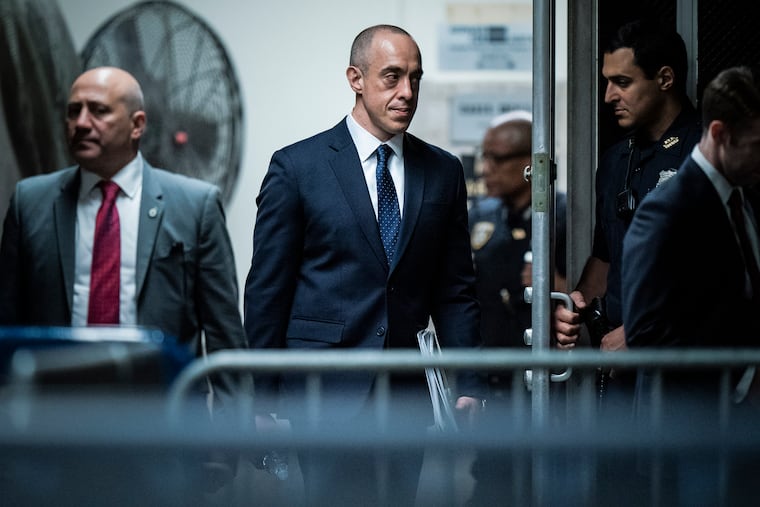
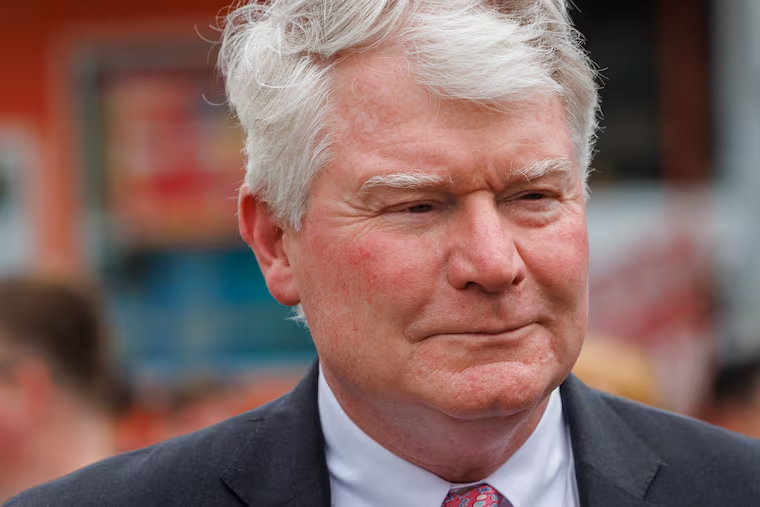
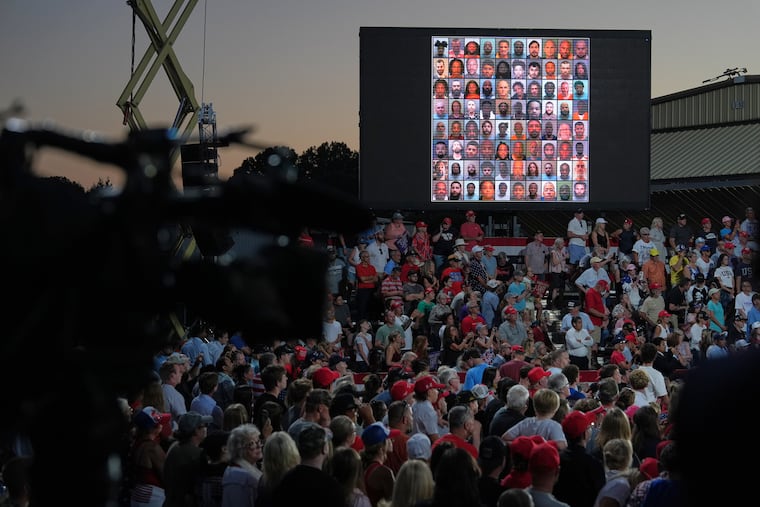
Emil Bove, a judge in Philadelphia’s federal appeals court and a staunch defender of President Donald Trump, faces an ethics complaint over his decision to attend the president’s rally in Pennsylvania earlier this week.
The complaint, written by Gabe Roth, who leads the advocacy group Fix the Court, was filed Wednesday with the chief judge of the U.S. Court of Appeals for the Third Circuit, based in Philadelphia. It alleges that Bove’s attendance at the campaign-style rally — which was billed as the first stop on an economic tour but went off-script with partisan attacks on immigrants and his critics — violated parts of the Code of Conduct for United States Judges.
That code includes provisions that a judge “should avoid impropriety and the appearance of impropriety in all activities” and “should refrain from political activity,” the complaint noted.
“I believe Judge Bove has violated multiple Canons of the Code of Conduct, should be admonished for his behavior and should be subject to any other discipline under the Judicial Conduct and Disability Act that the Chief Judge and the Judicial Council deem fit,” Roth wrote in the complaint, questioning whether Bove’s attendance hindered his impartiality as a judge.
A spokesperson for the Third Circuit, where Bove has been serving since his contentious confirmation in July, declined to comment. White House communications director Steven Cheung wrote in a post on X that it is not unusual for a judge, like Bove, to be at a rally.
“Stop your pearl-clutching,” Cheung wrote in response to another user. “An American citizen is at an event listening to the President of the United States speak. In your world, you’d rather give rights to illegal criminals over Americans.”
At Tuesday’s event, Bove said that he was “just here as a citizen coming to watch the president speak,” according to a reporter from MS NOW, formerly MSNBC.
Trump nominated Bove, who had worked as his personal criminal-defense attorney before the president chose him for a prestigious Justice Department role, in May to fill a vacant seat on the Philadelphia-based court. He was confirmed 50-49 by the U.S. Senate in July, with two Republicans voting with Democrats to oppose his appointment. The confirmation solidified Bove, whose career highlights have been defined by his loyalty to Trump, in a lifetime appointment on the bench.
Soon after coming into office in January, Trump tapped Bove to serve a key role in his administration’s plans to revamp the Justice Department. Bove oversaw swaths of firings and resignations, threatened consequences for officials who did not comply with the Trump administration’s immigration agenda, and secured the vexed dismissal of corruption charges against New York City Mayor Eric Adams.
He has also been the subject of whistleblower allegations. In June, a former high-ranking department lawyer accused Bove of saying U.S. officials should consider resisting court orders blocking deportations of alleged gang members.
Bove denied these allegations during a confirmation hearing before the Senate Judiciary Committee by saying, “I did not suggest that there would be any need to consider ignoring court orders.”
In July, new whistleblower accounts emerged from organizations representing former Justice Department employees. One alleged that an employee was concerned about Bove “actively and deliberately undermining the rule of law” when it came to court orders in an immigration case.
Another whistleblower said they had evidence that Bove was not truthful to the Senate Judiciary Committee during his confirmation hearing.
As to what could happen to Bove next when it comes to the misconduct complaint, the chief judge of the Third Circuit could conduct a “limited inquiry” into the allegations, according to the U.S. Courts website. Then, after considering, the chief judge would dismiss or conclude the complaint or appoint a special committee of judges to investigate.