The House passes a $1.9 billion bill to pay for Capitol security upgrades despite Democratic defections
The spending bill proved partisan and controversial, as Democrats failed to close ranks around the measure, and every voting Republican balked at the proposal's hefty price tag.
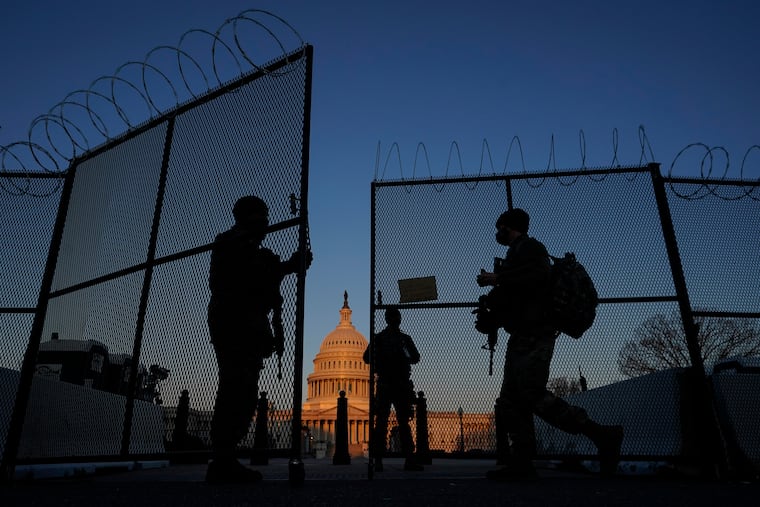
WASHINGTON — The House narrowly moved a $1.9 billion spending package through the chamber along party lines on Thursday to pay for security improvements at the U.S. Capitol, just one day after offering hearty bipartisan endorsement for an independent commission to investigate the Jan. 6 riot and break-in there carried out by supporters of former president Donald Trump.
The spending bill proved more partisan and controversial, as Democrats failed to close ranks around the measure, and every voting Republican balked at the proposal's hefty price tag and argued that Congress hadn't done enough yet to guarantee the money would be spent wisely.
Democratic opposition came from the more liberal wing of the party, including many voices who have called for reducing funding for police across the country. Reps. Ayanna Pressley (Mass.), Cori Bush (Mo.) and Ilhan Omar (Minn.) voted against the bill, while Reps. Alexandria Ocasio-Cortez (N.Y.), Rashida Tlaib (Mich.) and Jamaal Bowman (N.Y.) voted "present."
The 213 to 212 vote was a nail-biter, as Democratic leaders attempted to press some of the three Democrats who voted against the bill and the three who voted present — taking no position — to back the measure. As the vote closed, cries of “one more!” could be heard from the GOP side of the chamber, prompting the Democratic Leader, Rep. Steny Hoyer (Md.) to declare that they had run out of time, and demand the final count be called.
The slim and fraught victory in the House presages a difficult road ahead for the spending bill as written as it goes to the Senate, where Democrats and Republicans each control half the chamber but where it takes 60 votes to get around a procedural filibuster.
Republicans in both chambers have balked at some of the items in the bill, such as the $200 million dedicated toward establishing a "quick reaction force" within the Washington D.C. National Guard so that Capitol Police can draw upon military reinforcements more speedily in future emergencies.
On Thursday, Republicans also alleged that directing more funding toward the Capitol Police was premature because Congress has not yet taken any steps to reform the Capitol Police Board, which oversees the force.
"There is no question we must support the men and women of the Capitol Police, we must provide them the equipment, the training, and the leadership that support their efforts," said Rep. Jaime Herrera Beutler, R-Wash., the top Republican on the Appropriations subcommittee that controls funding for the government's legislative branch. "But to say that five months later, we're going to put the money before the actual reform, to me says there's a dereliction of duty."
Herrera Beutler, one of 10 House Republicans who earlier this year voted to impeach Trump for inciting the insurrection, directed her criticism toward the House Administration Committee, which on Wednesday held its first hearing with current members of the Capitol Police Board. The House sergeant-at-arms, who was not in that position Jan. 6, rejected the idea that the board needs to be reformed; the Senate sergeant-at-arms, also appointed after the Capitol attack, declined to appear.
Speaking Thursday on the House floor, Rep. Zoe Lofgren, D-Calif., who chairs that panel, took umbrage at Herrera Beutler's criticism.
“It’s not clear at the moment … whether it’s failings of the structure or failings of the individuals holding the positions in that structure,” said Lofgren. She argued that “it is a mistake to say if we can’t do everything at the same time, we should do nothing … The failure to act today is really to turn your backs on the men and women who fought as Capitol Police officers just yards from where we stand today.”
The legislation seeks to pay for updating the equipment and training that are provided to Capitol Police, and for hardening the Capitol complex with movable fencing, additional surveillance equipment, and reinforced windows and doors. It attempts to provide for extra security for lawmakers who have been threatened, both in Washington and in their home districts. In addition, it directs funds to pay for security improvements in the federal courts, which have also experienced a significant uptick in threats.
But the largest portion of the legislation — almost $700 million — goes to pay for costs that were already incurred by the Capitol Police, the D.C. police, the National Guard and other federal agencies that responded to the riot as it was unfolding, or stuck around in the weeks that followed to help patrol the vulnerable Capitol campus.
The discourse ahead of Thursday's vote grew testy as Democrats accused Republicans of forgetting the horrors of Jan. 6 and attempting "to rewrite history," while Republicans charged that if Democrats really wanted to make the country safer, they should be spending taxpayer money elsewhere.
"The true emergencies we should be funding are not part of this bill," said Rep. Tony Gonzales, R-Tex., listing the immigration crisis at the southern border and the ongoing hostilities between Israel and Hamas as more pressing matters, as he accused Democrats of running a "tone deaf" debate.
Toward the end of Thursday's debate, House Speaker Nancy Pelosi, D-Calif., spoke on the floor to advocate for the bill, arguing that the House had already collected ample advice about what improvements are necessary to help fortify the Capitol and protect its occupants, including from a task force she appointed retired Lt. Gen. Russel Honore to lead.
"This is what is urgent for us to do now," Pelosi said. "We have to prioritize, we need to sequence; we can't wait until we have every answer before we start with the solutions that we are aware, that we know of."
Herrera Beutler immediately challenged the speaker to do a better job of cementing the changes she advocated in law, before asking Congress to pay for them.
“I’m not saying hold everything back,” Herrera Beutler retorted. “At least take General Honore’s report and implement it, and then I wouldn’t be as opposed to funding it.”