Inside the fight to save more than a dozen Independence Park exhibits from potential Trump administration removal in September
Two Philadelphians are working to preserve or archive historic sites at Independence National Historical Park before items are removed or covered by the Trump administration in the fall.
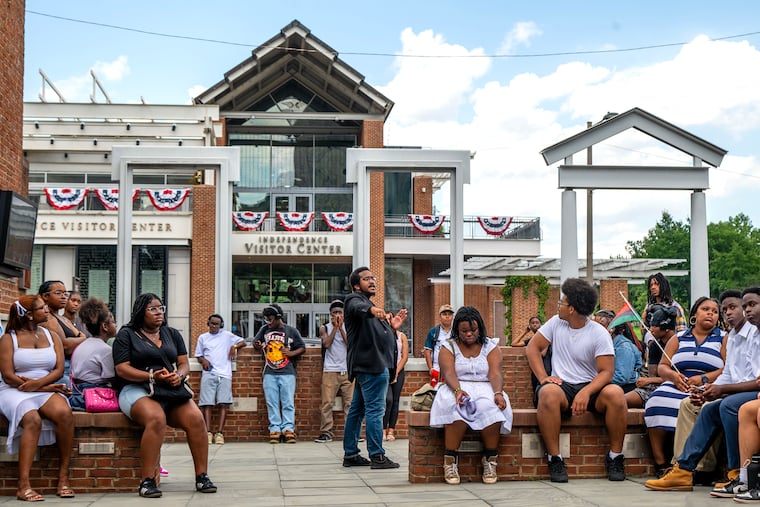
In roughly six weeks, more than a dozen exhibits about slavery at Independence National Historical Park could be removed or covered up by the Department of Interior.
Philadelphians are trying to preserve or archive these sites before it could be too late.
The potential removal comes in response to an executive order from President Donald Trump calling for Interior Secretary Doug Burgum to “ensure” that content that would “inappropriately disparage” Americans past or living ceases to exist at national parks, including Independence Park, which will be at the center of the country’s 250th anniversary celebrations next year.
Lynda Kellam, a data librarian based in Philadelphia, is a founding member of a group called Save Our Signs that created a crowdsourced community photo archive of national parks’ displays across the country.
And Faye Anderson, a preservationist and founding director of PHL Watchdog, wants to create a digital, 3D recreation of the President’s House Site, where Presidents George Washington and John Adams lived and Washington enslaved nine people. The site, which emphasizes the stories of the nine enslaved people and highlights the first president’s signing of the infamous Fugitive Slave Act, could be in particular jeopardy under Trump’s executive order.
There is a sense of urgency among those who are working to document these exhibits before the clock runs out.
“I’ve been sounding the alarm about what was coming with the President’s House and to get ready,” Anderson said.
The President’s House Site is the product of a push by Black activists, led by attorney Michael Coard, to have the nine people enslaved by Washington be the focus of the display. It was funded by city and federal dollars and opened in 2010 before it was transferred to National Park Service ownership in 2015. Coard and others involved held a news conference at the site Saturday afternoon.
“Those of us who fought for eight years from 2002 to 2010 to get this site and then 15 years later, now in 2025, we’re dealing with all of that work being erased,” Coard said on Radio Courtroom, a show he hosts.
The rush to preserve the exhibits reflects a timeline that has moved briskly since staff at national parks, including Independence Park, were first ordered by the Trump administration in June to identify “inappropriate” content and report it to the National Park Service by July 18. Items at the President’s House Site, the Benjamin Franklin Museum, the Second Bank of the United States, Independence Hall, an outdoor wayside exhibit panel on Independence Mall, and a proposed redesigned exhibit were flagged for review, The Inquirer reported.
By Aug. 18, all parks will receive further instructions. And by Sept. 17, the exhibits could be gone.
Here’s what Philadelphians are doing to preserve history before then.
‘I want people to know the full history of that space’
Kellam has been visiting national parks since she was a kid traveling to historic landmarks with her parents.
Spurred by Trump’s order, Kellam and a core group of librarians, public historians, and data experts created Save Our Signs with the goal of spreading awareness and preserving park materials.
The group’s website allows visitors at national parks across the country to submit photos to a community archive that will be released in October.
“To live in the city and being able to have access to the Liberty Bell and all of it, not just the bell, is great, but the whole park area is wonderful and I want people to know the full history of that space, and to be able to engage it and to put themselves in context with that history,” Kellam said.
As of Friday 150 photos from Independence Park were set to be released in October, alongside more than 3,000 images taken by visitors at national parks nationwide. That number could grow as more people submit images.
Kellam is an organizer of the Data Rescue Project, which aims to preserve at-risk federal public data. She joined forces with library and history experts from Minnesota to establish Save Our Signs, and the group had it up and running by early July.
Jenny McBurney, 35, a core leader of the project who also works as a government publications librarian at the University of Minnesota, said she took photos of the exhibits at the President’s House Site when she was visiting Philadelphia in June to test the submission form for the project.
“It’s also really important that the public is involved and is aware of what’s going on, and is involved in the preservation effort, because the national parks are really … our nation’s largest outdoor classroom,” McBurney said.
And while the project has collected more than 3,000 photos in less than a month, other parks — including the temporarily closed Edgar Allan Poe National Historic Site at Seventh and Spring Garden Streets — have yet to be represented in the archive. Poe’s site had two panels flagged by one or more employees for the Trump administration’s review, according to internal comments reviewed by The Inquirer.
“You could be the first to Save Their Signs!” the projects’ leaders implore national park visitors on their website.
“The point is to get people engaged with the community, but we do want to be able to figure out ways to preserve long term the memory of those signs,” Kellam said.
An ‘opportunity to tell a more complete story’
Anderson, a preservationist, said she has asked her followers on Facebook and LinkedIn to submit photos to the Save Our Signs portal.
But her drive to archive as much as she can before things change goes far beyond that. She has spent months archiving pages on the National Park Service website with plans to post them at some point to raise awareness, but she hopes her biggest plan can be ready by 2026, when the country is celebrating its 250th anniversary and all eyes are sure to be on Philadelphia.
“President’s House.ai,” as Anderson calls it, is a 3D, digital recreation of the President’s House Site, and users will have the ability to hold real-time conversations with the nine people enslaved by Washington — Austin, Christopher Sheels, Giles, Hercules, Joe, Moll, Oney Judge, Paris, and Richmond — with the help of artificial intelligence based on primary and secondary historical documents.
“We can use technology to … create a 3D model recreated bigger and better than ever, create AI characters of those nine enslaved Africans, and [users] can have conversations with them in real time,” Anderson said.
“This attempt to whitewash history has created this opportunity to tell a more complete story, because the President’s House is the result of not just protests, but also compromise,” Anderson said.
The President’s House is an open-air exhibit that features door and window frames, but does not have a roof — something that Anderson says she will be able to recreate in a historically accurate manner in a digital rendering.
“We know what it looks like. We have the floor plans. We have the layout of the ground. So we can simply reconstruct it the way it looked in the 18th century,” Anderson said.
Anderson said “we’re not even in the embryonic stages of” the digital recreation but hopes users on any device anywhere in the world will be able to use it. She plans to use SketchUp, a digital modeling platform, to help develop the project. She also needs to raise money, estimating the cost at $100,000 to $150,000.
The goal is for President’s House.ai to reach people where they are in order to provide them the full picture of U.S. history, especially when it is likely to be at risk.