Campaign ads and the return of gas pump stickers: How Pa. Democrats are using affordability to hammer Trump on Iran war
Four weeks into the Iran war, Democrats see the resulting economic impacts as a key message and a way of marrying a campaign-year focus on affordability with their opposition to the war.
One month into the war in Iran, Democrats pushing back against President Donald Trump’s decision to attack have coalesced around a familiar messaging strategy: affordability.
The buzzword critics used for months to hammer Trump and Republicans over rising costs has become a dominant theme as the party looks to rally public opposition to the war and win back control of Congress this fall.
Pennsylvania Democrats on Capitol Hill have leaned hard into the message, extending the same arguments they’d been pushing around healthcare and tariffs to, now, the largest-scale U.S. military engagement in the Middle East since the wars in Iraq and Afghanistan.
“Ultimately, the most important matters when it comes to whether or not we’re going to go to war are not just matters of dollars and cents. But we should be clear, they do have a direct ramification on dollars and cents,” U.S. Rep. Brendan Boyle (D., Phila.) said Thursday.
Boyle helped craft his party’s response during last year’s debates over Trump’s signature tax bill and healthcare policies. House Minority Leader Hakeem Jeffries (D., N.Y.) credited him for arguments about historic Medicaid cuts that he believed helped make Trump’s moves unpopular, the Inquirer reported in December.
Still perched in his leadership role as the top Democrat on the powerful House Budget Committee, Boyle used his time during a hearing last week to hit those same points while also underscoring the cost of the war.
“The American people deserve to know, and we deserve to ask to get this information, what the full cost of this war of choice will be. We have heard publicly the figure $200 billion,” he said, referring to reports of the Trump administration’s potential request for funding the war effort. “That is a massive sum. That is enough money that you could have extended the Obamacare tax credits in full for seven years.”
Other Pennsylvania Democrats in the House also took opportunities to highlight a long list of alternative spending priorities that they said were more worthy of taxpayer money.
U.S. Reps. Madeleine Dean (D., Montgomery) and Chris Deluzio (D., Allegheny) were among seven members of the Congressional Progressive Caucus, of which Boyle is also a member, to speak out specifically about the cost of the war.
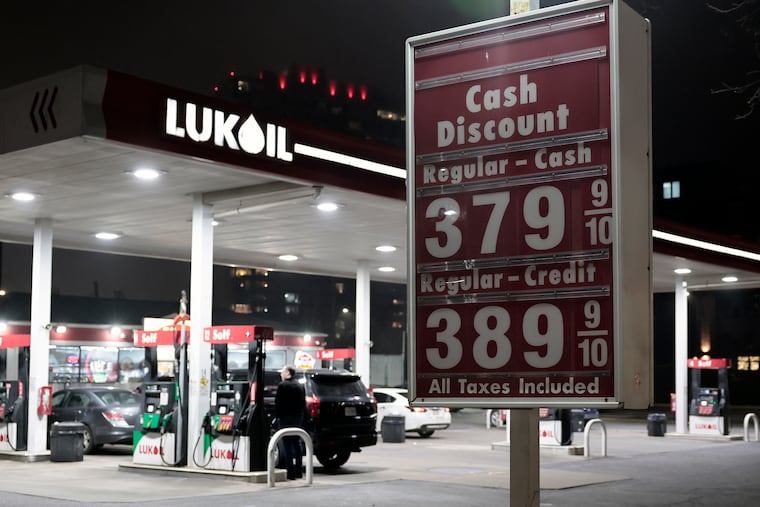
Standing in front of a poster highlighting Trump’s justification for the $200 billion — “A small price to pay,” he said this month — Deluzio said the money could instead cover two-year community college for 23 million people, high-speed rail, or free school lunches for millions of kids for years. Dean underscored the economic impacts that are already in full swing, like the spike in gas and diesel that means a higher price at the pump as well as additional costs to transport goods.
“The president is tasked with two things. Number one, to keep America safe. Number two, to make life more affordable for everyone. He’s failing on both fronts miserably,” Dean said.
“Everything is going up in price,” she added, noting that gas was averaging over $4 per gallon in her district that includes most of Montgomery County and parts of Berks County.
Democrats are betting on rising gas prices as a particularly effective messaging opportunity heading into November’s midterm elections.
The Democratic Congressional Campaign Committee — which is looking to flip four competitive Republican-held House seats in Pennsylvania — recently launched a digital ad campaign that blames Republicans for rising gas prices. Appearing on Facebook and Instagram, the ads are being geotargeted in 44 competitive districts, including the four in Pennsylvania.
Another group, the Progressive Change Campaign Committee, said it was sending donors stickers of Trump that they could place on gas pumps. The stickers — a callback to when Republicans put similar stickers of then-President Joe Biden on pumps — show the president pointing in various directions alongside phrases like “I did that!” or “Who did that? Me!”
Republicans say Democrats ‘suddenly care about affordability’
Trump officials, Republicans, and even one prominent Pennsylvania Democrat have looked to downplay those concerns.
U.S. Sen. John Fetterman (D., Pa.), who has supported the war and made frequent appeals to Trump and his base, on Thursday referred to the elevated price of gas during the Biden administration, which followed Russia’s invasion of Ukraine.
“The world wasn’t on fire and I don’t remember any Democrats complaining about it,” Fetterman said in an interview with News Nation host Chris Cuomo.
The senator — increasingly at odds with his own party — said he filled up his Jeep at a Sheetz in York County recently and it barely cost more than it did two years ago.
“Overall, yeah, gas is higher than it was before this. When you are having a military engagement, yes of course you’re going to find some fluctuation on it,” Fetterman said, while calling the military operation “remarkable.”
Trump administration officials have said the fluctuations are temporary, though Trump has also called affordability concerns a “hoax.” The National Republican Campaign Committee, charged with defending the GOP incumbents in Pennsylvania and elsewhere, meanwhile, said Democrats concerns are feigned.
“Democrats can pretend to suddenly care about affordability, but voters know who’s responsible for the historic inflation that decimated pocketbooks in Pennsylvania,” NRCC spokesman Reilly Richardson said.
Polls show a majority of Americans oppose the Iran war. A pair of surveys released last week from Pew Research Center and Quinnipiac University each found that six in 10 disapprove of Trump’s handling of the conflict. The latter found Trump’s handling of the economy at his lowest rating on record, with 38% voter approval.
The war has only added “fuel to the fire” around an issue that was already likely to be a central campaign theme this year, said Matthew Levendusky, a professor of political science and communication at the University of Pennsylvania’s Annenberg Public Policy Center.
“Democrats are leaning into affordability because it’s clear that it’s voters’ top priority, and stories about rising energy prices will make that even more so,” Levendusky said. “The war just magnifies this: It makes it easy for Democrats to argue that Trump took his focus off affordability, went to war with Iran, and made the problem worse.”
Matt Jordan, a Penn State University professor and media studies expert, said the affordability play has appeared to be effective in other aspects for Democrats, and it could work now to keep the war front-of-mind in a way that connects what’s happening overseas with people’s everyday lives.
Republican officials also shouldn’t ignore the issue as their own voters are paying more at the pump, he said. But with the GOP being successful at a “kind-of throw-everything-at-the-wall-and-see-what-sticks strategy,” Democrats also run the risk of getting “boxed in by their own message discipline,” Jordan said. He noted that there are also moral, legal and additional types of arguments to focus on when it comes to discussing war.
“The affordability message is something that the consultant class has locked in on as, ‘This is going to be our message discipline,’” Jordan said. “I could see how that would kind of be a throughline to frame the other side.”
Boyle, who is in line to become the Budget Committee chair if Democrats secure the House majority, said this week he would keep speaking out about the war and the economic consequences.
In a news conference he joined with a pair of progressive, economic-focused advocacy groups, a farmer from Nebraska spoke about the “huge hit” he’s taking because of a 48% increase in fertilizer costs spurred by the closure of the Strait of Hormuz. A mother from Somerset County, New Jersey, spoke about the compounding effects of her family’s medical bills and the impacts of war-created inflation.
“Even if I could afford to buy a car, I wouldn’t be able to afford to drive it,” Theresa Luioni, the New Jersey resident, said.
Boyle said he was not a pacifist who reflexively opposed all wars. But in a nod to his focus late last year on Medicaid cuts and broader affordability concerns, he said Trump had “doubled down on his unaffordability agenda.”
“This president, and his Republican enablers in Congress, are choosing war over the healthcare of the American people,” he said.