JD Vance has a lot in common with one of his predecessors
From his background to his pugnacious political style to the subjects of his attacks, JD Vance is a lot like Spiro Agnew.
Speaking to an applauding audience at the Richard M. Nixon Library on June 27, Vice President JD Vance favorably compared himself to the 37th President, “a young Senator, Vice President, writes some best-selling books, is hated by the media, it kind of sounds like JD Vance.”
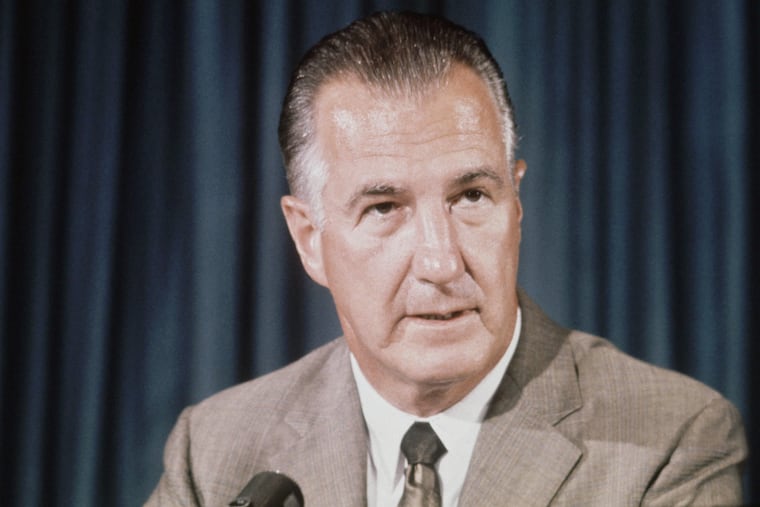
But in actuality, it’s not Nixon who Vance resembles. It’s Nixon’s vice president, Spiro Agnew. Agnew, a dour-faced hatchet man, was known as “Nixon’s Nixon.” Our current dour political hatchet-wielder is Trump’s Agnew.
Vance and Agnew share similar resumes. Both were elevated to the national ticket well ahead of their times to appeal to particular electoral constituencies and took on remarkably comparable foes during their vice-presidential terms.
Like Vance, Agnew came from humble beginnings. The son of a Greek immigrant father and Virginia-born mother, his family owned a diner in Baltimore. Before joining the military and serving in World War II, he Americanized his foreign sounding first name to “Ted” and returned from combat to attend law school on the GI Bill. In 1966, Agnew won the Maryland governor’s race.
Despite scant political experience, Agnew came to the attention of influential Nixon adviser Pat Buchanan, who recognized that there was national political appeal to the governor’s tough response to rioting in Baltimore following the assassination of Martin Luther King Jr. Agnew had pointedly criticized what he charged was the weak response of local Black leaders to civil disorder. Given that he wasn’t unacceptable to any of the feuding wings of the GOP — unlike many more prominent figures — this was enough for Nixon to make Agnew his running mate.
Once on the ticket, the Nixon campaign deployed Agnew to counter the alarming momentum of third-party candidate, segregationist and former Alabama Gov. George Wallace. On a campaign swing through North Carolina and Florida, Agnew rallied the crowd with “speeches that sounded not unlike Wallace texts,” the New York Times reported. In 1969 Wallace quipped, “I wish I had copyrighted my speeches. I would be drawing immense royalties from Mr. Nixon and especially Mr. Agnew.”
Agnew struggled in his first few months in the national spotlight and became known more for campaign trail gaffes than for policy positions.
Even so, Agnew successfully connected with nervous white suburbanites, primarily in the Midwest and South, who feared civil rights, mistrusted the metropolitan elite and wanted the anti-Vietnam War protesters put in their place. This group of voters — who Nixon later referred to as “the silent majority” — became Agnew’s biggest supporters.
Agnew’s penchant for gaffes and awkwardness continued after he and Nixon entered office. At a ceremony welcoming President Nixon home from a European trip in March 1969, Agnew slipped on an icy tarmac and smashed his nose. He then stepped up to the mic “bleeding profusely,” according to White House aide H.R. Haldeman.
Yet, Agnew’s response to his (literal) stumbles helped him to connect even more with anxious white Americans. He refused to stand by and let well educated elites or the news media mock him. Instead, the vice president lambasted them as “an effete corps of impudent snobs” and “the nattering nabobs of negativism,” respectively. Agnew started delivering blistering speeches with the help of Buchanan and his fellow White House speechwriter William Safire, excoriating precisely those forces who anxious white Americans loathed.
In November 1969 in Des Moines, Agnew made what a poll of leading scholars considered one of the 50 most significant American speeches of the 20th century. The vice president publicly called out the media, what he dubbed “this little group of men who not only enjoy a right of instant rebuttal to every Presidential address, but, more importantly, wield a free hand in selecting, presenting, and interpreting the great issues in our nation.” It would launch a more than half-century-long GOP crusade against mainstream journalists.
In other speeches, Agnew hammered universities for what he described as the coddling of student radicals, calling them ”circus tents [and] psychiatric centers for overprivileged, under-disciplined, irresponsible children of the well to do blasé permissivists.” Agnew warned, “The criminal left is not a problem to be solved by the Department of Philosophy or the Department of English — it is a problem for the Department of Justice.”
By the 1972 election, Nixon loathed the pugnacious Agnew and regularly disparaged him privately. He questioned his vice president’s intelligence, judgment and loyalty. Nixon, according to Haldeman, felt “Agnew doesn’t really have it” and had become convinced that “he can’t do the job” of president, should it come to that. The president even contemplated replacing Agnew on the ticket with Texas Gov. John Connally.
Yet, he demurred, because Nixon recognized how popular the vice president was with his “silent majority” base. Observers initially touted Agnew as a front-runner in the 1976 Republican presidential sweepstakes. Instead, however, the vice president’s political career crashed and burned.
In 1973, 10 months before Watergate ended Nixon’s presidency, Agnew pled no contest to tax evasion, stemming from unreported bribes he had received while governor of Maryland. Agnew slunk away from public life, disbarred and disgraced, to an odd final chapter of his life that included writing a steamy novel, lobbying for tin pot dictators and engaging in antisemitic conspiracy-mongering.
A half century after Agnew left office, Vance is having a very similar vice presidency.
He, too, comes from working class roots. The vice president grew up as James David Hamel in a working-class household in an Ohio Rust Belt town. There, he experienced poverty and domestic instability. Like Agnew, he served in the military, went to law school and spent only two years as an elected official — in Vance’s case, two years in the Senate — before being chosen as the GOP’s vice presidential nominee.
Just as Pat Buchanan sold Agnew to Nixon as a Silent Majority kindred spirit, pundit Tucker Carlson promoted Vance to Trump as a fellow America Firster. Like the former Maryland governor, Vance joined the Republican ticket in part because he could speak to “blood and soil” Americans.
Additionally, like his predecessor, Vance has experienced verbal stumbles. In 2021, anticipating a future Kamala Harris run for the presidency, he claimed that America was run “by a bunch of childless cat ladies who are miserable at their own lives and the choices that they’ve made, and so they want to make the rest of the country miserable too.”
In 2025, the vice president broke the national championship trophy in a ceremony with the Ohio State University football team. That year, the newly converted Catholic also earned gentle but firm pushback from Pope Francis for Vance’s jaw-dropping misinterpretation of the Church’s message on immigrants.
Trump has also deployed Vance as an attack dog, going after the same universities and media outlets Agnew regularly tangled with. Even before he was elected to the Senate, Vance told the National Conservatism Conference that “if any of us want to do the things we want to do for our country and the people who live in it, we have to honestly and aggressively attack the universities in this country.” As vice president, he has frequently targeted the media, charging that journalists have a “political bias” and cannot be trusted.
And like Nixon before him, Trump doesn’t seem 100% sold that his vice president is the rightful heir to his political legacy. Most recently, Trump talked about his decision to have Vance serve as the lead negotiator to end the war with Iran by throwing him under the bus, saying, “If it works out, I’m going to take the credit. If it doesn’t work out, I’m blaming JD.”
Vance’s post vice presidential chapter has not yet been written but it is a good bet that he will run for president in 2028.
If he decides to seek the top job, he will run, not as a Richard Nixon Republican, but as a Spiro Agnew one. Nixon’s Watergate cover-up and general paranoia overshadowed a more moderate side: the diplomatic achievements, support for environmental protections and the creation of Title IX.
Agnew, by contrast, was an emblem of the pugilistic, populist politics that Vance has made his calling card. Those, and not substantive policy achievements, constitute Agnew’s historical legacy. Vance’s is likely to be the same.
Chuck Holden is a professor of history at St. Mary’s College of Maryland. Zach Messitte is the former president of Ripon College where he was also a professor of Political Science. Jerald Podair is professor of history and Robert S. French professor of American studies emeritus at Lawrence University. They are the co-authors of Republican Populist: Spiro Agnew and the Origins of President Donald Trump’s America (University of Virginia Press, 2019)
Made by History takes readers beyond the headlines with articles written and edited by professional historians. Opinions expressed do not necessarily reflect the views of The Inquirer.