Senators seek review of Justice Department’s handling of Epstein files
The DOJ released millions of pages of documents, but Democrats and some Republicans in Congress have raised concerns about how faithfully it complied with the law.
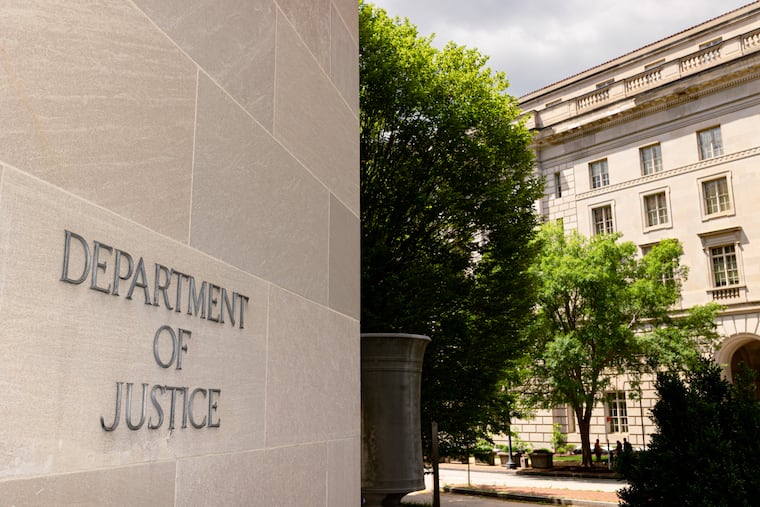
A bipartisan group of senators is asking the Government Accountability Office to examine the Justice Department’s handling of files related to Jeffrey Epstein amid concerns the department has not released all the documents required by law.
President Donald Trump in November signed an almost unanimously passed law mandating the Justice Department make public records related to the late convicted sex offender with narrow restrictions.
The department released millions of pages of documents, but Democrats and some Republicans in Congress have raised concerns about how faithfully it complied with the law. The lawmakers have questioned whether all relevant files have been released, criticized the department for failing to redact victims’ names in some instances, and challenged decisions to redact the names of Epstein associates they believe should have been identified.
Sens. Jeff Merkley (D., Ore.), Lisa Murkowski (R., Alaska), Ben Ray Lujan (D., N.M.), and Dick Durbin (D., Ill.) asked the GAO — an independent agency that is part of the legislative branch — on Wednesday to examine how the department reviewed the files “and the resulting failure of the Department to follow the law, respond to Congress and protect victims.”
The senators are seeking details including how many people were tasked with reviewing and redacting the files as the Justice Department scrambled to comply with the law and any guidance the administration provided them. In a letter to Orice Williams Brown, the GAO’s acting comptroller, they echoed concerns by Reps. Ro Khanna (D., Calif.) and Thomas Massie (R., Ky.) — the authors of the law requiring the files be made public — about how the documents were redacted.
“Contrary to Congress’s explicit directive to protect victims, these records included email addresses and nude photos in which the names and faces of publicly-identified and non-public victims could be identified,” the senators wrote. “But when it came to information identifying powerful business and politics figures who are alleged co-conspirators or material witnesses, DOJ appears to have heavily redacted those records.”
In the House on Wednesday, lawmakers dug into Epstein’s sprawling financial portfolio as a committee deposed his former accountant and tried to understand his connections to some of the world’s wealthiest men.
Richard Kahn, who worked closely with Epstein for years and now serves as an executor of his estate, appeared for the closed-door deposition on Capitol Hill. He told lawmakers that he had not personally seen evidence of Epstein’s sexual abuse, but provided a fuller picture of how Epstein acquired his wealth. The wealthy financier made hundreds of millions of dollars over two decades, during which he struck up friendships with some of the world’s most powerful men.
Kahn “was under the impression that Epstein made his money as a tax adviser and a financial planner,” said Rep. James Comer (R., Ky.), chair of the House Oversight Committee. Lawmakers argued that a fuller picture of Epstein’s finances could help the public understand how, for years, he was able to get away with trafficking and sexually abusing underage girls.
“Jeffrey Epstein’s sex-trafficking ring would not have been possible without Richard Kahn, who managed Epstein’s money for years, authorized payments, including payments to victims and survivors,” said Rep. James Walkinshaw (D., Va.), who added that Kahn told them he was unable to recall details of some of the transactions and communications that he was asked about.
Kahn has said he was unaware of Epstein’s sexual abuse and had not seen any of his victims.
Bipartisan scrutiny
The senators’ letter comes as lawmakers in both parties have continued to scrutinize the department’s handling of the files more than a month after most of them were made public.
Senate Minority Leader Chuck Schumer (D., N.Y.) accused the department last month of orchestrating “a massive cover-up” to protect Trump and Epstein’s associates. The House Oversight and Government Reform Committee voted last week to subpoena Attorney General Pam Bondi, with five Republicans joining Democrats in voting to compel her to appear for a closed-door deposition.
Bondi has defended the department’s compliance with the law. The department made public more records last week that it said had not been released before because they were wrongly determined to be duplicates of other records.
“This administration released over three million pages of documents — over three million — and Donald Trump signed that law to release all of those documents,” Bondi testified last month in a contentious appearance before the House Judiciary Committee. “He is the most transparent president in the nation’s history.”
The senators’ request was not lawmakers’ first effort to unearth more details about how the department has handled the massive task of reviewing and redacting the files.
A dozen senators — including Merkley, Murkowski, and Durbin — wrote in December to Don Berthiaume, the Justice Department’s acting inspector general, to ask him to audit the department’s compliance with the law. The inspector general’s office did not immediately respond to a request for information about whether it has undertaken such an audit.
This article contains information from the Associated Press.