‘Our heroes are dying.’ Why Jesse Jackson’s death leaves a void.
Civil rights icon Jesse Jackson leaves behind a movement that lacks a single unifying leader, but his legacy of inclusion could help it carry on.
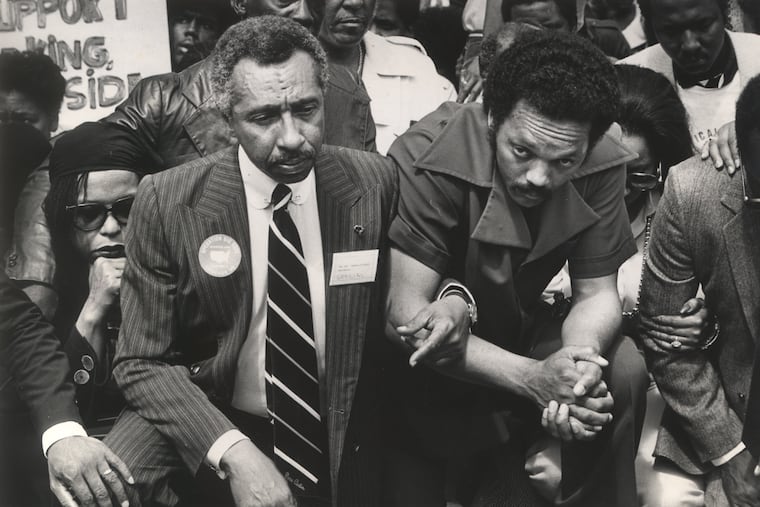
In the early-morning hours after the Rev. Jesse Jackson died on Feb. 17, his family called another prominent pastor for prayer and solace. “A mighty lion has passed,” Bishop William Barber recalled the family saying.
“I’ve been thinking about that imagery,” said Barber, who leads Repairers of the Breach, an organization that aims to bring moral and religious language to causes such as safeguarding voting rights and alleviating poverty. “Because lions, they protect the pride, but they also expand the territory of the pride.” And Jackson expanded the notion of civil rights in America, he said: from the Black community to the full spectrum of people seeking justice.
Thousands are expected to pay respects Friday as Jackson’s remains lie in repose at Rainbow/PUSH headquarters in Chicago, following the decision by House Speaker Mike Johnson (R., La.) to decline to allow Jackson to lie in honor at the U.S. Capitol.
Jackson’s death at age 84 comes at a perilous time for the civil rights crusade he helped lead for decades. Most of his iconic contemporaries are gone as President Donald Trump attacks their hard-fought principles, declaring war on diversity, equity, and inclusion initiatives while the foundational achievement of the civil rights movement, the 1965 Voting Rights Act, may be on the verge of being overturned by the U.S. Supreme Court.
“Our heroes are dying, and the question has to be asked: Who comes next or what comes next?” said author and political commentator Bakari Sellers. “This new era of regression, this new era of Trumpism, has shown clearly that … our new leaders [are] not able to meet the moment.”
It’s a major test of the movement in a fragmented landscape of social media and political division with no clear successor generation to rally a response. The wellspring that produced leaders such as Jackson and the Rev. Dr. Martin Luther King Jr. — the Black church — no longer plays the same role. Institutional religion doesn’t have the authority or power it once did in the United States, experts said, and the religious right for decades has been more loudly — and successfully — merging its view of Christianity and politics.
“The Black church isn’t as important as it was. It’s harder to have a figure come out of that tradition and command the power and respect that Jesse Jackson did,” said Claflin University historian Robert Greene II. “It’s hard to imagine someone today being able to enter the political realm already seen as a moral authority.”
If there is to be a robust defense of civil rights, many believe it will come from Jackson’s legacy of expansion — using the Voting Rights Act to get more people of color into voting booths and into elected office; broadening the definition of civil rights to include all marginalized communities, such as LGBTQ people and people with disabilities, in a common cause; and pushing beyond political rights to economic rights.
In some ways, the fact that there is no obvious individual to take the mantle is part of Jackson’s legacy, say civil rights activists, elected leaders and scholars. He advocated for leaders at all levels of government and activism carrying out different parts of the mission.
“We have democratized leadership in the civil rights movement and spread it throughout the country,” Virginia lawmaker Don Scott said.
Scott said his own life found a new purpose when he was a college sophomore in 1984 and met Jackson, who was running for president. Forty years later, Scott became the first Black person elected speaker of the Virginia House of Delegates.
“That’s the legacy of Jesse Jackson — he empowered a whole lot of folks to lift up their voice,” Scott said.
Bryan Stevenson, a lawyer and founder of the Equal Justice Initiative, said it’s important to remember the historical arc of the civil rights movement. After the Civil War, Black men had a brief moment when they were able to participate in democracy. Then Jim Crow swooped in and disenfranchised Black voters in the South for more than half of the 20th century.
During that time, without access to elected office, Black Americans looked elsewhere for leadership and resistance. Black churches filled that void, giving rise to the civil rights movement, Stevenson said, exemplified by King and other figures — such as Claudette Colvin, John Lewis and Fannie Lou Hamer — who blended the tone of the pulpit with politics.
Younger generations of pastors — including those from more conservative traditions — were “inspired to be not just pastors but prophets as well,” said Tyler Burns, a Florida pastor and director of the Witness, a multimedia organization aimed at elevating the voices of Black Christians.
Today there are some figures who echo Jackson in their focus on combining Black Christianity and politics to serve the disenfranchised, including U.S. Sen. Raphael G. Warnock (D., Ga.) and Barber, a North Carolina organizer who founded the Center for Public Theology & Public Policy at Yale University.
But Jackson was one of a kind, said Jemar Tisby, a historian, writer, and podcaster on race and religion. He represented “the longer Black freedom struggle,” Tisby said, and harnessed a blend of charisma, ambition, and eloquence to an unusual moment of political opportunity.
The Voting Rights Act of 1965, and Jackson’s immediate recognition of the door that it opened, “radically changed the opportunity for Black leadership,” Stevenson said. Jackson was particularly effective at voter registration, preaching the power of politics.
“It’s a different landscape today as a result,” Stevenson said.
The Supreme Court has already weakened much of the 1965 Voting Rights Act and will rule on whether to strike down its last major pillar in the coming months. The court could further limit the use of race in drawing legislative maps, which would most likely lead to a decline in the number of minorities holding public office.
Maryland Gov. Wes Moore, the state’s first Black governor and among only three African Americans ever elected governor of any state, said that “an attack on the VRA is in many ways an attack on decades of progress.”
Jackson’s pivot after the passage of the law, which helped Black officials win congressional and legislative seats, spurred the movement’s success, Moore said. “He was able to make the transition from demanding change to saying, ‘I want to be one of the people to help make it,’ right? Because he understood that part of the power of the civil rights movement was the fact that they were able to get into rooms.”
The Brennan Center for Justice at the NYU School of Law has tracked efforts to roll back access to the ballot box around the country, including states imposing voter ID laws, making registration more difficult, and aggressively purging voter rolls. Those actions are part of what Georgia politician Stacey Abrams calls “the exercise of diminishing democracy … [and] a wholesale attack on the pluralism of America.”
Abrams, a former Georgia state lawmaker and gubernatorial candidate, said Jackson’s legacy is key to fighting back. His Rainbow/PUSH Coalition framed the fight for civil rights broadly, as “how do we make America meet its obligations to all its people,” Abrams said.
That not only brought more marginalized groups into the struggle, she said, but it expanded the idea of civil rights beyond the political realm. “Now that we had voting rights and civil rights, we also had to have access to economic rights,” Abrams said.
For all the years Jackson carried on his fight, “the through line was always that he worked to bring more people into the process … [so that] as many people as possible believe they have the right to participate,” she said.
Former Richmond Mayor Levar Stoney — who, until term-limited out of office in 2025, was part of a new generation of young Black mayors around the country — said the effectiveness of Jackson’s work can be seen in state and local offices in the South, where minorities and women have made huge strides in representation.
The phenomenon cuts across generations, Stoney said, pointing out that in Virginia, 82-year-old L. Louise Lucas is the first Black woman to serve as president pro tempore of the state Senate; Scott, 60, is the first Black speaker; and Jay Jones, 36, is the first Black person elected as the state’s attorney general.
Apart from President Barack Obama, Stoney said, “I can’t foresee us ever looking to one singular leader.” He added, “There’s a collective of leaders now, [and] we expect to be represented by someone who looks like us.”
What might be lost, though, is the unifying emotional resonance of a figure such as Jackson. One element that gets overlooked, Sellers said, is that Jackson, King, and other leaders of the day “were more patriotic than most.”
They were able to “look at this country and call out its failures, call out its broken promises, and then try to reimagine her for what she should look like, which is an inclusive society built in the image of us all.”
Jackson was able to lend that stature to others, which is what several remembered this week in the lead-up to his memorial services.
Stevenson said he regularly conferred with Jackson in creating the National Memorial for Peace and Justice in Montgomery, Ala., which recognizes more than 4,000 African Americans lynched during the Jim Crow era. At the dedication for an affiliated memorial in 2024, Jackson had traveled to the ceremony but by then was using a wheelchair and had difficulty communicating. As Stevenson spoke before the crowd, he looked out and saw Jackson, who held his fingers in the shape of a heart.
“It was so moving to me,” Stevenson said. "And I told him, you know, you had me almost in tears."
Abrams recalled the night in 2018 when it became clear that she had narrowly lost the election for Georgia governor. Jackson was on hand as she prepared to concede before supporters, and some of her staff tried to get him to move into a VIP area backstage. He refused.
“He said: ‘I want to be here when she comes downstairs. I know what [defeat] feels like, and I need her to know that the work she’s done continues and she should still be proud,’” Abrams said.
Barber said he intends to honor Jackson’s legacy by convening a group in the coming weeks to study his speech at the 1988 Democratic convention — when his performance in the primaries brought him closer to the presidential nomination than anyone thought possible — to galvanize a new voter movement.
In the speech, Jackson called for unity to “keep hope alive,” and said he cherished America not as a uniform blanket but as a quilt.
“My prayer and hope,” Barber said, “is that we’re working toward that end and bringing folk together. And that the dying of Jesse will not cause us to just say, ‘Woe is us’ and ‘Oh, just look at what he did.’ Because commemoration is not how you remember people like him. You remember people like him by engagement. By recommitting yourselves.”