Gen. Joshua Rudd confirmed as NSA, Cyber Command head
The career Special Operations commander will take control of the nation’s largest spy agency and the military’s offensive cyber organization.
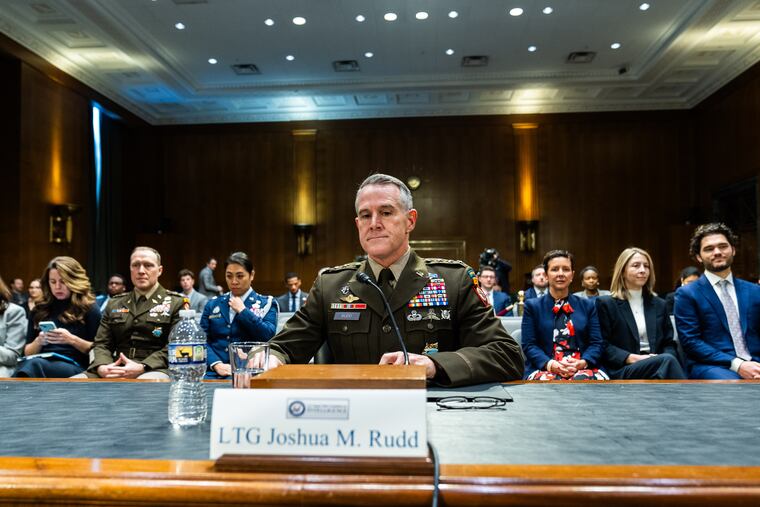
Gen. Joshua M. Rudd was confirmed Tuesday as the next head of the National Security Agency and U.S. Cyber Command, ending nearly one year of leadership limbo at the nation’s largest spy agency and the military’s offensive cyber organization.
Rudd, a former Delta Force commander, was confirmed by the Senate in a 71-29 vote. The confirmation elevates him to a four-star general, and he is expected to take up his position soon.
Rudd will assume command over an intelligence agency shaken by the abrupt firing of its director, Gen. Timothy Haugh, and Deputy Director Wendy Noble by President Donald Trump in April. The president’s move drew sharp bipartisan rebukes as an unjustified political move engineered by the far-right activist Laura Loomer.
Rudd will also serve in a “dual hat” role as head of U.S. Cyber Command, which conducts offensive and defensive cyber operations.
For the past year and a half, Rudd has served as deputy head of U.S. Indo-Pacific Command, which is the largest of the six combatant commands by geography and is largely focused on countering the Chinese military’s aggressive push for regional dominance.
“General Rudd is a war hero with a lifetime of service to our nation,” said Sen. Tom Cotton (R., Ark.), chairman of the Senate Intelligence Committee. “He is the right choice to lead the protection of our nation from cyberattacks by Iran, Russia and China.”
Rudd rose from an Army quartermaster focused on logistics to head the elite Delta Force — the clandestine unit that, along with SEAL Team 6, executes the military’s highest-stakes missions. He has overseen all Special Operations troops assigned to the Pacific and served in numerous combat deployments in Iraq and Afghanistan.
But his relative lack of leadership experience in cyber operations and signals intelligence has drawn scrutiny from some Democratic senators. At a confirmation hearing in January, Sen. Ron Wyden (D., Ore.) asked him to commit to not surveilling U.S. citizens without a judicial warrant. Rudd responded that he respected Americans’ civil liberties and pledged to follow the law if confirmed, but declined to explicitly oppose the practice.
“That, respectfully though, doesn’t get close to what I’m talking about,” Wyden said at the time.
On the Senate floor on Monday, Wyden said that while he respected Rudd’s years of military experience, he did not view him as qualified to serve in the dual positions. Wyden voted not to confirm.
While Rudd was confirmed by a narrower margin than most nominees to his position — who usually advance on a voice vote — other Democrats said they were satisfied by his answers during his confirmation process. Sen. Elissa Slotkin (D., Mich.), a member of the Armed Services Committee, asked at that committee’s confirmation hearing whether he would pledge not to use the agency’s tools for domestic surveillance.
“He answered that question appropriately, and a lot of others who have sat in that chair have not,” Slotkin, who voted to confirm, said in an interview.
In a statement last month, the Pentagon praised Rudd’s “outstanding qualifications” and urged the Senate to vote on the nomination at “the earliest opportunity.”
Rudd’s confirmation comes as a powerful surveillance tool, Section 702 of the Foreign Intelligence Surveillance Act, is set to expire April 20.
Trump is said to favor an 18-month renewal of the law, though the administration has taken no public stance on the matter. Section 702 was passed in 2008 to authorize U.S. intelligence agencies to collect communications on foreigners located overseas and has been reauthorized and amended several times.
The law has provoked much debate over the years about whether it lacks sufficient safeguards to protect Americans’ privacy and civil liberties. Lawmakers from both parties have tried to impose a warrant requirement to search for Americans’ communications within the information collected, but intelligence officials have argued that would limit the tool’s effectiveness. U.S. officials have often said that Section 702 provides the intelligence for about 60% of the items in the president’s daily brief.
Cyber Command was stood up in 2010 to defend military computer networks and conduct offensive operations. Over the years it has acquired new authorities and expanded its capabilities, but it still faces challenges in keeping pace with advanced adversaries, especially China. The Trump administration has signaled a desire to see more effective and aggressive offensive cyber operations.
Though Cyber Command shares some of the same special budgeting, hiring and training authorities as Special Operations Command, it still faces challenges in fielding an effective cyber force, experts say. The Pentagon is aiming to change that through a new cyber force generation strategy known as Cybercom 2.0 in the hopes of making the command more agile, recruiting top-class talent and expanding operational impact.
“The current strategic environment that we’re in definitely requires speed, agility, integration of all of our capabilities, not just of [Cyber Command and NSA], but across the joint force and across all domains,” Rudd said at the Armed Services confirmation hearing in January.