Louisiana asks Supreme Court to halt abortion pill access by mail
Louisiana officials on Thursday asked the Supreme Court to let stand, for now, a lower-court ruling that would prevent women nationwide from obtaining a widely used abortion medication by mail.
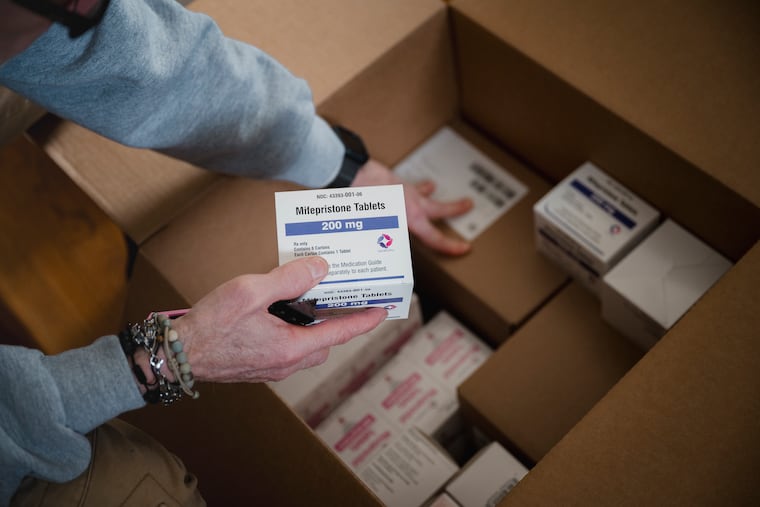
WASHINGTON — Louisiana officials on Thursday asked the Supreme Court to let stand, for now, a lower-court ruling that would prevent women nationwide from obtaining a widely used abortion medication by mail.
Last week, the conservative U.S. Court of Appeals for the 5th Circuit reinstated requirements that pregnant women visit a healthcare provider in person to obtain the medication, mifepristone. That order caused confusion for providers, patients and pharmacies, as well as companies that manufacture the pill used in nearly two-thirds of abortions nationwide — which asked the Supreme Court to get involved.
Justice Samuel Alito, who oversees emergency requests from the 5th Circuit, paused the appeals court’s order Monday for one week to give the parties time to respond. The full Supreme Court will review the filings and could decide at any time how to resolve the matter.
The 5th Circuit ruling came after the state of Louisiana sued the Food and Drug Administration to restrict access to mifepristone. State officials said the availability of the medication by mail has allowed abortions to continue in the state despite its almost total ban, which took effect after the Supreme Court eliminated the nationwide right to abortion in 2022.
The FDA first lifted in-person dispensing requirements for abortion medication in 2021 during the Biden administration, and about a quarter of abortions in the United States are now provided through telemedicine.
The case has thrust the issue back into the spotlight before the midterm elections and puts the Trump administration in a tricky spot. While the president’s Republican base generally opposes abortion, restricting access is not considered a broadly winning position in many critical midterm races.
The Trump administration is conducting a review of the safety of mifepristone. Officials have said in court filings that the review could lead the FDA to change or reaffirm its policies and have asked to delay resolution of this and other related legal disputes until the study is complete.
Administration officials declined to comment on the 5th Circuit ruling and took the unusual step of submitting no filing to the Supreme Court, even though a government agency, the FDA, was the losing party. Alito had asked for responses in the case by 5 p.m. Thursday.
Julia Kaye, a lawyer with the American Civil Liberties Union’s Reproductive Freedom Project, said the Trump administration’s silence at the Supreme Court is “incredibly telling, unusual and concerning.”
Although the administration did not weigh in by the deadline, Republican members of Congress, including Speaker Mike Johnson and Sen. John Thune, the majority leader, filed a brief siding with Louisiana and asking for the court to allow the pills to be restricted.
After the 5th Circuit ruled in Louisiana’s favor Friday, two manufacturers of mifepristone, Danco Laboratories and GenBioPro, rushed to the Supreme Court to try to restore nationwide access to the pill by mail.
In its filing Thursday, Louisiana said the FDA’s decision to make it easier to obtain mifepristone was based on inadequate or flawed data — an assertion that medical organizations dispute. Liz Murrill, the state’s attorney general, said the regulations had resulted in illegal abortions in the state and thousands of dollars in Medicaid costs to treat women harmed by mifepristone.
Even so, the state said it would agree to a proposal from the manufacturers to keep the 5th Circuit ruling on hold, provided the Supreme Court agreed to schedule a special argument session to immediately review the matter in depth before the end of its term in late June.
“While this court considers the pending applications, approximately 1,000 abortions are taking place in Louisiana every month, undermining its ‘prerogative of protecting unborn life,’” the attorney general said.
The Trump administration has appeared to try to straddle the issue. In October, the FDA granted approval for a new generic version of mifepristone, increasing the number of U.S. manufacturers of the drug to three.
While more than 100 studies have consistently found that mifepristone is safe and that serious complications from taking it are rare, the Trump administration said in September that it was undertaking a new review of its safety.
In the Louisiana case, a district court judge, David C. Joseph, in April granted the FDA’s request to pause the litigation and give the agency time to complete its review. Administration officials recently told The New York Times that the review would probably be finished toward the end of this year, timing that would mean it would not conclude until after the midterm elections.
On appeal, the 5th Circuit refused to wait for the review to finish.
In its ruling, a three-judge panel echoed the state’s arguments that the FDA’s regulations were “undermining its laws protecting unborn human life” and “causing it to spend Medicaid funds on emergency care for women harmed by mifepristone,” according to the order written by Judge Stuart Kyle Duncan, a Trump appointee. He was joined by Judge Kurt D. Engelhardt, another Trump appointee, and Judge Leslie Southwick, an appointee of President George W. Bush.
Mifepristone, the first pill in the two-drug medication abortion regimen, was approved by the FDA in 2000. The second, misoprostol, which is also used for other medical conditions, was not affected by the 5th Circuit ruling.
Pharmaceutical companies and former FDA officials have warned the Supreme Court in filings that the 5th Circuit’s order could have broader implications and significantly disrupt the nation’s science-based drug-approval system and stifle drug development.
Just two years ago, the Supreme Court heard a similar challenge from anti-abortion doctors to the FDA’s loosening of dispensing requirements.
Then, the court unanimously held that the doctors challenging the FDA’s regulation of mifepristone had not suffered the sort of direct harm that gave them legal grounds to sue.
This article originally appeared in The New York Times.