DHS chief faces crisis moment amid mounting arrests, fatal shootings
Homeland Security Secretary Markwayne Mullin has increased immigration arrests. But his attempt to quell an uproar over two fatal ICE shootings has angered the president and his hard-line base.
Homeland Security Secretary Markwayne Mullin was speaking to reporters this month in New York when one asked whether he was under pressure from the White House to increase immigration arrests. Mullin replied that his department was in lockstep with the president’s team and boasted that arrests and deportations were rising.
“When we go after the worst of the worst, which is exactly what we’re doing, we’re saving lives,” he said.
Just over two weeks later, Mullin is facing his biggest political and managerial crisis since taking office in March as he scrambles to respond to two deadly shootings involving U.S. Immigration and Customs Enforcement officers. The violence has drawn harsh denunciations from Democrats and immigration advocates, as well as criticism from one prominent Republican senator, and the situation has threatened to reignite the wide public backlash that arose in January when immigration officers killed two U.S. citizens during a surge of operations.
Mullin’s attempt to quell the uproar over the shootings this week — ordering a moratorium on vehicle-stop arrests by ICE officers — has exposed the precarious position he is in while trying to comply with President Donald Trump’s demands. Less than 48 hours after Mullin issued the directive on traffic stops, a White House official confirmed that it had been reversed.
Mullin promised to rebuild public trust in the Department of Homeland Security after replacing Kristi L. Noem, and he has undone some of his predecessor’s moves, taking a quieter approach in an effort to stay out of the headlines.
At the same time, he has doubled down on Trump’s deportation agenda. Data provided to Congress and reviewed by the Washington Post show that under Mullin’s leadership, ICE officers have been making record numbers of arrests. Through July 12, ICE had arrested more than 200,000 people in 2026, a more than 40% increase compared with the same period last year.
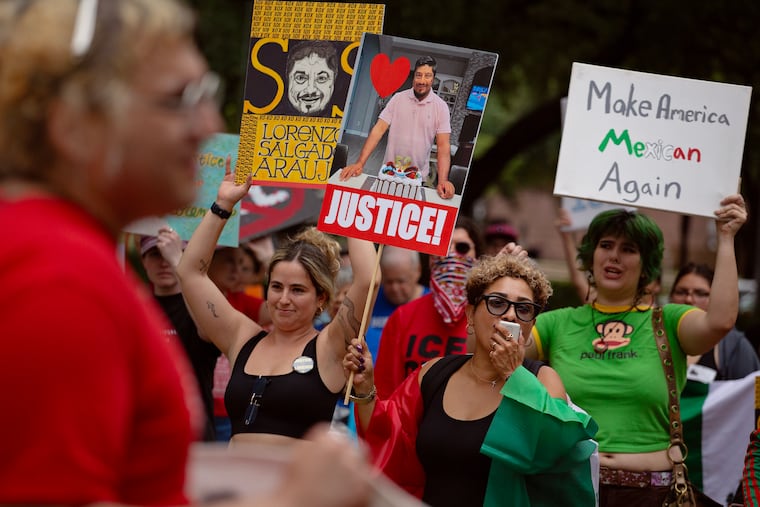
Those arrests were largely happening outside public view until last week, when an ICE officer shot and killed a 52-year-old Mexican man, Lorenzo Salgado Araujo, in Houston. Salgado had been driving to work, and DHS officials said he was not the target of the ICE operation. His family said he had lived in the United States as an undocumented immigrant for more than 35 years and had no criminal record. Surveillance footage has raised questions about DHS’s account of the events surrounding the shooting.
Less than a week later, a 25-year-old Colombian man, Johan Sebastián Durán Guerrero, was shot and killed by an ICE officer in Biddeford, Maine. He was also shot while driving, was the father of a young child and does not appear to have had a criminal record.
Mullin’s apparent predicament illustrates the competing incentives within the Trump administration over immigration enforcement ahead of the midterm elections in November that will determine whether Democrats win back control of Congress and establish a meaningful check on Trump’s power for his final two years.
Trump abruptly undercut Mullin on Wednesday by praising vehicle stops as one of ICE’s most important tools, and Trump’s far-right base revolted over Mullin’s leadership on enforcement, calling him weak and ineffective. After the policy was reversed, Mullin wrote on social media that there was no conflict between himself and the president.
“President Trump and I are on the same page,” he wrote. “We want our @ICEgov officers to have all options available to keep them safe while executing our mission of deporting as many illegal alien criminals from our country as possible.”
Some Republican allies and Trump political advisers are wary about the potential for a broader public backlash to the president’s immigration agenda in an election year. But the administration’s immigration hawks, including White House deputy chief of staff Stephen Miller, have continued to push for mass deportations to make good on the president’s campaign promise and appeal to his hard-line base.
“The president’s supporters reacted absolutely as they should have, and I think the president saw that,” said Mike Howell, president of the Oversight Project and a visiting fellow at the Heritage Foundation, in regards to Mullin’s pause on traffic stops. “Everyone is now seeing another example of the walk-back instinct of DHS leadership.”
ICE earlier this month had topped 2,000 arrests per day several times, a DHS official said, after setting that figure as a daily arrest target. The official spoke on the condition of anonymity to share internal information not authorized for release.
In June, ICE arrested and detained more than 39,500 individuals, topping the previous monthly high of 37,800 in December, according to the data reviewed by the Post. DHS is on pace to exceed that number in July.
The agency has added thousands of new officers, as well as surveillance technology and other resources, thanks to more than $170 billion in new immigration enforcement funding approved by congressional Republicans last year.
During his news conference in New York this month, Mullin called that funding “the most consequential bill — definitely of President Trump’s tenure and possibly in recent history.” He accused Democrats, including New York Mayor Zohran Mamdani, of being soft on crime and immigration enforcement, and said DHS “might have to flex a little bit more” to respond to the policies in places such as New York.
Yet Mullin’s pullback on the vehicle stops, which came after he spoke with Sens. Susan Collins (R) and Angus King (Ind.) of Maine, has left him open to criticism from immigration hawks inside and outside the administration.
One former DHS official suggested that Mullin made the policy change amid pressure from Collins, who is facing a difficult reelection campaign, without consulting the White House.
“A cabinet secretary just went 180 degrees from the policy of both Trump administrations,” said the former official, who spoke on the condition of anonymity to frankly discuss his former agency.
In an interview with Fox News on Tuesday, White House border czar Tom Homan said Mullin had made the decision to pause vehicle stops after consulting with ICE leadership.
“I’m confident that ICE is well trained in vehicle stops,” Homan said. “This is a temporary pause while they look at the incidents.”
Mullin has said little publicly about the shootings. When asked about the Houston incident in a brief phone interview with Atlanta News First, he expressed regret that ICE officers were not wearing body cameras and blamed a 76-day partial shutdown of DHS in the spring as Congress was deadlocked over a funding bill for slowing efforts to distribute more cameras.
Wednesday on X, Mullin reposted Trump’s message in support of ICE and added his own statement, saying DHS is focused on keeping officers safe and removing criminals.
“Illegal aliens will be arrested and deported wherever they are. If you are here illegally, LEAVE NOW,” Mullin wrote, adding that officers are facing a major increase in attacks by people using vehicles to threaten them. (In fact, federal prosecutors in several cases have dropped charges against people accused of assaulting officers in light of contradictory evidence.)
“We remind illegal aliens attempting to evade arrest is dangerous,” Mullin wrote.
A former ICE official said Mullin was chosen for the role because he would follow White House directives, and had predicted that Mullin would walk back the pause on vehicle stops or water it down if Trump demanded he do so.
“He’s not going to do anything counter to what the president wants,” the former official said, speaking on the condition of anonymity to offer a frank assessment of internal deliberations.
Immigrant rights advocates expressed skepticism that Mullin is committed to softening ICE’s image to restore broader public trust in the agency.
Nayna Gupta, policy director at the American Immigration Council, said the Trump administration “may have moved away from the more theatrical displays of force that characterized operations in places like Minneapolis and Chicago, but the basic objective has not changed: a fixation on increasing detentions and deportations simply for the sake of numbers.”
Gupta said that effort has accelerated as ICE has begun to spend the money from the congressional funding bill, and that it’s leading to more violence by federal officers.
Yet some business leaders who have worked with Mullin, who previously owned a large plumbing company in Oklahoma, say he has taken a measured approach to enforcement and been far more receptive than Noem to hearing their concerns over the impact of mass deportations on their companies, many of which rely on immigrant labor.
To the immigration hard-liners, any sign that Mullin is appeasing more moderate interests reads as a betrayal of the president and his voters.
“Secretary Mullin comes from the Senate, and when it comes to that body, there’s an overeagerness to please other people in that body,” said Howell, of the Heritage Foundation. “So when Senator Collins calls and asks him to do something, then he does it, and it looks bad.”