John Fetterman is the only Democrat to vote against curbing Trump’s power to order strikes in Iran
Both of Pennsylvania’s senators rejected the resolution that would have halted military force against Iran.
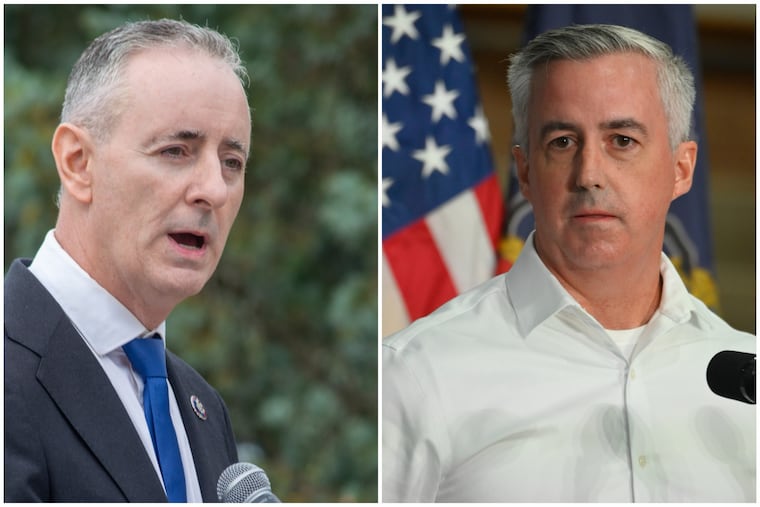
U.S. Sens. John Fetterman and Dave McCormick voted Wednesday against advancing a war powers resolution that would have barred President Donald Trump from ordering further strikes on Iran without congressional approval.
The vote came days after United States and Israel launched a missile attack on Iran, killing that nation’s supreme leader, Ayatollah Ali Khamenei. Six U.S. service members were killed in Iranian counterstrikes.
Fetterman, who applauded Trump’s comments about Iran during last week’s State of the Union, was the lone Democrat to vote against the measure, which would require the termination of U.S. military force against Iran.
Even before Trump ordered “Operation Epic Fury,” Democrats had pushed for a vote on a resolution to reassert congressional authority over military action.
But Fetterman has been at odds with the rest of his party, contending that military action is necessary to prevent Iran from developing nuclear weapons.
“Every member in the U.S. Senate agrees we cannot allow Iran to acquire a nuclear weapon. I’m baffled why so many are unwilling to support the only action to achieve that,” Fetterman said on X Monday. “Empty sloganeering vs. commitment to global security — which is it?"
The resolution, led by Sen. Tim Kaine (D., Va.), failed 47 to 53, falling short of the required 60-vote threshold to advance in the U.S. Senate. U.S Sen. Rand Paul (R., Ky) was the only Republican to support the measure.
The U.S. House will consider a similar measure on Thursday.
U.S. Sen. Andy Kim (D., N.J.) compared Trump’s decision to attack Iran to former President George W. Bush’s 2003 invasion of Iraq.
“We’ve seen this before. A president manufactures an imminent threat, chooses to start a war with unclear objectives and uses America’s resolve as an excuse for war without end because they’ve got no plan to end it,” Kim said in a Senate floor speech Tuesday in support of the resolution.
But Kim also noted a point of contrast. Bush had obtained authorization from Congress for military force, a step Trump didn’t even try to take, Kim noted.
“President Trump refused to make a case to the American people,” said Kim, who served on former President Barack Obama’s National Security Council.
Lawmakers’ attempts to rein in Trump comes as the U.S. is “accelerating, not decelerating” its military efforts, Defense Secretary Pete Hegseth told reporters in the Pentagon Wednesday, CBS News reported.
A 1973 law allows a single lawmaker to force a vote to withdraw troops or block military strikes, and it requires the president to obtain congressional authorization to commit the Armed Forces beyond 60 days.
Both of Pennsylvania’s senators have been strong supporters of Trump’s strikes, which followed failed negotiations.
McCormick (R., Pa.), an Army veteran and member of the Senate Foreign Relations Committee, said “the president has given the ayatollahs a chance for a deal, and they have rejected a path to peace and prosperity.”
During the first Trump administration, the president withdrew from an agreement Obama struck with Iran intended to prevent it from developing nuclear weapons in exchange for lifting sanctions.
U.S. Sen. Lisa Blunt Rochester (D., Del.), who voted to support the measure, said in a statement Wednesday that the Iranian government ”is a deadly one" and acknowledged the danger of the country’s nuclear capabilities.
“But after attending the Senate briefing on Iran, it was strikingly clear that there was no rational justification for military action and no imminent threat to the United States,” she said. “This administration has failed to define its goals, explain an exit strategy, or provide any long-term plan for what comes next.”
Her fellow Delaware Democrat, U.S. Sen. Chris Coons, also supported the resolution and this week called for Hegseth and Secretary of State Marco Rubio to appear before the national security committees to explain the lack of planning for the “protection and evacuation of Americans from their war of choice,” as U.S. citizens in the Middle East are scrambling to evacuate.
U.S. Sen. Cory Booker (D., N.J.) said on X Saturday that Congress cannot “simply roll over” and invoked the lessons from past conflicts in the Middle East.
“We should have learned from the last two decades of conflict in the Middle East that wars launched without clear goals and without an end-state in mind rarely end well,” he said. “They cost lives, destabilize regions, embolden adversaries, and weaken America’s moral standing.”