Stephen Miller’s hard-line Mexico strategy morphed into deadly boat strikes
The Trump administration originally planned to go after Mexican drug cartels, but pivoted to Venezuela.
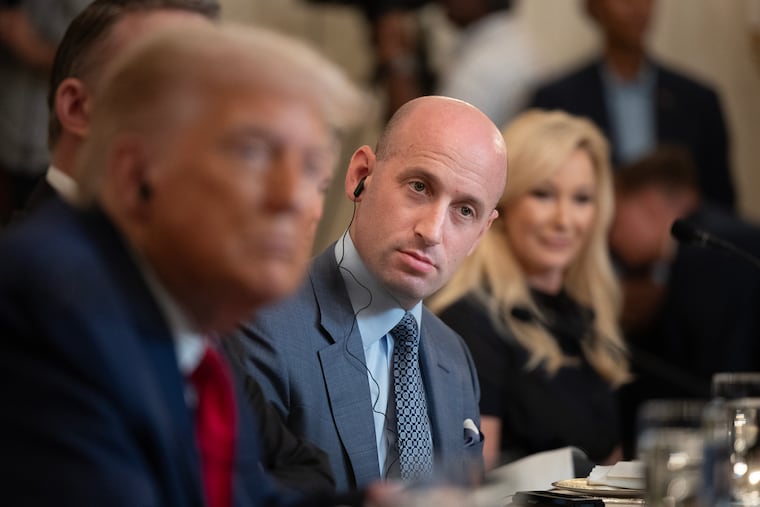
President Donald Trump’s homeland security adviser, Stephen Miller, and other senior officials were looking for a fight.
In the first months of the administration, Miller, the architect of Trump’s anti-immigration and border policies, and his team discussed starting a new war on drugs by striking cartels and alleged traffickers in Mexico, according to one current and two former U.S. officials.
Reducing the power of cartels, an idea that dated back to the first Trump administration, would ease the flow of migrants and narcotics, creating early political wins. But as the administration surged thousands of U.S. troops to the southern border, increased U.S. surveillance flights and boosted intelligence sharing with its neighbor, Mexican military operations across the border curbed cartel action, the people said. That left Miller and his team looking for another target.
“When you hope and wait for something to develop that doesn’t, you start looking at countries south of Mexico,” said the current official, who, like nine others interviewed for this story, spoke on the condition of anonymity because of the matter’s sensitivity.
The campaign that emerged in the Caribbean Sea and eastern Pacific Ocean is unprecedented in its use of lethal force by the U.S. military against alleged drug smuggling groups. These operations, which began Sept. 2, have evolved to embrace the Trump team’s long-running ambition to oust Venezuelan President Nicolás Maduro, whom the president has accused of overseeing “narco-terrorists” assaulting the United States.
Miller has been a driving force behind the administration’s counternarcotics campaign, pressing for results and fresh military options that could be turned into future operations, the current and former officials said.
“President Trump’s counternarcotics policies come from President Trump himself,” White House spokeswoman Anna Kelly said. “All senior administration officials work closely together to carry out the agenda President Trump was elected to implement, including eliminating the scourge of narco-terrorism that takes tens of thousands of American lives every year.”
Miller could not be reached for comment.
Miller steered the drafting of a July 25 classified directive signed by the president that authorized the military to undertake lethal force against two dozen foreign criminal groups, said a former U.S. official familiar with the campaign and its evolution. The administration has labeled these groups “designated terrorist organizations,” accusing them of using drugs as a weapon to kill Americans, using a moniker that many experts say has no basis in law.
“The president’s memo is the original sin of the whole operation,” the former official said.
That presidential directive provided the foundational authority for an “execute order” that Defense Secretary Pete Hegseth issued on Aug. 5 and that subsequently has been modified. The order, details of which were previously unreported, contains permissive targeting guidelines for lethal operations, current and former officials said. The presidential directive’s existence was first reported by the New York Times.
Together, these two documents guided a military campaign of lethal strikes against criminal organizations, grafting a wartime frame to what has been traditionally treated as a law enforcement problem. The execute order also contains targeting criteria lifted from the language of the counterterrorism campaign against al-Qaeda and the Islamic State, which some current and former officials say give the Pentagon an overly permissive license to kill.
The department will treat suspected drug smugglers “EXACTLY how we treated Al-Qaeda. We will continue to track them, map them, hunt them, and kill them,” Hegseth said on social media last month.
Pursuant to these orders, the Trump administration has launched strikes on at least 26 boats, killing at least 99 people in the Caribbean Sea and eastern Pacific Ocean. The Pentagon has not publicly identified those killed, and it is unclear whether it has collected the intelligence to do so.
“The administration appears to have authorized a campaign against civilians and alleged criminals that is now stretching the limits of international law so that it’s now totally unrecognizable,” said Todd Huntley, a former military lawyer who advised Special Operations forces for seven years at the height of the U.S. counterterrorism campaign and is director of the national security law program at Georgetown Law.
The White House’s early deliberations about the use of lethal force against cartels contemplated using covert action by the CIA. But as resistance emerged from lawyers and others over the ensuing months, Miller and his team turned increasingly toward the idea of using the military to pursue alleged traffickers.
Miller’s larger vision was to reduce the flow of drugs — and migrants — into the United States. He figured that attacking cartels would diminish their power and help stabilize Latin American countries, resulting in fewer people risking the trek to the United States, according to one of the former U.S. officials familiar with Miller’s deliberations.
As the summer progressed, the White House’s campaigns against narcotics and migration coalesced with a long-held desire of Secretary of State Marco Rubio to force Maduro from power. Rubio and the Justice Department in August doubled to $50 million the reward for information leading to the Venezuelan leader’s arrest, citing an indictment for corruption and drug trafficking during the first Trump administration.
Meanwhile, the White House found a willing partner in Hegseth, who had been knocked off stride by several missteps and was eager to show he could deliver on a high-priority mission.
“Pete very much wanted to keep Stephen in his good graces and also the president,” said the former official familiar with Miller’s thinking. “And that was a motivation for him — getting behind this campaign in an aggressive way.”
The Defense Department declined to address questions about its operations to strike alleged traffickers and how the mission took shape. Elements of Miller’s leading role were reported earlier by the Guardian.
“This reporting is inaccurate and is built on a false premise that ignores reality,” Pentagon chief spokesman Sean Parnell said in a statement. The department’s focus, he said, “is, and will continue to be, protecting the Homeland from any threat.”
Widening the scope
The Aug. 5 execute order, or EXORD in Pentagon parlance, stated that the campaign’s goal is to stop the flow of drugs by sea to the United States, two people said.
Initially, the order contained a geographic boundary that designated target areas in international waters off the coast of Venezuela, but it was modified about two months later to include the eastern Pacific area, one current and one former U.S. official said. It specified that at least for the initial strikes, Joint Special Operations Command would be in charge of operations, the two people said.
Over the late summer and into the fall, lawyers and policy personnel raised concerns about the legality of the lethal force campaign that was taking shape. Administration officials sought to reassure them by saying that a Justice Department Office of Legal Counsel memo was being drafted that determined that the lethal targeting of suspected drug runners was lawful under the president’s power to ascertain that the U.S. is in a formal state of war — in this case with alleged drug traffickers.
But the opinion was not signed until Sept. 5 — three days after the first boat strike — and some career lawyers were not permitted to read the draft OLC memo before the execute order was issued, said the former official familiar with the campaign’s evolution.
The OLC memo, signed by Assistant Attorney General T. Elliot Gaiser, asserts that alleged drug trafficking groups are a threat to the United States akin to a foreign nation attempting to invade, Sen. Mark Kelly (D., Ariz.), who was allowed to read it in his capacity as a member of the Senate Armed Services Committee, told the Post in an interview.
The execute order contains targeting instructions that do not require positive identification of any individual but rather “reasonable certainty” that adult males are members of, or affiliated with, a “designated terrorist organization,” or DTO, according to five current and former U.S. officials familiar with the criteria. To mitigate civilian harm, the order requires “near certainty” that no women, children or civilians are present, they said.
The administration is using the phrase “designated terrorist organizations” to refer to 24 alleged drug trafficking groups whose activities it contends are killing millions of Americans.
The term, said Rebecca Ingber, a professor at the Cardozo School of Law and a former State Department law-of-war expert, “is entirely manufactured as a source of targeting authority with no basis in law.”
The list of 24 such groups appears in an annex to Trump’s July directive and also in the EXORD, according to one current and one former official.
The assessment of “affiliation” is based on a number of factors, including the presence of drugs on board the vessel and its route, as well as intercepts of communications, the current and former officials said.
As a result, the campaign may be killing individuals who in some cases have a tenuous link to any organized drug-running operation, said one of the former U.S. officials, who has read the execute order.
“When you define DTO and affiliate so loosely and you’re attacking boats, [the guidelines are] basically meaningless,” the former official said.
If the United States were actually at war, the reasonable certainty standard would be “perfectly reasonable,” said Ryan Goodman, a former Pentagon special counsel who worked on counterterrorism targeting issues in the Obama administration.
“Not being in an armed conflict changes everything,” he said. “The idea that a government would kill people on the basis of ‘reasonable certainty’ that they’re a member of a drug cartel is beyond the pale. Any U.N. body would find that to be a gross violation of human rights.”
Identification and delegation
The targeting requirements, four former officials say, resemble the “signature strikes” of past global counterterrorism campaigns, in which the CIA and the military launched drone attacks in Afghanistan, Pakistan and Yemen on individuals or groups whose identities were unknown but who were targeted based on a pattern of behavior or other characteristics associated with terrorist activity.
The execute order, which sets the rules of engagement for the military, designates Hegseth as the “target engagement authority” — the official who can approve strike targets. It also stipulates that he can delegate that authority to others in individual missions.
“Now, the first couple of strikes … as any leader would want, you want to own that responsibility,” Hegseth said at a cabinet meeting this month in response to questions about the first boat strike, details of which — including a subsequent missile strike to kill survivors — were first published by the Post. “So I said I’m going to be the one to make the call after getting all the information and make sure it’s the right strike.”
Pentagon general counsel Earl Matthews — who had just been confirmed by the Senate on July 29 with a 50-47 vote — signed off on the Aug. 5 order, said a person familiar with the matter. Lawmakers have for weeks requested a copy of the order and related documents but have not received them. Matthews did not respond to a request for comment.
Trump has asserted, without offering proof, that the U.S. troops know who they are targeting in every case. “We know everything about them. We know where they live. We know where the bad ones live,” he told reporters this month.
The military knew the identities of all 11 people killed in the first attack of the campaign on Sept. 2, Pentagon officials have said. But “they don’t know all of the individuals on many of the other boats” in subsequent strikes, Sen. Mark R. Warner (D., Va.), vice chairman of the Senate Intelligence Committee, told ABC News on Sunday.
Trump posted on Truth Social the day of the first strike that the U.S. military had killed 11 “positively identified” members of the Venezuelan organization Tren de Aragua. He called them “narco-terrorists” operating “under the control of” Maduro, who has been condemned by both the Trump and Biden administrations for illegally retaining power after losing last year’s presidential election.
This week, the commander overseeing that operation, Adm. Frank M. Bradley, told lawmakers that the military knew one of the 11 was a member of Tren de Aragua and the other 10 were affiliates, according to three U.S. officials.
The U.S. intelligence community this year assessed that Tren de Aragua, a transnational crime syndicate, was not directed by Venezuela’s government.
Two family members of men killed on Sept. 2 did not deny that the boat was smuggling marijuana and cocaine. But they said Trump’s allegation the men had worked for Tren de Aragua was inaccurate.
“I knew them all,” one of the family members told the Post in October, speaking on the condition of anonymity for fear of retribution. “None of them had anything to do with Tren de Aragua. They were fishermen who were looking for a better life” by smuggling contraband.
In some of the strikes, the targets who have been identified are not high-level operators or cartel bosses, lawmakers said. “It’s one thing to be a narco-terrorist and another thing to be a fisherman that’s getting paid a hundred bucks a couple times a year … to supplement his income” to ferry drugs, Warner told reporters at the Defense Writers Group last week.
Lifting language from the ‘war on terror’
The Aug. 5 execute order adopts the language of previous administrations in successive global counterterrorism campaigns after 2001, but the context is vastly different, current and former officials say.
The fight against ISIS in Iraq from 2014 on generally involved clearing terrain of fighters who often barricaded themselves in buildings in cities teeming with civilians, and U.S. troops were often firing in self-defense at militants shooting at them, former Special Operations personnel said.
In the drug boat campaign, the U.S. military is launching munitions from afar, more like the counterterrorism operations in Yemen and Somalia during the Obama and first Trump administrations.
Under President Barack Obama, outside areas of active hostility, the targeting guidelines required that lethal force be used only when capture was not feasible and only to prevent attacks against U.S. citizens or when targets posed a continuing imminent threat. They required “near certainty” that a target was a member of a terrorist organization.
“Generally you had people swearing allegiance” to a group like al-Qaeda as an indicator of membership, said the former U.S. official, who is familiar with the counterterrorism targeting criteria. “So you had the presence of weapons and good intelligence on planning you could point to, to link people to the group and say this person is a planner of attacks, this is the money guy, this is a recruiter, etc.”
The standard was changed to “reasonable certainty” under the first Trump administration. But for all practical purposes, said a former senior military officer involved in special operations and battle in the Middle East, the military was applying the “near certainty” standard in these areas. The standard was returned to near certainty under Biden.
“In places like Yemen, whether it was under Obama or Trump,” the retired officer said, “we knew who we were going after. We knew what their place in the network was. We knew what the effects of removing them would be on the network. I don’t see that in some of what [the U.S. is] doing right now.”
One major contextual difference in the current operations against seaborne narcotics is the lack of congressional authority. In the battles against al-Qaeda and associated forces, Congress explicitly authorized the campaigns, giving the president permission to use “all necessary and appropriate force” against those who attacked the United States on Sept. 11, 2001.
The execute order and subsequent targeting guidelines were grounded in the 2001 congressional authorization to use military force.
In 2013, during the Obama administration, the “near certainty” standard typically required confirmation via two sources of intelligence, said Huntley, the former military lawyer for Special Operations forces.
A combination of intelligence tools — signals intelligence, eavesdropping, human spies, and drone surveillance — would contribute to a “positive identification of the individual,” Huntley said. To get to “near certainty” that civilians were not present, the attack location was usually a remote area or a place known to be frequented by only members of the terrorist organization that Congress had specifically authorized as a viable target.
If U.S. officials know the identities of who they are striking, as Trump and Hegseth maintain, then they should release them, the former senior military officer said. “It would help build the case,” he said, that the military is acting to protect civilians according to the law of war.
‘Anybody … is subject to attack’
Though the administration’s charges against Maduro have merit, its claims that Venezuela is sending massive amounts of drugs to America do not, analysts and officials have said. The main domestic drug scourge is fentanyl, a synthetic opioid produced in Mexico, not Venezuela.
Many strikes taken have been in the Pacific, the main sea lane used by traffickers from Colombia and Ecuador. Drug running in the Caribbean focuses mainly on non-U.S. markets, such as Europe. The lethal strike on Sept. 2, for instance, targeted a boat carrying cocaine ultimately bound for Suriname, officials have said.
That absence of information has prompted speculation that the larger buildup of U.S. forces in the region is a preparation for an attack on Venezuela. Miller has indicated to colleagues that a strong reaction from Caracas could provide the reasoning to invoke the Alien Enemies Act to quickly deport hundreds of thousands of Venezuelan immigrants from the United States, the former official noted.
This month, Trump suggested that he wanted to go after Colombian targets. “I hear the country of Colombia is making cocaine,” he said. “They have cocaine manufacturing plants. And then they sell us their cocaine. … Anybody that’s doing that and selling it into our country is subject to attack.”
He also has stepped up the pressure on Venezuela, seizing an oil tanker last week off that country’s coast.
“He wants to keep on blowing boats up until Maduro cries uncle,” Trump’s chief of staff, Susan Wiles, told Vanity Fair in an article published this week. “And people way smarter than me on that say that he will.”
On Tuesday, Trump announced in a social media post a “total and complete blockade” of all sanctioned oil tankers entering or leaving Venezuela, further ratcheting up the pressure.
On Wednesday, Miller amplified Trump’s post, commenting: “American sweat, ingenuity and toil created the oil industry in Venezuela. Its tyrannical expropriation was the largest recorded theft of American wealth and property. These pillaged assets were then used to fund terrorism and flood our streets with killers, mercenaries and drugs.”
Trump, meanwhile, has been signaling that the campaign is widening.
“We knocked out 96 percent of the drugs coming in by water,” he told reporters Friday in the Oval Office. “And now we’re starting by land, and by land is a lot easier, and that’s going to start happening.”