Supreme Court seems skeptical of Hawaii limits on carrying guns
The case before the justices could have a major impact on laws in California, New York, and elsewhere.
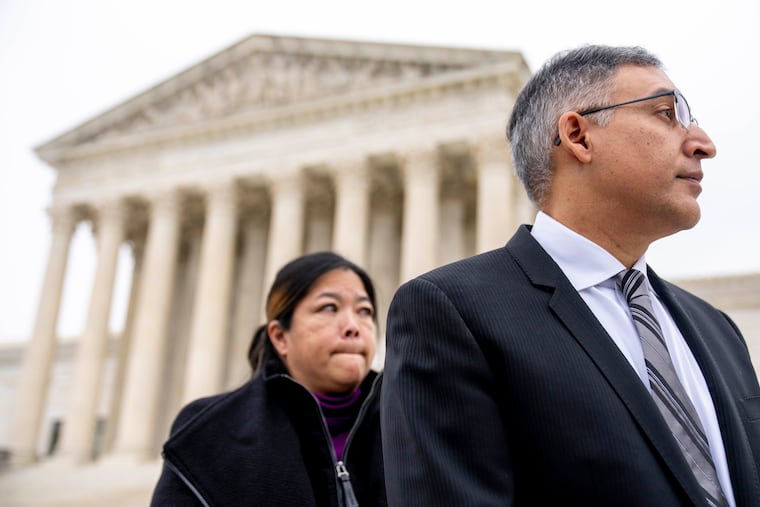
The Supreme Court on Tuesday appeared skeptical of the constitutionality of a Hawaii law that sharply restricts where people can carry firearms — a case that may offer a strong indication of how far the justices will go in their push to loosen restrictions on guns.
Hawaii’s law bans people from carrying firearms on private property open to the public unless they have the owner’s consent. The court’s conservatives sharply questioned an attorney defending Hawaii’s law, suggesting it unduly burdened a constitutional right to bear arms.
The decision will reverberate beyond Hawaii because four other states, including California and New York, have enacted similar laws in response to a landmark 2022 ruling by the high court that made it easier to challenge gun limits.
The default rule in most states is that gun owners can carry firearms onto private property open to the public until they have been told otherwise. The Hawaii law flipped the rule. Property owners generally have the right to restrict guns on land closed to the public.
“You are relegating the Second Amendment to second-class status,” Justice Samuel A. Alito Jr. told Neal Katyal, an attorney for Hawaii.
Chief Justice John G. Roberts Jr. said the First Amendment permitted a political candidate to walk up to someone’s door to campaign, and he questioned why Hawaii could place limits on another constitutional right in the same context. He said gun rights are often disfavored.
“You say it’s different for the Second Amendment,” Roberts said to Katyal. “What exactly is the distinction?”
The court’s three liberal justices all indicated they thought Hawaii’s law probably passed constitutional muster. Justice Sonia Sotomayor pointed out that Hawaii had long had some of the nation’s strictest gun-control laws and cited polling that indicates the restriction on public carry is popular.
“Nothing about Hawaii’s customs, tradition or culture creates an expectation that the general public carries guns wherever they go, correct?” Sotomayor said.
A trio of gun owners with concealed-carry permits and a gun rights group challenged the Hawaii law, which was enacted in 2023. The Trump administration is backing the gun owners.
The law also bans the carrying of firearms in 15 sensitive locations, including bars, parks, restaurants that serve alcohol and youth centers. The legality of those restrictions is not at issue in the Supreme Court case.
The petitioners argue Hawaii’s law violates the Supreme Court’s 2022 decision inNew York State Rifle & Pistol Assoc. v. Bruen,which found that “the Second Amendment guarantees a general right to public carry.”
That ruling held that any restriction on firearms must have precedent rooted in American history. The decision has sparked thousands of challenges to gun-control laws across the country, resulting in rulings that have relaxed restrictions on high-capacity magazines, age limits for firearms purchases and other rules. The decision has also created some confusion among judges about how to conduct the historical analysis.
The Supreme Court clarified the Bruen decision last term in a case in which it held that states could bar people with domestic violence restraining orders from obtaining guns. The court found modern gun restrictions need not have a “historical twin” but rather a “historical analogue.”
Justice Brett M. Kavanaugh questioned whether Hawaii’s law was based on precedents deeply rooted in American history. “There’s no sufficient history,” he said. “Case closed.”
The court has largely expanded gun rights since the Bruen ruling, but not in all cases. In one ruling, the justices struck down a federal ban on bump stocks, devices that allow semiautomatic rifles to fire hundreds of rounds a minute. In a major case last term, the justices upheld Biden-era restrictions on ghost guns.
In Hawaii’s case,a federal judge issued a preliminary injunction blocking the statelaw in 2023, but a panel of the U.S. Court of Appeals for the Ninth Circuit sided with the state last year. The appeals court cited historical laws from New Jersey and Louisiana that were “dead ringers” for Hawaii’s statute as it upheld the state law.
The ruling created a split among appeals courts because a Second Circuit panel struck down a similar New York law.
Alan A. Beck, an attorney for the gun owners and the Hawaii Firearms Coalition, said the Ninth Circuit ruling illegally constrains their rights since Hawaii’s law essentially outlaws public carry in much of the state. He also said the historical precedents that the appeals court relied on were outliers that should be discounted.
“There’s a clear body of evidence this law was passed to undermine Bruen and the Second Amendment," Beck said.
Katyal countered that the state’s law had precedent in anti-poaching laws and — controversially during arguments — a Louisiana “Black Code” statute aimed at preventing African Americans from possessing firearms.
“There is no constitutional right that every invitation to enter property is a right to bear arms,” Katyal said.
The case is not the only Second Amendment challenge the justices will hear this term.
The court will also decide the constitutionality of a federal law that bans habitual drug users from possessing firearms. Hunter Biden, the son of former President Joe Biden, was convicted of violating the law in 2024. Biden later pardoned him.
The Trump administration, which usually supports gun rights, urged the high court to uphold that ban.
“By disqualifying only habitual users of illegal drugs from possessing firearms, the statute imposes a limited, inherently temporary restriction — one which the individual can remove at any time simply by ceasing his unlawful drug use,” Solicitor General D. John Sauer wrote in a friend-of-the-court brief