Transgender troops will be removed from the U.S. military, the Pentagon says
The memo was made public Wednesday as part of a lawsuit filed by LGBTQ+ rights groups against an executive order signed last month by President Donald Trump.
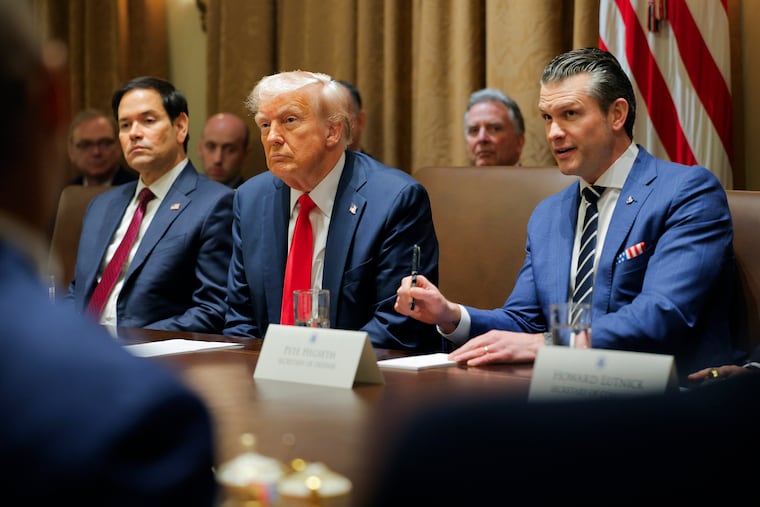
Openly transgender service members will be disqualified from serving in the U.S. military and will soon be removed from the ranks, according to a Pentagon memo that marks a significant shift from previous Defense Department policy that prohibited discrimination based on gender identity.
The memo was made public Wednesday as part of a lawsuit filed by LGBTQ+ rights groups against an executive order signed last month by President Donald Trump, which stated that the “medical, surgical, and mental health constraints on individuals with gender dysphoria” were “inconsistent” with the high standards expected of U.S. troops.
An earlier memo from Defense Secretary Pete Hegseth had said that people with a history of gender dysphoria would no longer be able to join the military, but that they would be “treated with dignity and respect.” The new memo goes a step further in stating that current service members will be removed if they have gender dysphoria or a history of it.
The memo states that exceptions could be made for transgender service members who directly support “warfighting capabilities” if the government feels it has a “compelling” reason to retain them.
» READ MORE: ‘Fear and anxiety:’ What Trump’s ban on federal support for gender-affirming care means for Philly transgender teens
Rights group have decried the push to ban transgender troops and say transgender people have served in the military with distinction for years without issue.
SPARTA Pride, a rights group for transgender troops, said thousands of transgender people are serving in the military and are “fully qualified” for their positions. “No policy will ever erase transgender Americans’ contribution to history, warfighting, or military excellence,” the group said in a statement. “Transgender service members have a unique fighting spirit and will continue to defend the constitution and American Values no matter what lies ahead.”
The Defense Department did not immediately respond to a request for comment from The Washington Post early Thursday.
» READ MORE: LGBTQ Philadelphians sped up gender-affirming care and sought out legal advice before Trump took office
The memo states that service members who are diagnosed with, have a history of, or exhibit symptoms consistent with gender dysphoria - a condition that involves feelings of psychological or physical discomfort tied to one’s gender identity - are disqualified from military service. Also disqualified are service members who have been treated for gender dysphoria with hormones or surgery.
The memo directs the secretaries of each branch to identify service members with gender dysphoria within 30 days and to “begin separation actions” within 30 days after that.
The affected service members will be honorably discharged as long as they meet normal conditions and qualify for involuntary separation pay, the memo states. If they voluntarily step down, they will be eligible to be paid twice as much under voluntary separation pay, it said.
The memo also states that the military will no longer pay for any treatments or surgery relating to service members’ gender dysphoria.
» READ MORE: Philly schools will continue to allow transgender athletes to participate in sports that match their gender identity
Even if a transgender service member obtains a waiver to stay in the military, they will face restrictions, the memo says. They cannot access "intimate spaces," including changing rooms, bathrooms and showers, reserved for members of the gender they transitioned to. They will also have to meet the same physical standards as those of the sex they were assigned at birth and their military records will be updated to reflect their assigned sex at birth.
It’s not clear how many transgender people serve in the U.S. military, but upper estimates by advocates for transgender people place the number at 15,000 - less than 1 percent of total active-duty, reserve or National Guard personnel.
Openly transgender people have been allowed to serve in the military since 2016, when the Obama administration repealed a ban on transgender service, citing the value of ensuring that all qualified individuals were able to serve their country in uniform. Previously, the military considered transgender people to be unfit for service.
Obama had also, in 2011, repealed “don’t ask, don’t tell,” a policy that prohibited gay service members from serving openly, and opened more combat roles to women in 2015. In 2016, Rand published a study that found that those changes in long-standing policy “had no significant effect on unit cohesion, operational effectiveness, or readiness,” and concluded that there was a “minimal likely impact on force readiness” from allowing openly transgender people to serve too.
In subsequent years, military leaders reported no significant harm from allowing openly transgender people to serve. In a hearing of the Senate Armed Services Committee in 2018, Army Chief of Staff Gen. Mark A. Milley told Sen. Kirsten Gillibrand (D-New York) that he had “received precisely zero reports of issues of cohesion, discipline, morale” caused by integrating transgender service members.
During Trump’s first term, the Defense Department effectively prohibited transgender people from joining the military but allowed those already in uniform to stay on. The policy was challenged in court, but the Supreme Court upheld Trump’s partial ban in 2019. The military began enforcing that policy later that year.
President Joe Biden quickly reversed Trump’s ban in an executive order after taking office in 2021.
Wednesday’s memo, which goes further than the policy implemented under Trump’s first term, was released as part of a lawsuit filed by GLBTQ Legal Advocates & Defenders and the National Center for Lesbian Rights on behalf of six transgender service members and two individuals seeking to enlist in the military. The suit alleges that Trump’s ban on transgender service members violates the equal protection clause of the Constitution.
The U.S. District Court for the District of Columbia is considering a motion to block enforcement of the ban until the outcome of the lawsuit is determined. The next hearing is scheduled for next month.