In Trump’s second term, fewer seats for women at the table
There also has been a historic amount of turnover among women in Trump’s Cabinet.
Nearly 10 years after their first bilateral meeting inside Beijing’s Great Hall of the People, President Donald Trump and Chinese President Xi Jinping again gathered last month for discussions about U.S.-China relations.
Much had changed over the preceding decade. Wars had broken out in Europe and the Middle East, shifting global alliances; the coronavirus pandemic had killed millions around the world and transformed the global economy; and at the table in Beijing, the makeup of aides and advisers sitting alongside each leader for the high-level talks was visibly different.
Images from Trump’s meeting with Xi in 2017 show Trump sitting alongside a large group of senior U.S. officials, including three women. Xi’s staff at the table also included a woman.
During their most recent meeting inside the same room in May, every U.S. and Chinese official at the table was a man.
The all-male delegation exemplifies a broader trend within the Trump administration’s hiring practices for senior executive branch roles that require Senate approval. Data reviewed by the Washington Post shows that Trump has selected fewer women to serve in these senior roles than during the same period of his first term. There also has been a historic amount of turnover among women in Trump’s cabinet.
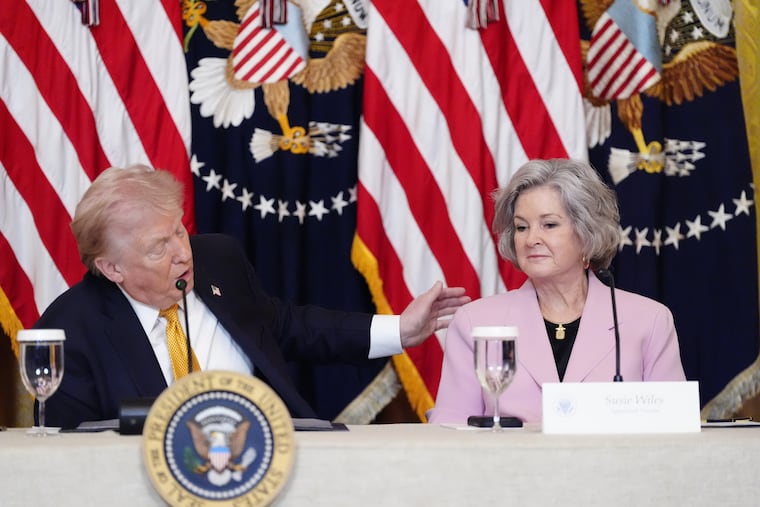
The Trump White House has expressed pride in the fact that some key senior staff have been the first women to hold certain titles, including Susie Wiles as chief of staff, and defended the president’s hiring choices in a statement to the Post.
“President Trump has assembled the greatest Administration in history, selecting each member of his incredible team based on one criterion: their ability to deliver for the American people,” Taylor Rogers, a White House spokesperson, said in a statement. “Unlike the identity-politics-obsessed Democrats, the President judges individuals on merit and qualifications, not immutable characteristics.”
Lower rate of female political appointees
According to the Partnership for Public Service, a nonprofit that says it aims to build a better government and a stronger democracy, Trump’s Senate-confirmed appointees are made up of the smallest percentage of women of any administration since George W. Bush.
A PPS political appointee tracker, launched with the Post in 2016, monitors appointments to roughly 800 executive branch positions, a portion of more than 1,300 positions that require Senate confirmation. It includes all full-time, civilian positions in the executive branch that require Senate confirmation except for judges, marshals, and U.S. attorneys. (Military appointments and part-time positions requiring Senate confirmation are not included.)
When excluding ambassadors and holdovers from previous administrations, PPS data show that so far in this administration, about a year and four months in, 14.53% of all nominees or Senate-confirmed political appointees — 51 out of 351 total roles — are women.
At this point in President Joe Biden’s term, women had been nominated for 199 out of 379 roles, comprising 52.5% of appointees. And at this point in Trump’s first term, women had been nominated or announced for 41 of 173 of those roles, comprising 23.7% of appointees.
Heather Higgins, CEO of the conservative nonprofit Independent Women’s Voice, told the Post that “the confirmation gantlet falls hardest on conservative women who can expect their families, faith, and reputations to be put through the wood chipper.”
“Plenty of enormously talented women make the entirely rational choice to serve the country some other way,” she added. “That’s not a deficit of ambition but a market signal that women don’t necessarily see politics as the only or best lane for influence. And looking at the life of those in those roles, which is no picnic, I’d say that that’s a testament to the groundedness and judgment of women on the right.”
But Max Stier, the president and CEO of the Partnership for Public Service, expressed concerns about the trend.
“The evidence is clear that drawing on people with different backgrounds creates a higher-performing organization,” Stier said in a statement. “At the end of the day, our government needs leadership that reflects the diversity of the American people in order to understand and best serve them.”
Turnover in Trump’s cabinet
The first female cabinet member was Frances Perkins, who served as secretary of labor from 1933 through 1945. But it wasn’t until the 1970s under President Jimmy Carter that more than one woman was part of the president’s cabinet at the same time.
Trump selected nine women to serve in his cabinet or in cabinet-level positions at the start of his second term. One of those cabinet-rank members, White House chief of staff Susie Wiles, does not require Senate confirmation. Another pick, Elise Stefanik, withdrew her nomination as U.S. ambassador to the United Nations.
Among Trump’s presidential predecessors, only Biden successfully nominated more women to serve in his cabinet toward the start of his presidency.
But nearly a year and a half into Trump’s second term, every departure from his cabinet has been a woman. And more female cabinet and cabinet-level officials have left their positions during this term than at this point in any previous presidential administration, according to an internal count by the Post based on a list of female cabinet members through U.S. history collected by the Rutgers University Center for American Women and Politics.
Most recently, Tulsi Gabbard announced last month that she would step down as the director of National Intelligence effective June 30. Along with Gabbard, Attorney General Pam Bondi, Labor Secretary Lori Chavez-DeRemer, and Homeland Security Secretary Kristi L. Noem all have left the cabinet. A man was chosen to replace each of them.
Fewer Republican women running for federal office
The start of Trump’s second presidency also marked the first Congress since 2011 in which the number of women serving in the House and Senate declined, due to a decline in Republican women. While Democrats set a record by sending 110 female lawmakers to the House and Senate at the start of 2025, Republicans elected 40, according to data from CAWP. The number of Republican women in the House and Senate hit record or near-record levels after the 2022 midterm elections.
There’s also been a decline in Republican women running for federal office, according to data from the Center for American Women and Politics at Rutgers. Republican women as a percentage of Senate and House candidates reached their peak in 2022.
A record-setting 38 women filed as Republican Senate candidates in 2022. The number of candidates dropped to 21 in 2024 and has risen slightly to 27 candidates filing to run in 2026.
Similarly, the number of Republican women registering to run for House seats hit a peak in 2022 with 261. That number dropped to 166 in 2024. So far in 2026, the number of female Republican candidates filing to run for House seats has declined further to 155 candidates.
“Republican women are underrepresented across the board, across states, even when we look at them as a percentage of their own caucus in highly Republican states,” said Kelly Dittmar, director of research and CAWP scholar at Rutgers. “This change in a Republican administration is consistent with what we have seen before: When Republicans are in office, when they hold a state legislature, the majority party — we know that almost always there are going to be fewer women.”
Public polling suggests that waning female representation in Washington may not be seen as much of a problem for many Republicans.
A 2023 Pew Research study found that 5% of Republicans and Republican leaners say it is extremely or very important to them that the U.S. elects a woman as president in their lifetime. Among Democrats, 31% said it was extremely or very important. Republican women were also about twice as likely as Republican men to say there are too few women in high political offices in the country.
“It’s odd to assume that women are succeeding only if they’re found in government rosters. That’s a surprisingly narrow definition of success,” Higgins, the Independent Women’s Voice CEO, said. “One of the lessons of the last several decades is that women don’t all want the same things, don’t make the same choices, and shouldn’t be expected to. Equality means respecting those choices, not treating every statistical difference as evidence that something has gone wrong.”