Trump’s $1.8 billion fund may be dead, but there are still paths to payouts
Even with the plans for the fund now scrapped, the Justice Department could still strike deals on any claims it deems to be valid without congressional approval.
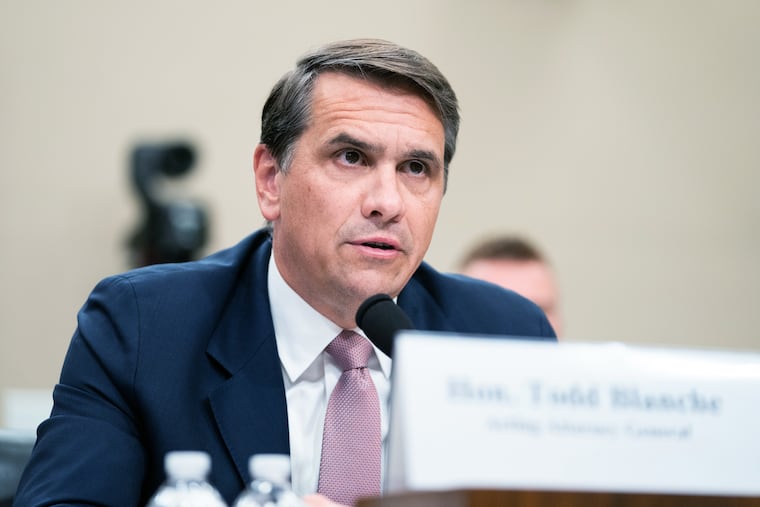
Acting Attorney General Todd Blanche sought to quell bipartisan backlash by assuring lawmakers Tuesday that the Trump administration’s plan to create a nearly $1.8 billion fund to compensate those who claim they were targeted by politicized investigations was officially dead.
But his pledge left several questions unanswered and might not permanently close the door on Justice Department efforts to award payouts to supporters of President Donald Trump who say they were victims of a weaponized justice system.
“We are not moving forward with the fund, period,” Blanche told members of a House Appropriations subcommittee, referring to the idea that was laid out in an agreement the Justice Department struck last month with Trump’s personal lawyers to resolve several legal claims the president filed against the government in his personal capacity.
However, Blanche declined requests from Democrats to put that in writing, which — along with a statement from another Justice Department official — stoked further confusion about the agency’s plans.
In a post to social media, Sen. Lindsey Graham (R., S.C.) proposed that Congress create its own version of an “anti-weaponization” fund.
Stanley Woodward, the Justice Department’s No. 3 official and one of the signatories to Trump’s settlement deal, appeared to endorse the idea. He shared Graham’s post with the message “We’re on it” — only to delete that hours later. The Justice Department did not immediately respond to requests for comment to clarify Woodward’s remark.
Here’s a look at some of the key questions that remain:
Could Trump allies seeking compensation still get paid?
Even before the proposed $1.8 billion fund, mechanisms existed for the Justice Department to financially compensate people who claimed they were victims of politicized prosecutions under previous administrations.
And department officials already have signed off on deals awarding significant sums to Trump allies. Those include his 2016 campaign adviser Carter Page, his former national security adviser Michael Flynn, and the family of Ashli Babbitt, the Trump supporter from California who was fatally shot by police during the Jan. 6, 2021, attack on the U.S. Capitol.
Under federal law, those seeking to file legal claims against the government must first submit a request under the Federal Tort Claims Act. That statute allows the Justice Department to investigate their request and decide whether to offer a settlement before any lawsuit is filed.
Hundreds of defendants charged or convicted as part of the investigation into the Jan. 6 riot had already filed such claims before the $1.8 billion fund was announced, though several attorneys leading those efforts have said the government has not yet responded to their requests.
Any deals reached through that process or through litigation filed in court are paid out from the government’s Judgment Fund, an uncapped pool of money Congress has appropriated to cover settlements involving federal agencies.
The fund proposed by Trump’s legal settlement would have drawn its $1.8 billion from that pot of money and granted a five-member commission, largely appointed by the attorney general, the authority to dole out awards to those with claims it deemed worthy.
But even with the plans for that fund now scrapped, the Justice Department could still strike deals on any claims it deems to be valid without congressional approval.
Peter Ticktin, an attorney who represents hundreds of Jan. 6 defendants, said he plans to continue to file claims for damages now that the Trump administration appears to have scrapped its plans for a dedicated fund.
“If there’s no such fund at all, the government needs to settle these lawsuits,” he said.
Will Blanche’s backtracking satisfy lawmakers?
The death of the proposed fund came after days of pushback from Senate Republicans who objected to the idea that a dedicated pot of taxpayer money could reward those involved in the Jan. 6 attack, including defendants who previously had been convicted of assaulting police officers that day.
Senate Majority Leader John Thune (R., S.D.) said Wednesday that most members of the GOP caucus appeared to have been satisfied by Blanche’s backtracking Tuesday.
But the debate over settlements that could benefit Jan. 6 defendants may not be over.
Some Republicans, including Sen. Thom Tillis of North Carolina and Sen. Bill Cassidy of Louisiana, said Wednesday that Blanche’s assurances that the fund had been scuttled were not enough. They called for legislation that would permanently block the proposal.
“The way to ensure the Trump retribution fund is more than mostly dead would be for Congress to put a stake through it,” Sen. John Cornyn (R., Texas) said in a post to X.
Others, including top Democrats, have floated the idea of bills to permanently restrict payouts to Jan. 6 participants or impose limits on settlement amounts that the Justice Department can independently authorize through the Judgment Fund.
“To anyone who takes the constantly lying Todd Blanche at his word — I have a bridge to sell you,” Senate Minority Leader Chuck Schumer (D., N.Y.) said on the Senate floor Wednesday.
Graham, in his social media post Tuesday evening, suggested that Congress establish its own fund to compensate those who claim they were unfairly targeted.
“There are many victims of the weaponized Biden Justice Department throughout this country,” Graham wrote on X, adding: “I am proposing that we create a weaponization fund that will be available to those who can prove their claim against the federal government through the Federal Tort Claims Act.”
It was not clear how Graham’s proposal would differ from the process that already exists, and a spokesperson for the senator did not respond to requests for comment.
What about the part of the settlement that offered Trump protection from IRS audits?
The deal to settle Trump’s legal claims included another controversial element that “forever barred and precluded” the government from pursuing unpaid tax claims against Trump, members of his family, or his businesses that arose before the settlement being reached.
Blanche told lawmakers Tuesday that despite the plans to scuttle the $1.8 billion fund, the Justice Department still intended to stand by the protections extended to Trump under that provision of the agreement.
Though Blanche defended that stipulation as a typical element of any legal settlement involving the IRS, critics have derided it as a deal that could spare the president and his family from millions of dollars in tax liability.
During a hearing Wednesday, Democrats and some Republicans on the Senate Finance Committee pressed Treasury Secretary Scott Bessent on the agreement to drop existing inquiries into the president, his family, and his businesses’ taxes.
Bessent repeatedly declined to provide additional details — including about whether he reviewed a defense memo from the IRS counsel and who came up with the idea for the audit agreement — citing ongoing litigation.
The audit agreement, said Sen. Ron Wyden (D., Ore.), the top Democrat on the committee, is “the part that presents the biggest direct benefit to Trump.”
“It was just a matter of time before the Trump administration set the new high-water mark for public corruption,” he said.
What happens to lawsuits challenging Trump’s settlement?
The federal judge in Florida who was overseeing one of the claims that precipitated Trump’s settlement — his suit against the IRS over the leak of his tax returns by a former agency contractor — has since launched an inquiry into how the deal was reached.
In a written order last week, she suggested an interest in discerning whether it was the result of a “fraud on the court.”
U.S. District Judge Kathleen Williams had raised questions before the announcement of the agreement last month about whether Trump’s lawsuit could proceed given that he effectively controlled both parties in the case — the personal attorneys arguing on his behalf and the government lawyers for the IRS, who ultimately report to him as the president.
The parties’ decision to strike a private deal outside court came just days before deadlines Williams had set for further briefing on that question.
Since then, Williams, an appointee of President Barack Obama, has said she is considering reopening the case, acting on a motion filed by 35 former federal judges who have urged her to do so. The former judges described Trump’s case as a “frivolous lawsuit for the sole purpose of forcing a settlement” and accused Trump and government lawyers of involving the court to give their dealmaking the sheen of legality.
It is unclear whether Williams has the authority to issue any order that could attempt to void the agreement, including the provision protecting Trump and his family from audits. But she ordered Justice Department attorneys to respond to the allegations of fraud by June 12.
The settlement deal has also been challenged in five federal lawsuits in D.C., Virginia, and California, all of them focused on the legality of the $1.8 billion compensation fund.
One of those suits — filed by a former Jan. 6 prosecutor, who was fired last year, as well as several critics of the Trump administration — led a federal judge in Virginia last week to order a temporary pause on any actions relating to the fund until at least June 12, when she is scheduled to hold a hearing on whether to extend her order.
A federal judge in D.C., Richard J. Leon, has scheduled a hearing for next Wednesday in a case filed by the group Citizens for Responsibility and Ethics in Washington on whether to issue a temporary restraining order against the fund.
For the moment, those hearings are still on the court calendars. And none of the groups suing over the fund have signaled they will drop their lawsuits in light of Blanche’s comments about the death of the fund this week.
After Blanche’s comments at the House hearing Tuesday, attorneys from Democracy Forward, the group that obtained the temporary court order in Virginia blocking the fund, asked him in a letter to clarify what he meant.
“If you can say it on TV, you should say it in court,” Skye Perryman, the organization’s president, said in a statement.