Supreme Court decision could deliver GOP a host of House seats in 2028
The Supreme Court’s decision limiting the Voting Rights Act inflames an already raging partisan war over congressional districts and is expected to lead to a House with far fewer Black members.
The Supreme Court’s decision limiting the Voting Rights Act inflames an already raging partisan war over congressional districts and is expected to lead to a House with far fewer Black members.
Republicans could use Wednesday’s ruling to capture a few more seats in this fall’s midterm elections but do not have enough time to immediately take full advantage of it. For the 2028 elections, they could capitalize on the decision to give themselves a dozen or so seats.
“We’ve been dealt a bad hand,” said Rep. Sanford D. Bishop Jr. (D-Georgia), who represents a district with a large Black population that the Supreme Court’s decision could put at risk of being withdrawn. “We’ve got to play the hand we’re dealt.”
The 6-3 ruling tightly limited the use of race to draw congressional districts, giving Republicans an opportunity to break up Black and Hispanic majority districts for partisan gain. Its effects will likely be seismic, and could alter the makeup of Congress in a way that hasn’t been seen since the period after the Civil War, said Harvard law professor Nicholas Stephanopoulos.
“We’re very likely to see the biggest drop in minority representation of the modern era — maybe even bigger than the drop we saw in the end of Reconstruction,” he said.
The decision scaled back a central provision of the Voting Rights Act meant to ensure minority communities can elect candidates of their choice. The act, passed in 1965 and strengthened in 1982, greatly expanded the number of Black and Latino officials in local, state and federal positions. The House and Senate included 66 Black members at the start of this term, making it the most racially diverse Congress on record, according to the Pew Research Center.
While Democrats decried the ruling, conservatives praised it, saying it would ensure fairness by preventing officials from considering race when they draw political lines. “The Supreme Court today returned the Voting Rights Act to its original intent, which was to protect against intentional racial discrimination,” James Blair, who heads President Donald Trump’s political operation, wrote on social media.
The ruling comes amid an unusual, wide-ranging battle among states to draw congressional lines to maximize partisan advantage.
States ordinarily draw new districts once every 10 years, at the beginning of each decade when they receive data from the U.S. Census Bureau showing how populations have shifted. Last year, Trump blew up that approach and pressed Republican-led states to draw new lines in their favor ahead of the midterm elections. Democrats responded in kind.
That battle has put Republicans on track to claim as many as 13 more districts across five states — including four seats approved Wednesday in Florida. Democrats have countered some of those projected gains with as many as 10 seats across three states.
Wednesday’s decision will give Republicans even more of an advantage.
The Supreme Court case stems from Louisiana, and Trump suggested the state should redraw its districts before early voting begins on Saturday for the May 16 primaries. Louisiana Gov. Jeff Landry (R) praised the ruling in a social media post but did not say publicly what he would do. The Washington Post reported Wednesday night that he told candidates he planned to suspend the House primaries so new districts could be drawn.
“I would hope that legislatures across the country don’t take this opinion and run to redraw lines,” said Rep. Cleo Fields (D-Louisiana), who won a Black-majority district in 2024 that was created because of a lower-court ruling in related litigation.
He and other Democrats called for the passage of the John Lewis Voting Rights Advancement Act, which would ban partisan gerrymandering and provide more protections for minority representation. The House passed the measure in 2021, when Democrats held the majority, but proponents failed to get enough votes in the Senate to weaken the filibuster and approve it.
“Minority voters not only in Louisiana but across the nation — particularly in the southern part of our country — they are in my view left without real protections from the Voting Rights Act,” Fields said. “Basically, there is no Voting Rights Act.”
Sen. Marsha Blackburn (R-Tennessee), who is running for governor, urged Republicans in her state to give themselves another district there. “I’ve vowed to keep Tennessee a red state, and as Governor, I’ll do everything I can to make this map a reality,” she posted on X.
A spokesperson for outgoing Tennessee Gov. Bill Lee (R) did not say whether he wanted to put in place new districts ahead of the state’s August primaries.
Around the country, Republicans have few opportunities to draw new maps immediately because of state election calendars. Early voting is underway in Georgia’s primaries, so changing the lines for those districts would be exceedingly difficult.
Two leading Republicans running for governor in Georgia — business owner Rick Jackson and Lt. Gov. Burt Jones — called for redrawing the state’s districts. Jackson said he wanted to immediately redraw them in a special session; Jones didn’t say how soon he wanted to act.
Last week, Mississippi Gov. Tate Reeves (R) announced he expected the Supreme Court to change its interpretation of the Voting Rights Act and would soon hold a special legislative session to redraw the districts for the state Supreme Court.
He could try to expand that session to include changes to House districts, but doing so may be legally impossible because the state has already held its primaries. A spokesperson for Reeves did not address whether he would try to adopt a new map for this year.
For 2028, Republicans across the South have far more opportunities to draw districts in their favor. They could target about a dozen districts in Alabama, Georgia, Louisiana, Missouri, Mississippi, South Carolina, Tennessee and Texas.
Democrats could respond by suspending nonpartisan redistricting commissions that draw lines in some states, giving them a free hand to stack districts in their favor. Efforts are already underway to do so in Colorado via a ballot measure.
Democrats could also alter Black or Hispanic majority districts in states they control to spread their voters into Republican-leaning areas. That would increase the number of Democratic seats, even though fewer of them would have Black or Hispanic majorities.
Democrats and their allies described the ruling in apocalyptic terms. “It’s going to open the door to a wave of racially discriminatory redistricting,” said Amir Badat, southern states director and senior adviser for Fair Fight Action, a liberal group focused on voting rights.
An analysis by the Fair Fight Action and Black Voters Matter found that up to 19 congressional districts protected by the Voting Rights Act could be redrawn into safe Republican House seats in the South, along with eliminating 191 state legislative seats held by Democrats in the region.
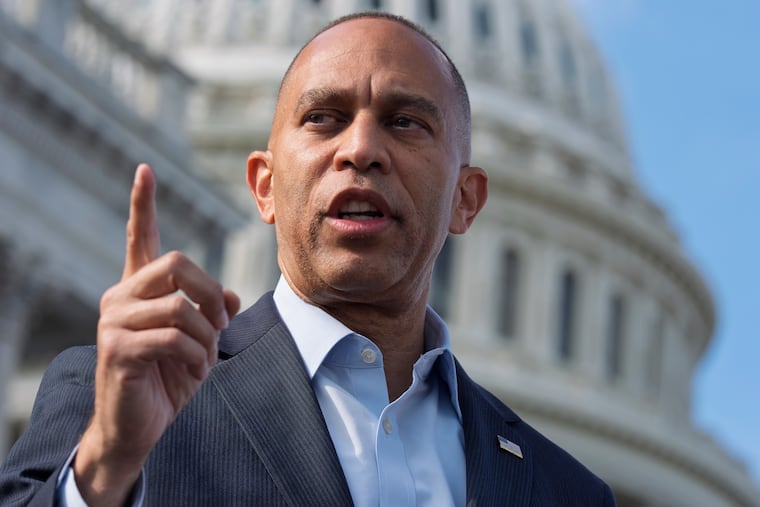
House Minority Leader Hakeem Jeffries (D-New York) argued the decision shows why Democrats must win the House in November.
“We will not let their scheme to rig the midterm election and beyond be successful,” he said.
Rep. Yvette D. Clarke (D-New York), chair of the Congressional Black Caucus, called the decision “an outright power grab” aimed at “silencing Black voices.” And Sen. Raphael G. Warnock (D-Georgia) said the decision will prompt Americans to “stand up in a multiracial coalition of conscience saying that this will not stand.”
While the ruling wipes out a Democratic advantage in drawing districts for Black voters, who tend to be faithful to the party, it has less certain implications for districts drawn to keep Latino communities together.
“Every Latino seat could be cracked and packed in a lot of different ways,” said Republican strategist Mike Madrid, who wrote a book about Latino voters. “Once you’re looking at partisanship only, it’s a whole new ballgame.”
Litigation over redistricting will continue, and in some cases will now rely on state voting laws, said Sophia Lin Lakin, voting rights director for the American Civil Liberties Union.
The Supreme Court’s decision “was a betrayal of the civil rights movement,” Lakin said. “But it’s never going to be the end of the fight.”
Clara Ence Morse and Riley Beggin contributed to this report.