Vet school under threat
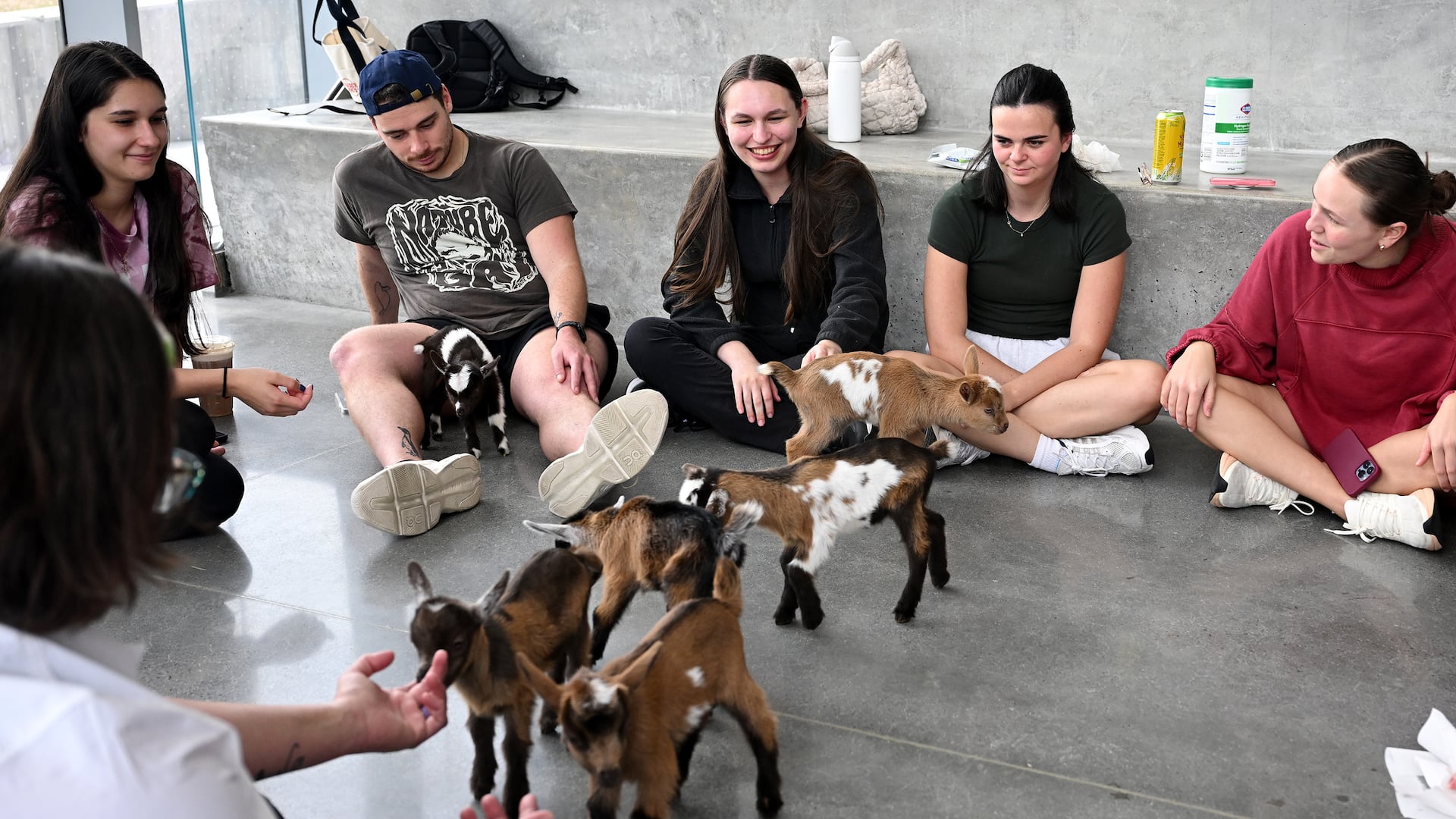
When one of Cana Patterson’s female goats was struggling to give birth in the middle of the night, she and her family had no choice but to hop in a van and head to New Bolton Center in Chester County, an hour and a half from their South Jersey farm.
Patterson and her mother aided the doe as it tried to push out a stuck baby in the back of the van with her dad behind the wheel. They were able to get the baby out alive on the ride over, but if they hadn’t, the mother and her two babies would have likely died because of the time it would have taken to get her set up for a C-section.
“I wish I could say that was rare,” said Patterson, 19, whose family has a goat farm in Atlantic County’s Corbin City.
Patterson is all too familiar with the large-animal vet shortage in the region, which she said has led farmers to rely on one another for medical advice, struggle to get prescriptions, and ultimately have animals suffer.
She plans to become a traveling large-animal vet in South Jersey to address that shortage as part of the first class of students at Rowan University’s Shreiber School of Veterinary Medicine — the first and only vet school in New Jersey, which just opened in the fall.
The veterinary school brought a teaching hospital to the region that will soon become a round-the-clock emergency center, cutting down emergency drives for pet owners. It also launched a field vet service that helps farmers like Patterson.
But the school’s future is in question following Gov. Mikie Sherrill’s budget proposal, which completely strips state funding from the school as part of broader cuts to higher-education allocations in her record $60.7 billion budget proposal. The governor, who prioritized housing homeless veterans and student mental health programs, said the state would need to make hard decisions to keep state spending under control.
First class of students
South Jersey legislators had long advocated for a veterinary school amid a nationwide vet shortage and a particular demand for large-animal vets in rural parts of South Jersey. The legislature dedicated $75 million of state funding in 2021 to create the school and has budgeted millions to the effort in subsequent years.
The school is named after Gerald B. Shreiber, board chairman of the Pennsauken-based J&J Snack Foods Corp, whose $30 million donation for scholarships was announced at the school’s groundbreaking in 2023. Its creation made Rowan one of just two schools in the country to offer degrees from a medical school, an osteopathic medicine school, and a veterinary school, along with Michigan State.
The four-year veterinary program only has its first class of students, so its income from tuition has been limited. The school requested $20 million for the budget year beginning in July, but Sherrill’s proposed budget offers it nothing.
The first class has 75 students, the majority of whom are from New Jersey, and future classes will incrementally grow in size, said Rowan spokesperson Jose Cardona.
Patterson had wanted to become a vet for a while, but the closest option — the University of Pennsylvania — was too far from her goats. When she heard about Rowan, she applied right away.
She said the 24-7 large-animal field service — which serves six South Jersey counties — already provided her friend’s goat an emergency C-section. Before the service came to the region, getting care for an animal in pain could mean waiting 12 hours for a vet to even bring medication, or making tough choices.
“Euthanasia without a veterinarian means shooting the animal. … No one wants to do that,” she said.
In a statement, veterinary school dean Matthew Edson said that state funding is critical for the school and that its leaders will work with legislative leaders to secure state support.
“As one of New Jersey’s leading public research universities, Rowan relies on consistent, stable state budget support to ensure that we can continue providing affordable and accessible public education,” Edson said. “This is especially critical for our School of Veterinary Medicine, which welcomed its inaugural class just eight months ago.”
Sen. John Burzichelli, a Gloucester County Democrat, said he does not think the new school could continue to operate without state funding.
“I think you’d have to move the existing class through and not accept any new admissions,” he said.
Sherrill’s proposal is just the starting point in a long negotiation with the legislature, and Burzichelli said South Jersey legislators will protect the school. Former Gov. Phil Murphy also zeroed out the school’s funding in his proposal last year, but after negotiations with lawmakers, the school ended up getting $8 million of the $12 million it requested.
“Under no circumstances will the vet school be left without funding,” Burzichelli said.
‘Domino effect’
A Sherrill administration official said the decision to cut the vet school funding is part of the governor’s “blanket cut to all legislative add-ons” and referred to her budget address, in which the governor spoke about making “tough choices.”
The governor in her budget remarks spoke out against so-called Christmas tree items, or spending items that legislators secure for their districts.
Former State Senate President Steve Sweeney, who landed a job as Gloucester County administrator after losing to Sherrill in the gubernatorial primary, had championed bringing a vet school to Jersey. He said losing state funding could put the school’s pending accreditation at risk, and he does not believe Sherrill actually wants to put it on the chopping block.
“I don’t think the governor intends to close the veterinary medical school. … I really don’t believe that,” Sweeney said. “I think it’s just part of the budget process.”
He said governors sometimes leave out items they know legislators want as a negotiating tactic.
“You got to fund the school, or it doesn’t exist,” he added.
The new program keeps in-state students who want to become vets and brings in talent from elsewhere, like Mackenzie Campbell, 23, an incoming student from Ohio who will begin her studies in the fall.
Campbell said one thing that drew her to Rowan was the school’s community outreach, including low-cost spay-and-neuter clinics. She said she hopes the governor learns about those benefits as budget negotiations continue.
“There’s a lot of things that go into veterinary medicine that I hope she just becomes more informed about ... to gain a little more insight before she finalizes a budget decision,” Campbell said.
Hailing from Maryland, first-year student Paige Huntzberry, 23, knew she wanted to be an aquatic vet the moment she saw a vet working on sea turtles in Roanoke Island, N.C. She was attracted to Rowan because it is close to the ocean and resources like the Marine Mammal Stranding Center in Brigantine and the Adventure Aquarium in Camden, where she volunteers.
She said as a first-generation college student, she felt like she could not relate to her peers in undergrad — but now, everyone is part of something new.
“We’re still working on this all together to build this program into what we want it to be … if we have a suggestion, they’re really, really into listening to us and tweaking things to be the way that we think it should be,” she said.
She’s looking forward to watching surgeries through a “Grey’s Anatomy suite” that overlooks hospital rooms at the teaching center, which offers longer appointments in larger spaces so students can learn from the care.
And the school’s research goes beyond animals with the One Health research center, which focuses on the connections among people, animals, plants, and the environment — such as pandemics, bacteria, and food safety.
“You’re looking at health that doesn’t just affect one thing, but it can have a domino effect, and it can affect everything,” she said. “So if you cut funding for that, you’re cutting funding for things that could potentially save our entire ecosystems.”