Former Trump lawyer Alina Habba steps down as U.S. attorney in N.J. after court ruling, begins national role in DOJ
Habba hinted on Monday that the Trump administration hasn't given up, writing that she will serve in her new role “as we wait for further review of the [court’s] ruling.”
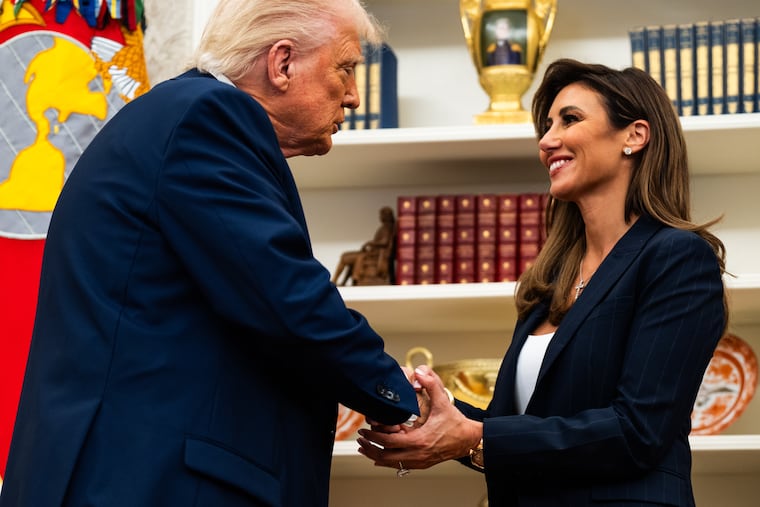
Alina Habba, President Donald Trump’s pick for New Jersey’s U.S. attorney, stepped down from her role Monday after a federal appeals court ruled that she was not allowed to hold the position.
She’ll remain in the Trump administration as a senior adviser to Attorney General Pam Bondi overseeing U.S. attorneys.
“My fight will now stretch across the country,” Habba said in a statement she shared online Monday.
A three-judge Third Circuit Court of Appeals panel unanimously ruled last week that Trump’s efforts to keep Habba, his former personal lawyer, in the role of U.S. attorney were unlawful, backing a federal district court ruling in August.
Habba’s interim term technically expired in July, but when federal judges in the District of New Jersey appointed her first assistant and longtime prosecutor Desiree Leigh Grace to replace her, Bondi quickly fired Grace and reinstated Habba through maneuvers that Trump’s administration argued were allowed.
Habba hinted on Monday that the Trump administration isn’t done with the fight to keep her in the role, writing that she will serve in her new role “as we wait for further review of the [court’s] ruling.”
It’s not clear what she was referring to exactly. The Trump administration could bring the case to the Supreme Court or request a hearing “en banc” which is an uncommon rehearing in front of all of the appeals court judges, said Carl Tobias, a professor at the University of Richmond School of Law who specializes in federal judicial selection.
Tobias said that Habba could be stepping down to avoid legal challenges that could discredit cases her office has pursued.
Habba said in her statement that she is resigning in response to the appeals court ruling “and to protect the stability and integrity of the office which I love.”
“But do not mistake compliance for surrender,” she continued. “This decision will not weaken the Justice Department, and it will not weaken me.”
Habba criticized the confirmation process that prevented her from being approved by the Senate because she didn’t have support of U.S. Sens. Cory Booker and Andy Kim, the Democrats representing the state.
“What these obstructionists misunderstood is that my loyalty is not to politics, a title, or a ZIP code,” she said in her statement Monday. “It is to this great country.”
Judge D. Michael Fisher, who was appointed by former Republican President George W. Bush, acknowledged in the appeals court opinion that “the current administration has been frustrated by some of the legal and political barriers to getting its appointees in place.”
“Where a vacancy exists, Congress has shown a strong preference that an acting officer be someone with a breadth of experience to properly lead the office,” he also stated in the roughly 30-page appellate court opinion.
Habba’s appointment was controversial in part for politicizing the office and also because of her lack of experience. Not only did she have no prosecutorial experience prior to her appointment, but most of her experience was in state courts, not federal.
“Make no mistake, you can take the girl out of New Jersey, but you cannot take New Jersey out of the girl,” said Habba, who previously worked as a partner in a small law firm near Trump’s Bedminster golf course along with representing Trump in a variety of matters and holding a public-facing role in his campaign.