AI surveillance is coming to schools in New Jersey. This Gloucester County lawmaker wants to get ahead of it.
Assembly member Cody Miller's bill requiring schools to implement policies and signage in order to use artificial intelligence surveillance passed the Assembly.
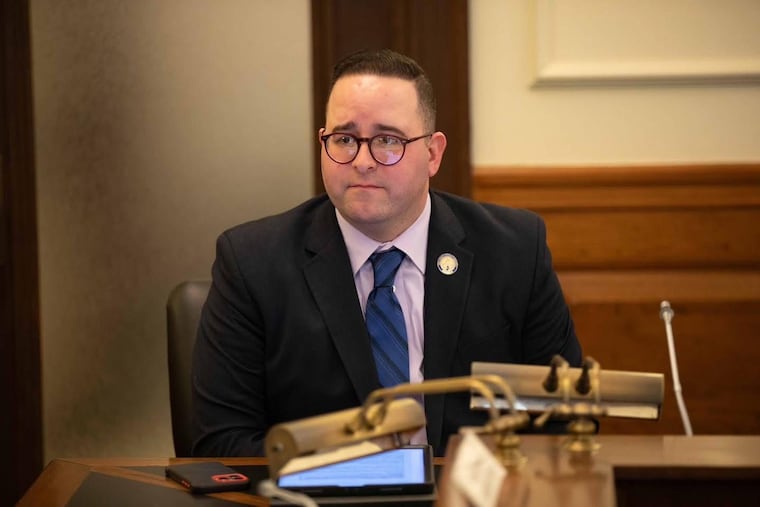
The alarm bells went off for Assembly member Cody Miller when he heard about Newark schools installing artificial intelligence surveillance. The South Jersey lawmaker wants to get ahead of the technology before it spreads in his region.
Miller, a Democrat who represents parts of Atlantic, Camden, and Gloucester Counties, sponsored a bill that would require schools to develop AI surveillance policies and to communicate them to parents before using the technology and post public signage about it.
The bill passed the Assembly 78-1 on Tuesday with bipartisan support and one member not voting.
“We need guardrails,” Miller said. “And that’s really why we developed and drafted this legislation. It was in response to something that we know is going to become a part of a larger operation — most likely — as artificial intelligence becomes the new norm for things.”
Artificial intelligence surveillance is already present in South Jersey. Glassboro Public School District in Gloucester County became the first school to implement a new system developed by a Pennsylvania company that uses artificial intelligence to detect guns through security cameras last year, NJ.com reported.
Miller, 35, said he sees the pros and cons to AI but is concerned about student privacy and cybersecurity surrounding students’ images, campus layouts, and security protocols.
» READ MORE: New Jersey digital innovation office that uses AI becomes permanent with new law
“Safety is important, but when you decide to implement something like this, you need to make sure that you’re communicating with the families and the parents, and students should also have a right to know what information is being collected on them,” the Democrat said.
The bill states that a district school board, charter school board of trustees, or renaissance school project that uses video, X-ray, or body scanner surveillance systems with AI must create a policy about using the technology and distribute it to district families.
The policy would need to include benefits and challenges of using the tool, what information will be collected, and how it will be used and accessed.
Signage would have to be posted in a “prominent, public place” where the system is used, indicating the use of AI.
If the bill becomes law as written, it would be implemented in the next school year.
Newark Public Schools announced plans to install more than 7,000 cameras with artificial intelligence capabilities in 2024 through a multimillion-dollar plan funded with COVID relief money in 2024, Chalkbeat Newark reported.
“I read it, and I went, ‘Whoa, this is a first. This is the first time I’m seeing something like this,’” said Miller, who works at Rowan College and served on the Monroe Township Board of Education.
Miller sponsored another version of the bill last session that didn’t make it to a floor vote. One of his cosponsors is Assembly member Dan Hutchison, another South Jersey Democrat who represents parts of Camden, Gloucester, and Atlantic Counties.
Sen. Linda Greenstein, a Democrat whose Central Jersey district includes parts of Mercer and Middlesex Counties, is slated to introduce a companion bill in the Senate.
The only lawmaker to vote against the bill in the Assembly was Republican Brian Bergen, who represents parts of Morris and Passaic Counties in North Jersey.
Bergen said schools are capable of figuring out their own policies and would already have policies in place for video surveillance.
“What’s the difference about AI? Your ring camera at home has AI in it,” he said.
» READ MORE: Candidates for NJ governor used AI in their ads in new ways. Is it ethical?
The GOP lawmaker called the bill a “silly” example of legislators wanting “to write bills to write bills.” Bergen also questioned why it only focuses on schools and not other government buildings kids use.
“Schools have policies all over the place,” he said. “They’re local school boards. They have local control. They’re smart people.”