Bondi, pressed over Epstein files, places responsibility on Blanche and Patel
Former Attorney General Pam Bondi insisted Friday that she had little real authority in overseeing the release of the Jeffrey Epstein files.
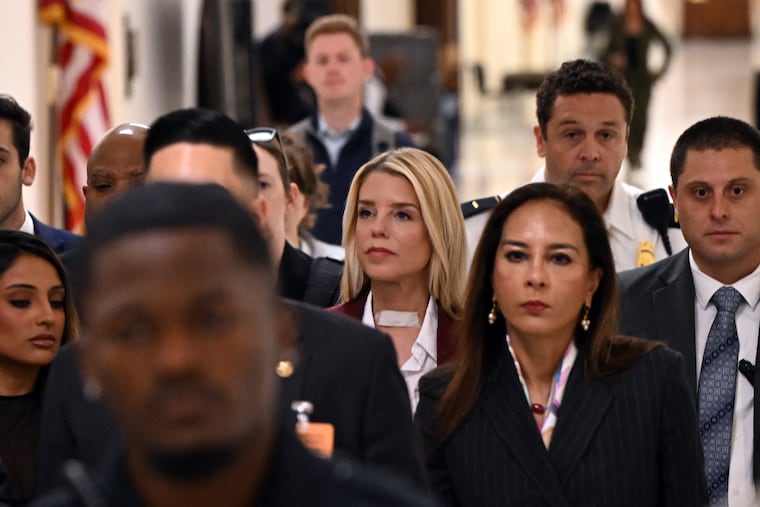
Pam Bondi, fired as attorney general by President Donald Trump in April, insisted Friday that she had little real authority in overseeing the release of the Jeffrey Epstein files, putting responsibility squarely on her former deputy and successor, Todd Blanche.
Her remarks, delivered during a closed-door interview before the House Oversight Committee, were a bracingly candid admission of her own powerlessness that belied her nominal role as one of the most powerful figures in government. It was a noticeable shift from her past appearances on Capitol Hill, when she resorted to maximum-volume attacks on Democrats who raised questions about her performance or challenged her authority.
Bondi told committee members that Blanche was managing “the entire investigation,” Rep. Robert Garcia of California, the ranking Democrat on the committee, said after emerging from a tense session that Bondi had long sought to delay or dodge.
She added in the hearing that Blanche was responsible for determining which documents would be released, another person present for her testimony said, describing how she also repeatedly punted to FBI Director Kash Patel.
Current and former Justice Department officials, speaking on the condition of anonymity to discuss internal conversations, disputed Bondi’s characterization. She was not only informed of every key development in the Epstein case, they said, but signed off on every major decision — including by issuing a memo in July 2025 that formally ended the government’s review of the files.
Bondi, in a social media post after she left the interview, praised Blanche’s “herculean task” of handling the Epstein case, said he was an “incredible” attorney general and denied there was any friction between the two.
Asked by lawmakers about key details of the Epstein case, Bondi expressed ignorance and flatly declined to answer any queries involving Trump. She urged committee Democrats to “ask Todd” instead of her as they pelted her with inquiries about the Justice Department’s missteps in releasing the files, like publishing information that identified or embarrassed Epstein victims, Garcia said.
In one remarkable exchange, Bondi claimed to have played no role in the drafting or release of the July 2025 memo — now seen as a major blunder that fed a political backlash and claims of a cover-up and eventually paving the way for the Justice Department’s full release of the files.
When asked if she knew what information was used to put a stop to the review, Bondi told committee members that they needed, yet again, to ask Blanche and Patel, not her.
How did Ghislaine Maxwell, Epstein’s imprisoned accomplice, manage to secure a transfer to a more comfortable federal prison last year — after sitting for an interview with Blanche, then the deputy attorney general?
Bondi said she had no idea about it until she read about in the news.
To lower the stakes of Friday’s hearing, Bondi and committee Republicans agreed to conduct a “voluntary” interview rather than a sworn deposition that would have been legally binding, or a formal committee hearing with greater consequences and heightened scrutiny.
The hearing took place early on a Friday of a holiday week, with most of Congress, including all but one of the committee’s Republicans, out of town.
Most of the committee’s Democrats attended, and relished the opportunity to grill, leaving Bondi without the support of her fellow Republicans.
The exception was the committee’s chair, Rep. James R. Comer of Kentucky, who had to be there, and offered her a polite thank-you for appearing before the panel a second time.
“I appreciate that she’s coming back today,” he told reporters as he headed into the interview.
Bondi’s exit from the Justice Department was hastened by a disastrous appearance before a House committee in February, when she hurled insults, stonewalled questioners, and refused to make eye contact with several of Epstein’s victims in the audience.
On Friday, some of those same women gathered outside the closed-door committee room to criticize Bondi, but also to make the point that she was not the only one who needed to be held accountable.
“I really hope that we are not using Pam Bondi as a scapegoat,” said Danielle Bensky, one of the survivors. “I feel that Todd Blanche is actually more dangerous in a lot of ways than Bondi.”
That Bondi was compelled to testify at all reflected the growing anger in her own party about the department’s erratic actions in the Epstein case that grew from a conspiracy theory sideshow into a crisis that engulfed the Trump presidency.
In mid-March, Rep. Nancy Mace of South Carolina and four other Republicans on the committee blindsided their own leadership, and Bondi, by joining Democrats to vote to subpoena her to testify under oath behind closed doors about the Epstein case.
Comer scheduled a deposition for April 14.
Bondi and Comer began quietly working together to avoid the deposition. To ease the pressure, Bondi appeared at the Capitol on March 18 for a briefing with members of the committee. Democrats pelted her with questions, then stormed out, saying her appearance was no substitute for her sworn, transcribed testimony.
She was fired April 2, and weeks of negotiations followed to determine the format of Bondi’s interview, which Democrats have criticized as an attempt to shield the former attorney general and her party from answering questions under oath in a televised spotlight.
Democratic lawmakers questioned the unusual presence of Harmeet Dhillon, the assistant attorney general for civil rights, at Bondi’s side, where she frequently intervened to advise Bondi not to answer questions.
Democrats have accused Dhillon of serving as an enforcer to ensure that Bondi did not answer potentially damaging queries, but Dhillon has said she was appearing as Bondi’s private lawyer.
This article originally appeared in the New York Times.