These Pennsylvanians walked 63 miles to get lawmakers to stop taking gifts — and unlimited campaign contributions
Most states restrict gifts from lobbyists to lawmakers and limit how much individuals can donate to a candidate’s campaign. Pennsylvania doesn’t set limits.
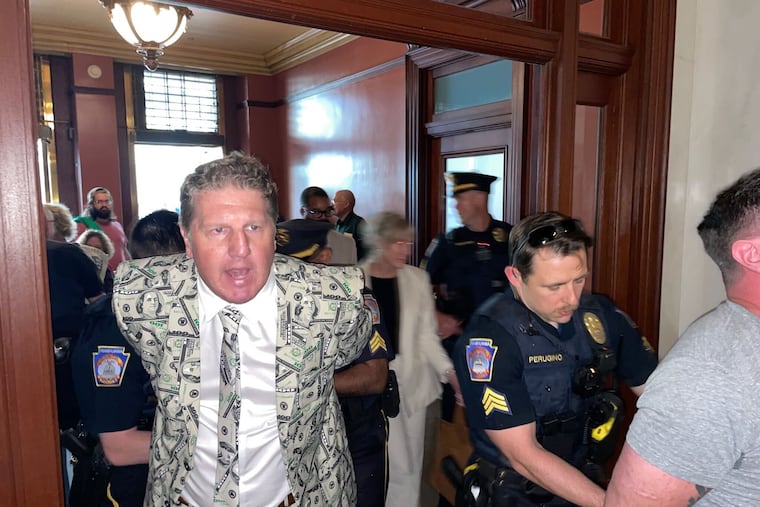
HARRISBURG — For the last 10 years, a good-government advocacy group has been protesting — and disrupting — at the Pennsylvania state Capitol to press the General Assembly for regulations on the way money influences state politics and policy.
And during that time its members have walked a lot of miles.
March on Harrisburg completed its sixth long-distance march Tuesday, with a group of 20 Pennsylvanians walking a four-day, 63-mile route from Reading to Harrisburg, with other residents joining for parts of the trip along the way.
The rowdy collection of activists ended their dayslong march inside the Pennsylvania Capitol, with protesters decked out in The Handmaid’s Tale-inspired costumes and dollar-bill suits. They interrupted the busy dual-session day by blocking a main thoroughfare in the heart of the Capitol, leading to the arrest or citation of nine protesters.
Here’s why the anti-corruption group keeps literally walking back to Harrisburg.
Pennsylvania allows lawmakers to accept unlimited gifts from lobbyists and industry leaders
Pennsylvania’s laws regulating what lawmakers can accept as a gift is incredibly lax compared to other states, allowing them to accept unlimited gifts from lobbyists and other powerful interests hoping to sway them — as long as the official reports any gift over $250 on an annual financial disclosure form.
While state law says that government officials can’t accept gifts for the purpose of influencing their official work, there are carve-outs used by many elected officials to accept lavish trips or experiences and little enforcement of the law, said Andrea Pauliuc, an organizer with the nonprofit March on Harrisburg.
The group wants to ban officials from accepting these gifts, arguing they are “legal bribes,” she said.
Democratic Gov. Josh Shapiro, for example, has implemented a gift ban among members of his administration. But there are questions about whether he has violated his own ban by accepting sports tickets, including Super Bowl tickets, Spotlight PA previously reported.
March on Harrisburg has a number of other proposed changes to lessen the role money plays in Pennsylvania’s democratic process, but the gift ban is the “lowest hanging fruit on this larger rotten, money-in-politics tree,” Pauliuc added.
Forty-seven states have tougher gift bans than Pennsylvania, she said, in addition to the federal government.
There’s no cap on campaign contributions in Pennsylvania
While there are limits on how much a person can give to an individual candidate at the federal level, there are no limits on how much a person or organization can contribute in state elections in Pennsylvania.
Pennsylvania is one of only 12 states that allow for unlimited campaign contributions directly to candidates, according to the National Conference of State Legislatures. This allows uber-wealthy people to send millions of dollars directly to candidates they want to elect.
It’s not uncommon to see six- and seven-figure contributions in state campaign finance filings. In the race for Pennsylvania governor, Shapiro’s biggest individual contributor last quarter was Christian Larsen, a Silicon Valley investor who gave him $1 million.
Treasurer Stacy Garrity, Shapiro’s GOP challenger who has struggled to fundraise compared to the incumbent, received her biggest individual contribution from Jay Sykes, an Oregon-based cryptocurrency executive who gave her campaign $20,000.
Pennsylvania is an outlier in the region. New Jersey, for example, has a $5,000 limit on direct campaign contributions to candidates for legislative races, and a slightly higher limit for candidates for governor and other statewide races.
“When a person is able to give unlimited amounts of campaign cash, that person has a lot of power and the power of the rest of us is diminished,” Pauliuc said.
States across the country have seen an influx of money in politics since 2010, when two federal court rulings allowed for the creation of super PACs, also known as independent expenditures, as long as they don’t coordinate with individual candidates, said Hilary Braseth, the executive director of OpenSecrets, a nonprofit that tracks money in politics for the public to search.
“Pennsylvania is not alone in being frustrated by that,” Braseth said.
Unanswered calls
March on Harrisburg has turned to the dramatic measures of walking from other Pennsylvania cities to the state’s capital — including several dayslong marches from Philadelphia, Lancaster, York, and Reading, with more to be planned — when officials have failed, session after session, to pass a gift ban.
They’ve escalated those tactics to bring attention to the issue by including non-violent protests that usually end in a few arrests.
This month, legislative leaders in the state House and Senate declined to meet with constituents who wanted to urge them to pass the gift ban, Pauliuc said. Both Senate Majority Leader Joe Pittman (R., Indiana) and House Majority Leader Matt Bradford’s (D., Montgomery) rejected the meetings, she claimed.
A spokesperson for Pittman said the staff has met with the group previously, and Pittman has met with constituents affiliated with March on Harrisburg. Bradford’s office rejected the claim, with a spokesperson saying “no House Democratic leadership office received a request for a meeting” and they have met with the group’s organizers multiple times about the gift ban.
Four gift ban bills have been introduced this legislative session, including two in the House introduced by two Philly-area Democrats, and two in the Senate that have been introduced by a Democrat and a Republican.
All of them await a vote in committee, which is the first step of the legislative process.
Bradford and Pittman both control the legislative calendar in their respective chambers. Pittman’s office did not respond to a question about whether he would push for the review of the gift ban bills, while Bradford’s spokesperson Beth Rementer said they are reviewing the bills.
Ethan Blackwood, a University of Pennsylvania PhD student studying neuroscience, was among the protesters cited by police in Harrisburg on Monday. He was given a summary citation for trespassing, he said, after blocking a hallway with a banner reading, “You take bribes, people die.”
This was Blackwood’s first long-distance march with the group.
“We’ll get arrested if that’s what it takes to show that we’re serious, so that lawmakers in Harrisburg work for us, not big corporations,” he added.