‘We could only go up’: Media’s mayor is retiring after reshaping the Delco community
Bob McMahon's 33-year tenure as mayor has turned the borough into a regional destination, friends and colleagues said.
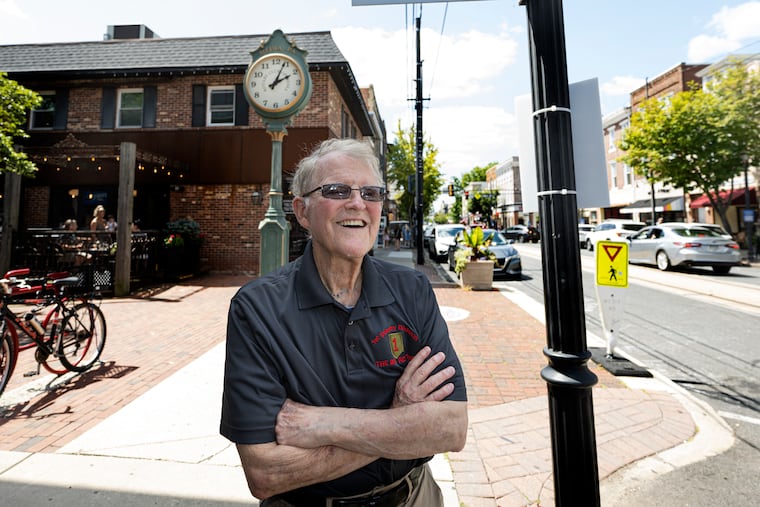
To Mayor Bob McMahon, every corner in downtown Media has a story — a restaurant he recruited to come to State Street, an intersection that shuts down for parades, a business that used to be something else and, before that, something else.
Though it’s tradition for locals to lament changes that befall their hometowns, Media’s evolution doesn’t bother McMahon. In fact, Media’s changing landscape is a testament to McMahon’s 33-year tenure as mayor, which will come to a close with his retirement in January.
“It’s great to watch the change,” he said.
As McMahon, 82, prepares to pass the torch, friends and family say his work on economic development and public safety have made the borough into a regional destination, helping it shed its prior reputation for vacant storefronts and frequent burglaries. They say the borough’s hustle and bustle are a product of years of hard work by the longtime public servant, who had a vision for a vibrant Media decades ago.
Becoming Mayor McMahon
McMahon was born in 1943 in Philadelphia. He graduated from Malvern Prep in 1960, then St. Joseph’s University in 1965.
As the Vietnam War persisted, McMahon’s father encouraged him to enlist in the Army and complete Officer Candidate School. He arrived in Vietnam in early 1968 as the Tet Offensive began. When he came home, he worked as a financial adviser for Merrill Lynch and Smith Barney.
Frank Daly, a longtime lawyer who served as Media’s mayor before McMahon, said he had known McMahon as “a bit of a gadfly in the Republican Party.”
After Daly and his colleagues convinced McMahon he would be better suited as a Democrat, he switched parties, ran for Media Borough Council in 1981, and won.
When asked why he switched parties, McMahon put it simply: The party label didn’t matter much to him.
Following his decade on council, McMahon was appointed mayor in 1992 after Daly stepped down. He has held the office since, winning numerous elections, and sometimes fending off competitive challengers, which he enjoyed.
Redeveloping Media’s economy
Back in the 1980s, there was a saying in Media that you could shoot a gun down State Street and not worry about hitting a single person, Daly said.
The adage paints a picture of Media as a ghost town — a place people went for jury duty and appointments before heading home.
Colleagues said McMahon was instrumental in Media’s turnaround, seeking out grants, supporting redevelopment projects like the Media Theater, and, at times, persuading business owners to relocate to town. They described him as personable, friendly, and unafraid to pick up the phone.
Many cited the case of Fellini Cafe, a local Italian restaurant, as a quintessential Mayor McMahon story. For years, McMahon patronized Fellini’s Springfield location every Tuesday.
Eventually, “I got tired of driving, so I talked them into coming here,” he said.
Fellini’s opened in Media in 2001.
Media’s economic redevelopment also hinged on bringing down its crime rate.
Back in the day, Media was “notoriously dangerous,” and burglaries were common, said Mark Paikoff, current borough council president.
In 1985, while serving as public safety chair, McMahon appointed a then-28-year-old Marty Wusinich as police chief. Wusinich would go on to serve as chief for nearly 40 years before retiring in 2022. For years, McMahon and Wusinich spoke on the phone every day.
McMahon helped revamp the police department, reporting monthly crime statistics to residents and working to build trust between elected officials and law enforcement.
“Bob was never afraid to open a door,” Joan Hagan, a former borough council president who worked closely with McMahon, said. “All you had to do was give Bob a blueprint, a road map, and Bob was off and running.”
There were gripes about Media’s redevelopment under McMahon. Downtown never had enough parking. Business owners pushed back on some council decisions designed to spur economic growth, including a 1999 ordinance that reserved vacant first-floor sites on State Street for retail use only. Political challengers to McMahon called for fiscal responsibility and more timely infrastructure improvements.
On the changes he made, however, McMahon said, “We could only go up.”
The Armory chapter
Ask people about McMahon’s tenure, and they’ll name the Media Armory.
After the National Guard vacated the nearly 120-year-old building in the early 2000s, the armory needed a tenant, and the borough needed a grocery store. Gail Whitaker, a longtime member of the borough council who died last year, proposed Trader Joe’s. McMahon drove to Boston to pitch the corporate executives. The grocery store opened in 2004.
To honor Pennsylvania’s veterans — and to get the state on board with selling the armory to Media — McMahon worked with officials to put the Pennsylvania Veterans Museum in the armory’s basement.
At the unveiling for the museum’s plans in 2004, McMahon was flanked by U.S. Reps. Robert Brady, a Democrat, and Curt Weldon, a Republican.
“Bob McMahon has clearly risen above self-serving politics in gaining bipartisan support for projects that could well serve the community for many generations,” the Delaware County Daily Times editorial board said. “His uncompromised zeal is both commendable and refreshing.”
Friends and family say McMahon’s time in Vietnam changed him.
After spending a few months on “search and destroy,” McMahon was selected as an adviser to a Vietnamese village. He lived in the village, getting to know its residents, patrolling, and setting up a safety network. He was awarded a Bronze Star and two air medals for his service.
But by the 1970s, growing anti-war sentiment had created a hostile environment for some Vietnam veterans returning home, many of whom said they were met with harassment from an American public fed up with the endless war. McMahon was among them.
In courting the museum and organizing veterans parades, McMahon “has always tried to make up for” how he and others were received, Daly said.
‘That was all that mattered to Bob’
Though friends describe McMahon’s work as foundational to today’s Media, some say his efforts have faded into the buzz of the growing borough.
“I don’t think people are aware of the evolution,” Hagan said of Media’s economic development. “They just know it’s where they want to be.”
Looking out his office window at a luxury home under construction, Daly said, “If you had ever told me that somebody would pay $2.5 million to live in the borough of Media, I would have laughed.”
As in many suburban enclaves, Media’s desirability has made it unaffordable for some, a challenge for the next mayor.
After he finishes out his term in January, McMahon plans to work on his memoir and step out of the public light.
Though there’s much to be celebrated, McMahon’s inner circle said he was never one to seek praise.
As Hagan said: “It got done, and that was all that mattered to Bob.”
McMahon will be celebrated during Dining Under the Stars on Sept. 10. Learn more here.

Want to get Inquirer Greater Media straight to your inbox every week? Sign up here for our guide to the news, stories, and events shaping life in Media, Swarthmore, and Wallingford.
This suburban content is produced with support from the Leslie Miller and Richard Worley Foundation and The Lenfest Institute for Journalism. Editorial content is created independently of the project donors. Gifts to support The Inquirer’s high-impact journalism can be made at inquirer.com/donate. A list of Lenfest Institute donors can be found at lenfestinstitute.org/supporters.