Longtime Philly State Sen. Anthony Williams is running for the last time —and won’t commit to fulfilling his full term
The veteran Philadelphia state senator did not commit to completing another four-year term, opening up the possibility he could choose his successor if he decides to retire early.
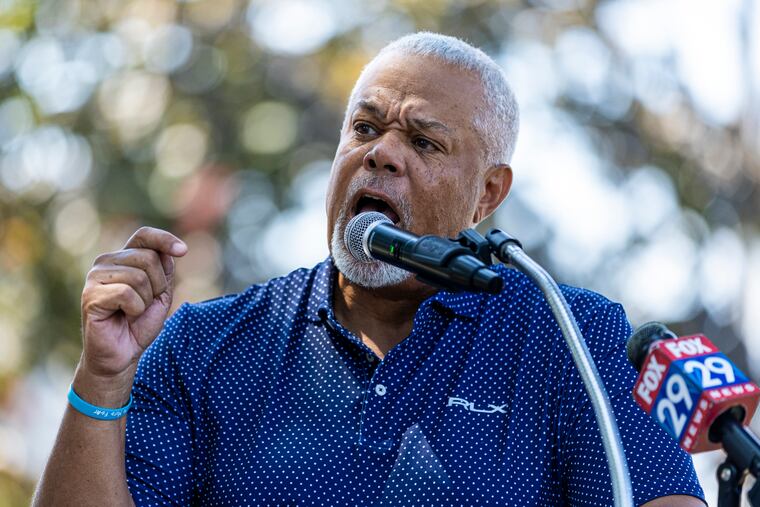
State Sen. Anthony H. Williams, a veteran state senator from Philadelphia known for his advocacy on school choice and who has led one of the city’s most muscular political factions for decades, says November will be his last time running for reelection.
But first, he has more work to do for the advancement of Black Philadelphians and the Democratic Party before he retires, he added in an interview this week.
Williams, 69, did not commit to completing another four-year term, opening up the possibility that he could handpick his successor if he decides to retire early.
“I’m thinking about getting reelected and serving, that’s all I’m thinking about,” he said. “I’m here, I’m gonna run toNovember, and we’ll see what happens after that.”
Williams ran unopposed in 1998 for the seat after his father, the late Hardy Williams, decided within hours of the filing deadline he would not run for reelection. At the time, the move was was widely seen as an intentional play by the late Williams to hold the seat for his son. Now, Anthony H. Williams says that recollection excluded a key piece of information as to why his father retired so suddenly: He had been diagnosed with dementia just before he decided not to run.
“We didn’t have a plan for me to take over,” the younger Williams said, noting that former State Rep. James Roebuck Jr. had filed to run, too, but ultimately withdrew from the race due issues with his petitions. “It wasn’t like I got a free pass.”
When a state legislator resigns before the end of his or her term, a special election is called to fill the vacancy. The ward leaders in that district then get to choose who should take over the seat, dodging a competitive primary and largely deciding the outcome in closed-door meetings.
Williams —who has been in state government, both as a representative and senator, for nearly four decades — is seeking his sixth term to represent parts of Southwest Philadelphia and Delaware County in Harrisburg. He recently won his primary election over Democratic challenger David Goldsmith Jr. and will not face a Republican challenge in November.
Williams has had a far-reaching — and at times, turbulent — legacy in Harrisburg and the city, running twice unsuccessfully for Philadelphia mayor in 2015 and 2019 and once unsuccessfully for governor in 2010.
Over 37 years in Harrisburg, Williams has mentored numerous young Philadelphians who started as aides in his Senate office, who have gone on to become top legislative leaders. That list includes: House Speaker Joanna McClinton, Philadelphia City Council President Kenyatta Johnson, House Appropriations Chair Jordan Harris, Superior Court Judge Timika Lane and more.
“It’s a testament to his dedication and his commitment to seeing Black independent politics grow and mentoring young people to get into office — not to just be there, but to do something,” Harris said Friday.
Looking at Williams’ list of mentees who now outrank him in office shows his legacy and humility, Harris added. And Williams is willing to have spirited disagreements with his mentees, Harris said.
“He’s mentored people who vehemently disagree with him on certain issues, but the endgame of upward mobility for underrepresented people is all the same,” Harris said.
Johnson, in a statement, credited Williams for playing a formative role in his political climb, and for always being willing to “share his wisdom, offer candid advice, and invest in the next generation of leaders.”
“Philadelphia is a better city because of [Williams’] service, and I am proud to call him both a colleague and a friend,” Johnson added.
In an interview, Williams said that he’s seen Harrisburg change tremendously since he first was elected to as a state representative in 1989. Today, Democrats control the state House after flipping the chamber in 2022 for the first time in 12 years, a Black woman from Philadelphia leads the House, and a democratic socialist leads Philadelphia’s delegation to Harrisburg in the Senate. Democratic lawmakers successfully fought to change how Pennsylvania’s public education system is funded, and they’ve advanced gun reforms.
And, he said, it’s no longer a place for career politicians like him.
But Williams said there are still critical issues of policy and politics that he wants to address with his time left in office.
First, he wants to be a bridge between generations of Democratic leaders — though he dislikes how Democrats currently label themselves as “progressive” or “moderate” to differentiate their views. He said he’s been speaking frequently with progressive leaders since State Rep. Chris Rabb, a democratic socialist, won the party’s nomination to represent Pennsylvania’s 3rd Congressional District in Congress.
“The Democratic Party as it’s currently constituted is something that’s not current, and not visionary about moving forward,” Williams said.
“I want to spend time working with those folks who are in that progressive community who will identify with the fact we have common ground on a lot of these areas. We have a different rhythm, or as they say, a different vibe,” he added.
Throughout his time in office, he said he’s had his ideas stolen and boasted by white leaders, including a successful illegal gun task force. He’s cut deals with top Republicans for impactful programs that still exist today, such as an apprenticeship program that helped increase diversity in the building trades. He’s been an outcast at times as one of few Democrats to advocate for school choice options, a label that he knows follows him.
Now, he wants the buy-in of state legislators and the private sector to address economic inequities among Black Philadelphians. Black residents make up the largest racial or ethnic groups in Philadelphia, but have one of the highest poverty rates in the city with 22.3% of Black residents living in poverty in 2024, according to a Pew Research survey released this year. Instead, Black residents should be driving the economy, Williams said.
“Fundamentally, we have to take hold of the economy in the city,” he said. “We collectively have the power to do something about it. Not individually, collectively.”
He sees more school choice options — and reimagining the whole public school system if necessary — as part of this solution. He’s faced criticism throughout his career for his support of school choice efforts, citing his big-dollar support from Pennsylvania’s richest man Jeffrey Yass, who solely supports candidates willing to send state money to private schools.
Yass, who usually supports Republican candidates, was among the sole funders of Williams’ failed bids for governor and mayor. Williams has been criticized for taking money from a top GOP supporter who wants to divert money away from Pennsylvania’s public school system.
“People think I’m a one-hit wonder,” Williams said of his support for using public dollars to send some students to private schools. “We have to be honest about what we’re doing and not doing and have honest, hard conversations about how we’re gonna change how we do this.”
