Blanche stares down confirmation hurdle of lingering GOP doubts
The acting attorney general goes before the Senate Judiciary Committee on Wednesday for what is expected to be a contentious hearing.
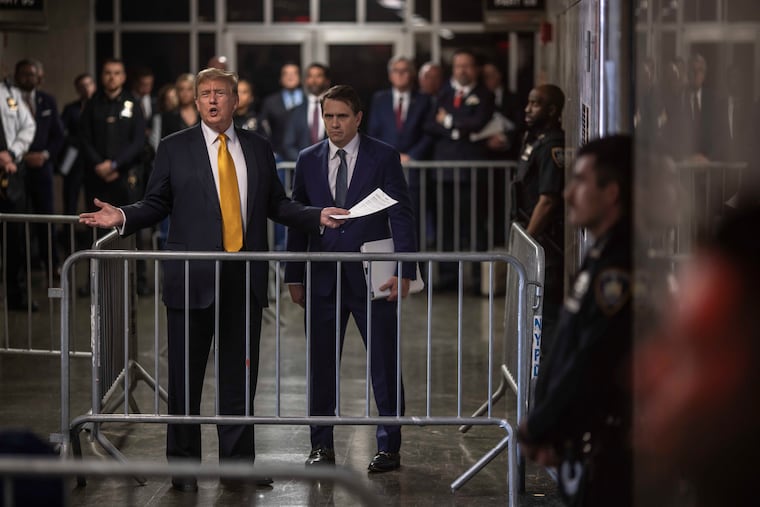
WASHINGTON — Sen. Thom Tillis (R., N.C.), who is still undecided about Todd Blanche’s nomination as permanent attorney general, drew a red line last month: He would vote no if Blanche was too soft on the rioters who had ransacked the Capitol on Jan. 6, 2021.
Soon after, Tillis, a moderate on the Senate Judiciary Committee, said he had a “positive predisposition” after meeting with Blanche, despite the fact that the acting attorney general had recently signed off on a $1.8 billion fund that could have been funneled to those who stormed Congress.
Just a single no vote from a Republican would deadlock the committee and effectively sink the confirmation of Blanche, who became the Justice Department’s acting leader after Pam Bondi was fired in April. That gives Republicans on the panel rare leverage to extract concrete concessions from Blanche, 51.
Whether they will use that leverage is arguably the biggest wild card before Blanche’s high-stakes confirmation hearing on Wednesday.
It is not yet clear how the death of a committee member, Sen. Lindsey Graham (R., S.C.) late Saturday, will affect the timing of the hearing — or who will be chosen by leadership to replace him on the panel.
“Blanche tries to dress it up, but at the end of the day, he’s just Donald Trump’s personal lawyer, and that is all he will ever be,” said Sen. Chris Van Hollen (D.,Md.), who squared off in May against Blanche in a contentious hearing that centered on creation of the compensation fund.
Republicans are not in revolt, but they are restless. During a testy confrontation in late May, Republican senators lambasted Blanche for agreeing to create what critics have described as a “slush fund.” The deal forced them to defend a related provision shielding Trump and his family from tax investigations that might be worth more than $100 million to the president.
Blanche quickly backtracked from the fund proposal, telling lawmakers during a June 2 hearing before the House, “We are not moving forward with the fund, period.” But Democrats have pointed to his flat refusal to put his reversal in writing as an indication that he could devise an alternative.
In private meetings, Blanche has repeatedly told senators the fund plan was “dead,” at times repeating the word three times for emphasis, according to people familiar with the conversations. But he has given no indication that he intends to scrap the part of the agreement offering immunity on past IRS audits.
On Monday the federal judge who oversaw the case, Kathleen M. Williams, issued a scathing decision calling the lawsuit an improper exercise in self-dealing, and criticizing Blanche for his actions.
The tax provision has emerged as a major sticking point for another Republican on the Judiciary Committee, Sen. John Cornyn of Texas, who lost a primary election this spring.
Unlike Tillis, Cornyn has not yet indicated how he is leaning and has requested a follow-up briefing on the tax issue. “I will not make a decision on confirmation until after that briefing and completion of his hearing before the committee,” Cornyn wrote in a recent social media post.
Cornyn and Tillis have also questioned Blanche’s independence from White House control. Tillis, who is retiring next year, warned Blanche during an interview on CNN that he would oppose his nomination if he detected “even a whiff of a lack of independence.”
Democrats say there has been a waft, not a whiff. They see the hearing as an opportunity for the committee’s Republican majority to reassert legislative authority over a department they regard as a cabal of Trump’s former personal lawyers acting in his interests, rather than for the public good.
“A lot depends on how much Trump baggage Republicans want to carry into the November election,” said Sen. Sheldon Whitehouse (D., R.I.), who serves on the committee.
The committee, led by Sen. Chuck Grassley of Iowa, has pushed through Trump appointees, even those Republicans have criticized — like FBI Director Kash Patel — after extracting vague assurances from the nominees that they would safeguard the department’s tradition of independence and abide by the rule of law.
Blanche is unique among recent Cabinet nominees in that he is basically seeking confirmation for a job he has already been doing for a year and a half, first as the deputy attorney general, then as acting attorney general.
Allies of Blanche believed he could simultaneously restore stability and competence to the department in the wake of Bondi’s turbulent tenure — and take a handful of calibrated actions sufficiently drastic to convince Trump he was tough enough.
He has been a compliant if not always gung-ho executor of Trump’s demand that the department open investigations against his perceived enemies and let friends off the hook. He played a major role, along with Bondi, in protecting the president during the furor over the Jeffrey Epstein files, vetting documents for Trump-related material and personally interviewing Epstein’s longtime associate, Ghislaine Maxwell, in prison.
During his monthslong audition for the job, he trumpeted Trump’s false claims of election fraud and greenlit the prosecution of former FBI Director James Comey, for posting an image of seashells on a beach spelling out “86 47.” He oversaw the drafting of the $1.8 billion fund that spurred a powerful backlash in his own party.
Blanche has a mixed record when it comes to the attacks on the Capitol in the wake of Trump’s defeat in 2020, the issue Tillis has identified as dispositive for his support.
It is not clear what Blanche, a former federal prosecutor in New York, thought of Trump’s decision to offer broad clemency or pardons to hundreds of rioters convicted of crimes. He has not talked about it much. But there is no indication he protested to anyone in the White House, and he has often diverted questions about its moral and political implications, citing Trump’s nearly unrestricted pardon power under the Constitution.
No one can last long in Trump’s orbit while offering frank criticism about the Jan. 6 rioters — or, for that matter, the riot itself.
But as Bondi’s deputy, he repeatedly clashed with the department’s most outspoken defender of the Jan. 6 rioters, Ed Martin, a right-wing lawyer from Missouri who raised money for many of the participants and even defended some in court.
Martin, who now serves as the department’s pardon attorney, was one of the first officials to back the idea of paying restitution to the Jan. 6 rioters, claiming they had been wronged by the criminal justice system. But Blanche shut down that proposal, according to allies of Martin and lawyers who helped the rioters file claims against the government.
He has since been more equivocal, however, holding up the presidential pardons during an appearance in March at the Conservative Political Action Conference as a prime example of the Trump administration helping those rioters who faced excessively aggressive prosecution.
Nonetheless, criticism from Martin’s allies persists. Jonathan Gross, a rabbi and lawyer who represented several Jan. 6 defendants before working in the Justice Department’s civil rights division, has been particularly vocal. Gross, who has left the department, claimed that Blanche stood in the way of efforts to investigate and expose wrongdoing by the prosecutors who worked on Jan. 6 cases.
Even if Blanche’s nomination were to make it out of the Judiciary Committee, he would still face the uncertainties of a floor vote. He could only afford to lose four Republicans if all Democrats vote no — three if Sen. Mitch McConnell (R., Ky.), who has remained hospitalized, is a no-show.
Another senator on the committee who could complicate the confirmation is Josh Hawley (R., Mo.,) who is typically in lock step with the White House. Hawley has criticized the department for failing to restrict access to abortion pills by mail — part of a campaign spearheaded by his wife, a conservative lawyer who argued a case involving the medication before the Supreme Court.
Blanche has met with many of the Republicans on the committee and said he was open to meeting with all the Democrats, too. Only a couple have taken him up on his offer, including Sens. Richard Blumenthal of Connecticut and Alex Padilla of California.
Blanche also met with Sen. Lisa Murkowski of Alaska, one of the few Republicans to criticize Trump publicly. Their conversation was cordial, but Murkowski asked him pointed questions about his handling of the Epstein files, a person with knowledge of the exchange said.
Blanche made his first visit to the state last week, for a previously scheduled listening tour aimed at addressing violent crime, fentanyl traffic, and cutting regulations on the state’s critical energy sector. Questions about his confirmation followed him north.
During a sit-down interview with a local TV station, Blanche wryly dismissed a scathing letter, signed by 1,200 former department employees, calling on the Senate to reject his nomination.
“There’s 1,200 former DOJ employees, I think, out of what — 40,000?” he said. “I’m not a math guy, but that’s not a very high percentage.”
This article originally appeared in the New York Times.