IRS blocked from pursuing past tax investigations, audits of Trump or his family
The Justice Department on Tuesday broadened the government’s settlement while acting Attorney General Todd Blanche was grilled by members of Congress about the "anti-weaponization" fund.
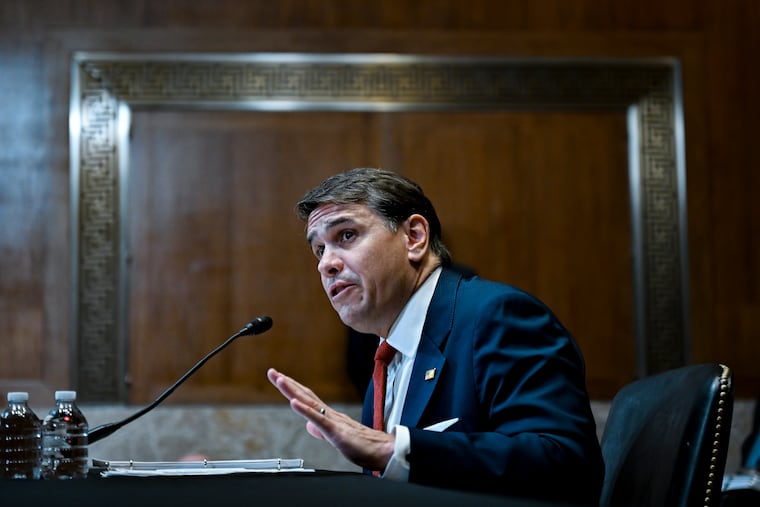
The Justice Department on Tuesday broadened the government’s settlement deal to resolve legal claims brought by President Donald Trump to include a provision that would prevent the IRS from pursuing past tax claims or audits of him, his family, or his businesses.
The one-page addendum to the deal, signed by acting attorney general Todd Blanche, was posted to the department’s website a day after officials announced a broader deal with the president that included the creation of a $1.8 billion “anti-weaponization” fund meant to compensate people who, like Trump, claim they have been targeted by a politicized justice system.
It said the IRS is “forever barred and precluded” from pursuing audits or investigations of Trump, “related or affiliated individuals,” and related organizations regarding conduct from before the date of the settlement agreement. It does not appear to exclude the possibility of future IRS probes going forward.
Still, the addition could prove lucrative for Trump, who has battled with the agency over his tax filings in the past. It was not immediately clear Tuesday whether the IRS had any open audits or investigations into Trump or his family at the time the settlement deal was finalized this week.
Officials from the Justice and Treasury departments did not immediately return requests for comment.
The revelation of the new provision comes as other aspects of the deal, which resolved a lawsuit Trump and his two eldest sons filed against the IRS earlier this year, drew bipartisan scrutiny.
Blanche defended the Trump administration’s plan to create a $1.8 billion “anti-weaponization” fund as he faced sharp questions Tuesday from Democratic lawmakers who derided the deal as an “outrageous, unprecedented slush fund” aimed at rewarding the president’s allies.
Testifying on Capitol Hill, he acknowledged the unusual nature of the taxpayer-backed fund announced Monday. However, he insisted it was not unprecedented.
Blanche maintained that awards would not be decided based on party affiliation, and pledged “full transparency” on reporting how the money is distributed and to whom.
“There is no limitation, whether you’re Hunter Biden,” Blanche said, referring to President Joe Biden’s son, who was convicted of tax fraud and a firearms offense during the Biden administration only to be pardoned during his father’s final days in office. “Or whether you’re another individual who believed they were a victim of weaponization, they can all apply for this fund.”
His explanations did little to quell concern from Democrats alarmed by the fact that the agreement establishing the fund gives Blanche nearly full control to appoint the five-member committee that will disburse the awards, only broadly lays out the criteria on which claims will be evaluated, and leaves open the possibility that fund payments could be kept confidential. Lawmakers did not ask him questions about the new addition to the settlement deal limiting IRS audits.
“This is corruption that has never been more blatant or more widespread,” said Sen. Patty Murray (Wash.), the top Democrat on the Senate Appropriations Committee. “What is happening is you write the check, Trump and his cronies cash it. American taxpayers who are already being whacked with high prices are going to foot the bill.”
Though Blanche reiterated that the president and his family are exempt from payouts, he refused to commit that donors to Trump’s political campaign or those who’d been convicted of violent attacks on Capitol police during the Jan. 6, 2021, riot at the U.S. Capitol would also be excluded.
“That is pure theft of public funds, and rewarding individuals who committed crimes is obscene,” Sen. Chris Van Hollen (D., Md.) said. “Every American can see through this illegal, corrupt, self-dealing scheme.”
The “anti-weaponization fund” is the central plank of a broader settlement the Justice Department announced Monday to resolve three claims Trump filed in his personal capacity, including the lawsuit he and family members brought against the IRS earlier this year over a contractor’s leak of their tax returns to the media.
Legal experts and ethics watchdogs have questioned the deal, which was struck outside of court and without a federal judge’s approval, as the product of potentially collusive litigation. Both Trump’s personal attorneys and Justice Department lawyers who negotiated the deal on behalf of the government all ultimately report to him.
Government attorneys made no effort to try to fight the lawsuit in court and had not yet even formally entered appearances in the case before the announcement of the settlement Monday.
Complicating matters further, Blanche, before joining the Justice Department last year, personally represented Trump in some of the matters central to the claims resolved Monday, including the FBI’s search of the president’s Mar-a-Lago estate as part of a probe into his alleged retention of classified documents. Some Democrats questioned Tuesday why he had not recused himself from discussions over the settlement.
“The record is crystal clear,” Van Hollen told Blanche on Tuesday. “You are still acting as the president’s personal lawyer, not acting as the attorney general.”
Blanche, visibly peeved, shot back: “I’m acting as the attorney general, OK?”