Trump’s Venezuela move pushes the limits of ‘America First’
President Donald Trump on Saturday demonstrated how expansively he is willing to exert U.S. power abroad.
President Donald Trump on Saturday demonstrated how expansively he is willing to exert U.S. power abroad, removing a foreign leader who had not threatened military force against America and declaring that Washington could assume long-term control in Venezuela.
The operation echoed those by past hawkish U.S. presidents to overthrow leaders in Iraq and Panama, raising questions about whether Trump’s “America First” doctrine is being redefined as he authorizes successive foreign attacks and pursues regime change in the South American nation.
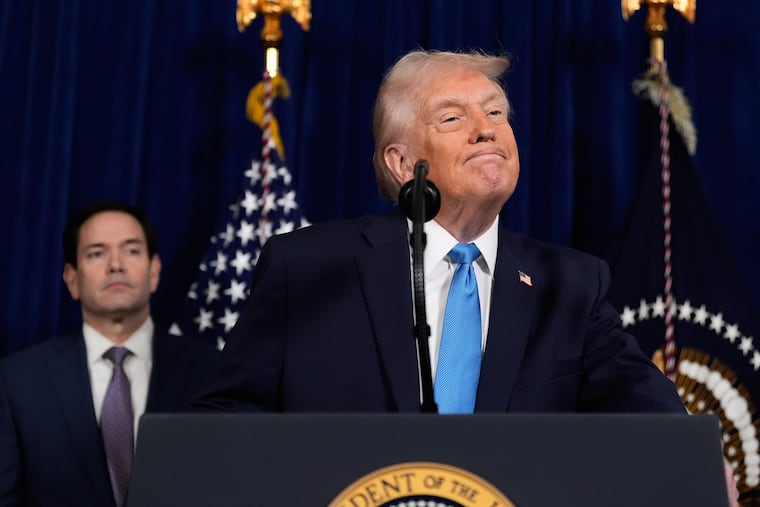
“We’re going to run the country until such time as we can do a safe, proper, and judicious transition,” Trump said in a news conference at Mar-a-Lago. The remark contrasted with Trump’s past criticism of U.S. leaders who, he has argued, acted as “the policemen of the world,” and stood to sharpen tensions inside his political movement, which has long been skeptical of overseas entanglements. He did not say how long the United States would seek to control Venezuela.
But Trump described the operation as part of a broader effort to reassert “American dominance in the Western Hemisphere,” language that echoed Cold War-era interventionism more than the restraint he once championed.
“We’re not afraid of boots on the ground,” Trump said, adding that the United States would be “replacing” the country’s oil infrastructure. The remarks pointed to a scope of involvement that could extend beyond the limited, short-term actions Trump has previously championed.
In a wide-ranging news conference, Trump pointed to multiple justifications for the action, citing drugs, dictatorship, and regional dominance. Taken together, the shifting explanations suggest not a single rationale for the operation, but a broader assertion of presidential authority — one in which the White House claims latitude to act first and justify later.
Trump’s approval of a “large scale strike” on Venezuela early Saturday to capture President Nicolás Maduro and his wife marked the latest in a series of U.S. military actions since Trump returned to office, following strikes on Iranian nuclear facilities in June and attacks against the Islamic State in Nigeria on Christmas that underscore his expanding use of force abroad.
Despite branding himself a “peace president” who ran on a promise of “no new wars” and openly coveted the Nobel Peace Prize, Trump has increasingly relied on military force abroad — a turn that has unsettled parts of his MAGA base even as it has not yet produced prolonged U.S. involvement. The approach reflects a gamble Trump appears willing to take as he seeks to project strength and test the limits of presidential authority, even if doing so strains the anti-interventionist identity once central to his political brand.
Asked how taking control of a South American country was “America First,” Trump told reporters it is because he wanted to “surround” America with “good neighbors” and “stability.”
“We have tremendous energy in that country,” Trump said. “It’s very important that we protect it. We need that for ourselves. We need that for the world.”
Trump rose to power in 2016 in part because of his willingness to break sharply with previous Republican interventionism, especially the 2003 invasion of Iraq, which his Democratic rival Hillary Clinton supported.
Throughout his first term, he focused on reducing U.S. presence abroad, including setting in motion the pullout from Afghanistan ultimately carried out by President Joe Biden in 2021.
But Trump has been willing to be sharply more interventionist in his second term, declaring a desire to take over Gaza and again threatening Iran this week — saying the U.S. is “locked and loaded” to take action if the government harms more protesters in a 3 a.m. social media post Friday.
The president said he had watched the Venezuela mission in real time from his Mar-a-Lago estate in Palm Beach, Fla., surrounded by military generals, and compared the feed to an action-packed “television show.” The “massive number” of aircraft — helicopters and fighter jets — and “steel all over the place” that didn’t stop the U.S. team from snatching Maduro in the dead of night.
Calling into Fox News’ morning show, Trump touted “the speed, the violence” employed by the military personnel assigned to the mission.
“‘Violence.’ They used that term,” Trump said, describing accounts of the operation relayed to him. “It was just an amazing thing.”
As he spoke with the conservative news channel, his first extensive public remarks about the operation since he had announced it hours earlier on Truth Social, Trump offered shifting rationales for why the apprehension of Maduro had occurred, suggesting that he is still testing how to sell the operation to American voters.
On the one hand, Trump said, preventing Venezuela from being “run by a dictatorship” was important, asserting that the United States has a role in shaping the country’s political future — a claim he framed as serving Venezuelan citizens’ interests.
“We can’t take a chance of letting somebody else run it and just take over what he left off,” Trump said. “We’ll be involved in it very much. And we want to do liberty for the people … I think the people of Venezuela are very, very happy because they love the United States. You know, they were run by, essentially, a dictatorship or worse.”
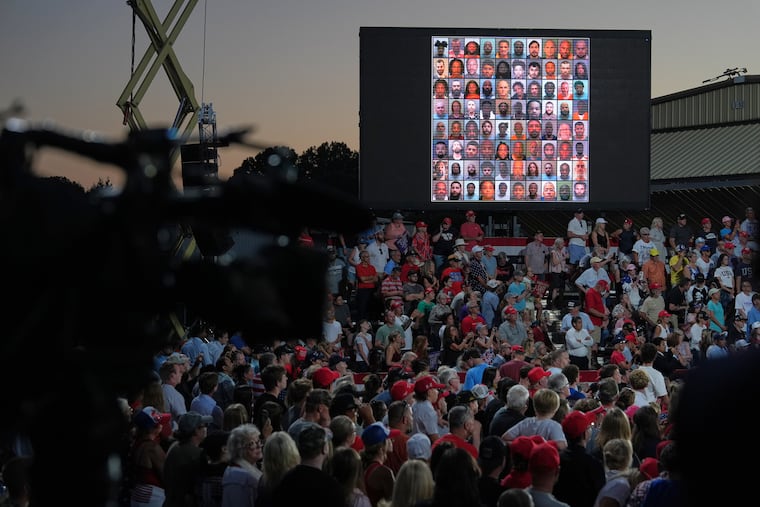
“But look,” Trump said as he returned to the antidrug message he has emphasized for months, “Tremendous numbers of people were being killed through drugs. And what they did to our country in sending prisoners and mental people, people from mental institutions and drug lords and everything — they sent them by the hundreds of thousands of people into our country — and that is just unforgivable.”
An Economist/YouGov poll conducted Dec. 20-22 found that 52% of respondents opposed using the U.S. military to overthrow Maduro, while just 22% said they supported doing so. Another 26% of adults, meanwhile, said they were not sure.
Vice President JD Vance, who has privately urged restraint in some foreign-policy decisions, said on social media Saturday that Trump had “offered multiple off-ramps” to Maduro before apprehending him, framing the operation as chiefly a law enforcement mission. He cited U.S. indictments of Maduro “for narco-terrorism.”
“You don’t get to avoid justice for drug trafficking in the United States because you live in a palace in Caracas,” Vance wrote.
He was not among the senior officials flanking Trump during a news conference at Mar-a-Lago on Saturday — a notable absence given his past criticisms of excessive military action abroad. A spokesperson for Vance said the vice president “was deeply integrated in the process and planning of the Venezuela strikes and Maduro’s arrest,” and remotely took part in several late-night meetings ahead of and during the operation. Vance “briefly” met with Trump at his West Palm Beach golf club Friday to discuss the strikes, the spokesperson said, but steered clear of Mar-a-Lago as the operation took place for fear of signaling an attack was imminent.
Trump gave little indication this week that his administration was preparing the strike, declining to answer reporters’ questions about Venezuela as he entered his glitzy New Year’s Eve party Wednesday. He spent Friday shopping for marble for his planned White House ballroom project and spending time at his West Palm Beach golf club.
Photos released by Trump on Truth Social showed that the administration had stood up a makeshift situation room where the president, Defense Secretary Pete Hegseth, and Secretary of State Marco Rubio — a longtime proponent of regime change in the South American country — monitored the attack. Black fabric draped the room, where the president and administration officials sat on golden chairs.
Trump at the news conference Saturday embraced the “Donroe Doctrine” — a play on former president James Monroe’s declaration that the Western Hemisphere is Washington’s sphere of interest and that U.S. leaders would not tolerate unfriendly nations in their backyard.
Despite a flurry of recent declarations from right-wing commentators and online influencers criticizing the Trump administration for focusing too much on foreign affairs, many MAGA-aligned voices were largely silent Saturday morning, a sign that they were waiting to see the scope of the strike and potential fallout.
Stephen K. Bannon, a former Trump adviser and prominent MAGA commentator who has been sharply critical of the prospect of the United States pushing for regime change in Iran, initially spoke favorably about the operation in Venezuela.
Before Trump’s news conference, during his War Room show, Bannon called it “a stunning and dazzling overnight strike by U.S. forces.” But after Trump declared the United States would “run” the country, Bannon withheld further endorsement.
While Trump appeared to have the backing of traditional, hawkish Republicans, there were signs that his staunchest supporters may remain uneasy about open-ended control.
MAGA-aligned pollster Rich Baris warned that any brief “rally around the flag” effect from Trump’s announcement would fade if the Venezuela mission expanded. “Unless Trump can pull off the first ever successful regime change in a non-Western European nation since WWII,” Baris wrote on social media, “this will consume much of the year and voters will get more pissed he isn’t focused on them.”
So far, however, resistance inside Trump’s coalition has been limited. Congressional Republicans largely praised the strike despite Trump not seeking authorization or briefing lawmakers in advance, while only two House Republicans publicly raised concerns. Democrats, by contrast, warned the move amounted to an overreach of executive authority that could set a dangerous precedent.
Trump has declared ambitions over the Western Hemisphere so sweeping that they would reshape world affairs — and maps — for generations. He has said he wants to turn Canada into the 51st state, an effort that would require military force.
He evinced interest in annexing Greenland from Denmark, a close ally, and has tapped a top Republican as a special envoy to the territory. He has tied military action in Latin America to his top domestic priorities of reducing immigration and stopping the flow of drugs into the United States.
On Saturday, he left the door open to further military action against the leaders of Cuba and Colombia, who have also opposed Trump and his policies.