‘Clothespin building’ is slated to become a hotel and up to 500 apartments after office vacancy crisis tanked the price
Centre Square was once Philadelphia's largest office complex, besting even the Comcast towers in terms of square footage.
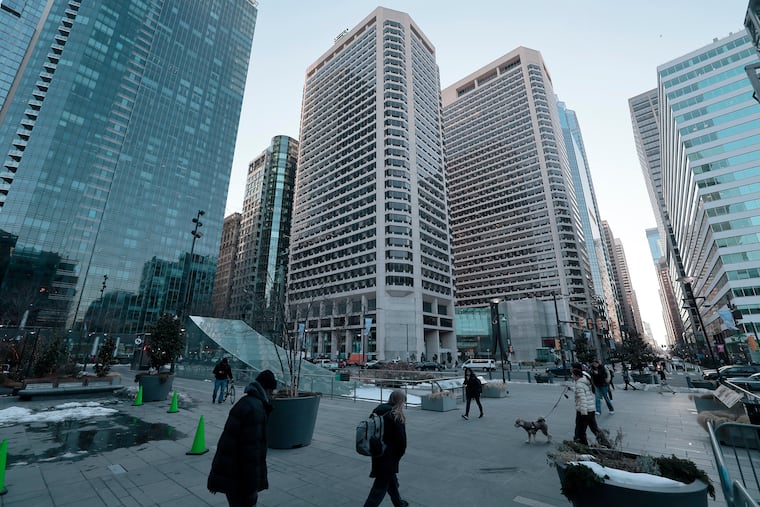
When it opened in 1974, the connected concrete towers of Centre Square boasted the most office space in Philadelphia, at over 1.7 million square feet.
Over 51 years later, the Brutalist behemoth still holds that title.
But probably not for much longer.
Centre Square — also known as the “Clothespin building” for its four-story pop art sculpture — is slated for mixed-use redevelopment by PMC Property Group and investor and developer Dean Adler, with much of the complex being devoted to hotel rooms and apartments.
“That corner of West Market is the best corner in the city,” Adler said. “You get …all the visibility going around the circle. When you look at City Hall, it may not be so nice inside, but outside, it’s a 1904 Beaux Arts building.”
Centre Square’s fortunes sank when COVID-19 struck and have never recovered. At the end of 2025, occupancy stood at 37.6%, giving it the highest vacancy rate in Center City, according to Morningstar Credit.
In 2017, when Centre Square last sold, it went for $328 million. Last July, the complex was appraised at $104.4 million and is now under agreement of sale to PMC and Adler for less than $94 million, according to Adler.
He says the plan is to retain 500,000 square feet of office space, enough to house the remaining tenants. Then there will be between 250 and 500 apartments spread between the building’s two towers. Three hundred luxury hotel rooms will be built on the upper floors of the east tower, facing City Hall.
“William Penn is in your bedroom,” Adler said of the hotel.
On the lower levels of Centre Square, Adler says there will also be a spa and a 50-meter pool — amenities that he says the building previously had.
The acquisition of Centre Square is part of a wave of high-profile redevelopments between Adler and PMC, led by its president, Ron Caplan.
In recent years, the partners have purchased and redeveloped the Bellevue on South Broad Street, the Battery on the Delaware River, and the Bourse on Independence Mall.
“In today’s environment, there’s a real estate crisis, and we are buying these buildings for 20 cents on the dollar,” Adler said. “We …are rejuvenating architectural gems that are functionally obsolete.”
PMC declined to comment. News of Centre Square’s acquisition was first reported by the Philadelphia Business Journal.
More than ‘an office district’
The new Centre Square is part of a trend in which struggling office buildings have sold for less than half their previous prices with plans to convert the spaces into homes.
Centre Square’s discount was even deeper: The reported sale price is almost half what it sold for in 2002, not even adjusting for inflation.
The Wanamaker Building, which had over 1.4 million square feet of office space, is another example. Previously one of Philadelphia’s largest office buildings, it is being turned into apartments by TF Cornerstone and Alterra Property Group. Only a small number of offices will be preserved.
Supporters say that taking huge blocks of empty office space off the market will mean good things for Center City, as apartment leasing remains healthy.
“The office district isn’t only an office district anymore,” said Prema Katari Gupta, president of the Center City District.
“There’s hospitality; there’s increasing residential. What makes a city great is when you have these layered neighborhoods with a lot of different types of demand drivers,” Gupta said.
The partners in Centre Square’s redevelopment have worked together for decades, including on the new Aramark headquarters on the Schuylkill and 2040 Market St.
Adler‘s longtime business partner, Ira Lubert, with whom he founded real estate investment group Lubert-Adler, is not involved in the project. Instead, the Centre Square project partnership with PMC is being done under the auspices of a new venture, Adler & Co.
Philadelphia’s No. 1 business address
Centre Square spans two towers because it dates to an era when developers would not build taller than the William Penn statue atop City Hall, an unofficial agreement with the city that lasted until the 1980s when the Liberty Place skyscrapers were erected.
Planning for Centre Square began in the mid-1960s, signaling a shift, along with the construction of Penn Center, for Philadelphia’s office district from the Art Deco South Broad Street to West Market Street.
“Those buildings created the momentum,” said Bill Hankowsky, former CEO of Liberty Property Trust, which developed neighboring office skyscrapers like Liberty Place and the Comcast towers. “It was the biggest single project that said we’re going down Market West.”
Designed by architect Vincent Kling and developer Jack Wolgin, it was seen as a revolutionary project and hailed as Philadelphia’s No. 1 business address in ads in The Inquirer.
Centre Square also bears the architectural hallmarks of the 1960s, like its poured concrete building materials that — along with its respect for the old height limit — set it apart from the steel skyscrapers built farther down West Market later in the decade.
The building’s Brutalist architecture — often a polarizing style — has bedeviled many of its subsequent owners, who pumped millions of dollars into Centre Square nearly every decade since the 1970s to keep it competitive.
“It is structurally built differently than other buildings on Market West,” Hankowsky said. “It’s a substantial building, but also it is a tougher building to deal with. The walls are thick, the floors are thick. It’s a big challenge.”
That’s part of what deterred many other developers who considered buying the building.
The sheer scale is a challenge, too. Some interested parties were put off by the percentage of the building that would have to remain office, as a full residential conversion is unlikely.
“The buildings don’t particularly lend themselves to a complete conversion to apartments,” said John Grady, who used to lead the Philadelphia Industrial Development Corp. and studied the building for its prior ownership. “They’re too big, and the floor plates don’t work as well as other buildings.”
Born in drama, considered for Comcast HQ
Centre Square’s birth was not easy. Its planning and construction took almost 10 years, with legal and financial delays that included an investigation of the project by then-District Attorney Arlen Specter. (Wolgin told reporters that the Republican politician was “out to get” him.)
The delays left a yawning vacant lot just west of City Hall, which led Mayor James Tate to describe Centre Square as “doomed” in 1969.
When Wolgin eventually began construction, he then faced blowback from powerful critics of Claes Oldenburg’s Clothespin sculpture that he wanted to place in front of his towers.
“It was a disaster!” Jack Wolgin told The Inquirer in 2001. “They said, ‘How can you take something like this pop art and put it in front of City Hall? It’s a monstrosity! It’s a disgrace!’”
Despite the building’s polarizing beginnings, it became a mainstay of the office market, attracting one-time corporate giants like CoreStates bank and Towers Perrin consultants.
It snagged Comcast as a tenant in the early 1990s, after the company was forced out of its first urban home by the fire that destroyed One Meridian Plaza.
Comcast studied the building as a possible headquarters for the company before eventually turning to Liberty Property Trust to build their skyline-defining towers.
Still, many of its 1960s-era flourishes proved difficult to adapt to the modern era. By the 1980s, the atrium that connects the two towers and houses its inward-facing retail received its first renovation.
Centre Square’s atrium has undergone renovations almost every decade since.
Looking ahead
Inquirer architecture critic Inga Saffron wrote about Centre Square‘s latest update in January 2020.
“Fortunately for Philadelphia, the city’s biggest, baddest Brutalist complex, Centre Square, has always been too big to fail,” she wrote just before COVID-19 struck and emptied office towers around the country.
Now, six years later, Adler and PMC Property Group believe they can bring it back as something new.