Northeast Philly’s Franklin Mills mall is for sale
The sale comes amid a wave of mall redevelopment in the region, with demolition and residential construction a common fate for struggling shopping centers.
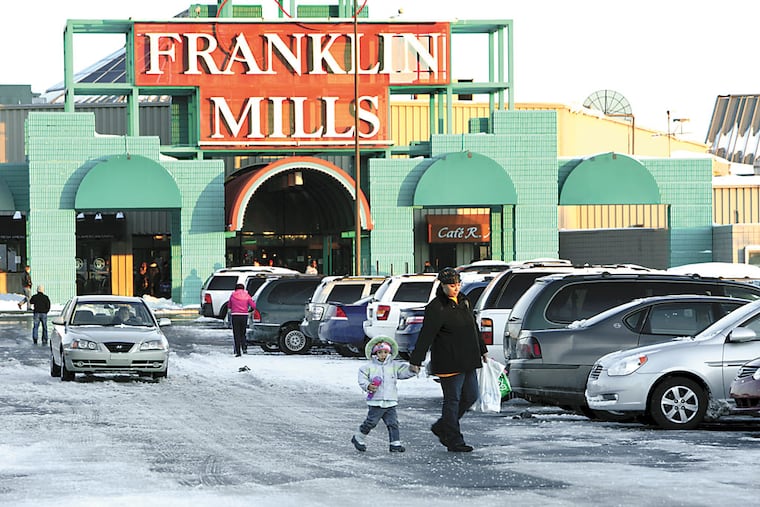
Northeast Philadelphia’s Franklin Mall — better known by its original name, Franklin Mills — is for sale after years of plummeting valuation, occupancy, and visitor numbers.
A listing on the website of real estate brokerage Jones Lang LaSalle (JLL) includes possible uses a new owner can consider, including industrial and office development. The parcels including Sam’s Club and Walmart are not included in the sale.
“Franklin Mall presents the opportunity to acquire meaningful control of more than 137 acres ... in a densely populated location that may support additional densification and redevelopment,” the listing reads.
The move comes amid a wave of mall sales and redevelopments in the region, with demolition and residential construction a common fate for many struggling shopping centers.
Over 68% of Franklin Mall is occupied, which could be an incentive for continued retail operations. But sales and visitor numbers have been falling for years, and JLL reports the average existing lease lasts for only another 1.7 years.
If a new use is sought, the mile-long, one-story structure would be difficult to repurpose.
“I think it’s unlikely to be a shopping mall” again, said Jerry Roller, founder of the design firm JKRP and a longtime architect in Philadelphia. “What could it be? Obviously, residential. It might be a warehouse. It’s essentially a large vacant piece of land. It was fairly inexpensive when it was built, so it’s not hard to demolish.”
The hundred acres of land that Franklin Mills sits on at the edge of Far Northeast Philadelphia is zoned for auto-oriented commercial use.
JLL’s listing advertises the site’s suitability for industrial redevelopment.
“The property’s infill location and highway access make it a strong candidate for redevelopment into a modern industrial facility,” the listing reads. The zoning “could provide a basis for an investor to pursue the development of up to 1.4 million square feet of new warehouse space.”
The residential redevelopment opportunities for the site could be aided by a promised 20-year property tax abatement for the conversion or demolition of outmoded commercial buildings into housing, which Mayor Cherelle L. Parker’s administration promises next year following enabling legislation from Harrisburg.
But the existing zoning would not allow that, so a residential project would need to win the permission of the city’s Zoning Board of Adjustment or have the land-use rules changed legislatively by Councilmember Brian O’Neill.
Tribulations of a Northeast Philly icon
The 36-year-old, 1.8-million-square-foot facility at Knights and Woodhaven Roads is the second largest mall in the Philadelphia area after King of Prussia. But while its larger cousin remains a dominant retail force, Franklin Mall has been struggling for years.
The mall opened in 1989 to great fanfare as the largest outlet mall ever, with an iconic zigzag-shaped concourse that stretched for 1.2 miles.
In its 1990s heyday, it attracted 20 million visitors annually. The latest numbers, provided by JLL, are 5.6 million visitors a year.
In 2007, in retrospect near the end of Franklin Mills’ golden era, the property and the rest of the Mills Corp. was taken over by Simon Property Group, the largest mall owner in the country. The new ownership group rehabbed the property in 2014, although there were already signs Simon was distancing itself by moving Franklin Mills (renamed Philadelphia Mills) into a different balance sheet category than its core properties.
Simon’s loan on the property had been intermittently distressed since 2012. An April 2024 report from real estate analytics firm Morningstar Credit was headlined “Legacy Philly Mall Back to Special Servicing for the Umpteenth Time.”
The 2007 loan still had an outstanding balance of almost $250 million when it came to maturity in July 2024. Simon stepped away from the day-to-day operations at that time, with Philadelphia-based OPEX CRE Management appointed as receiver of the distressed property. The name was changed to Franklin Mall because Mills was trademarked by Simon.
Last year Franklin Mall’s appraised value was $76 million, a precipitous decline from its $201 million valuation in 2012 and $370 million in 2007. According to Morningstar Credit, a new appraisal is likely in the next month.
Full financials haven’t been publicly updated since last year, but at that time, the cash flow for the property was $9.5 million, the lowest since Simon took over in 2007. That’s down from 2019, when cash flow was $17.5 million, according to Morningstar, and from $11 million in 2022.
According to Morningstar, the latest reports from the special servicer for the property, Greystone Servicing Co., say cash flow is even lower this year and occupancy has fallen to 65.4%.
Possible reuses for Franklin Mills
Franklin Mall’s for-sale status comes as some old-school regional shopping destinations are declining.
While some of its counterparts like King of Prussia and the Cherry Hill Mall are still thriving, there has been a wave of sales and redevelopments of area malls as the nature of retail evolves.
Some ailing malls have been purchased on the cheap, allowing their new owners to reinvest and refurbish the property in its previous mold.
“In terms of using the buildings that are there, it’s a challenge because they are generally big box retail, and they’ve got a center mall, which is completely out of fashion,” Roller said. “Could somebody, if they had the right tenants, recreate the mall? Turn it inside out, open the thing up?”
“Maybe it’s possible,” Roller said. But “I don’t see a lot of uses for the buildings that are there right now.”
When regional malls are redeveloped, more commonly, the retail options are reduced with much of the old structure demolished. Diverse new uses often take a faded shopping center’s place.
Two weeks ago, the sale of Plymouth Meeting Mall was announced with the new owner planning residential development. The contentious redevelopment of the Exton Square Mall would also see a burst of residential development and expanded healthcare options — if the owner can win a lawsuit against the township.
In New Jersey, the Echelon, Moorestown, and Burlington Center malls have or are going through a variety of demolition and redevelopment options. The commonality is that residential building is a part of all three plans.
At Franklin Mall, redevelopment would likely require demolition of the existing building.
“Ultimately, it may just be a piece of land” for sale, said Roller.
JLL’s listing, however, pitches the property as either redevelopment or continued mall use.
“This offering presents prospective purchasers with the opportunity to acquire a strategically positioned super regional shopping center with significant upside potential and/or redevelopment opportunity,” it reads.
JLL’s managing directors on the sale are John Plower, David Monahan, and Jim Galbally.