Penn’s Landing cap over I-95 is 30% complete, with completion hoped in 2029
The projected cost has risen sharply from the original 2017 projections as a result of the inflationary environment.
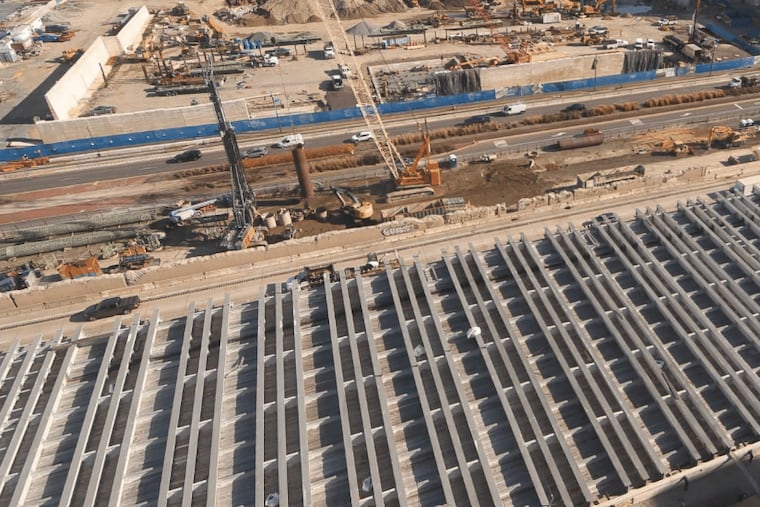
The cap over I-95 between Walnut and Chestnut Streets, which will host the 12-acre Penn’s Landing Park, is about 30% complete.
After almost six years of engineering, design, and COVID-related delays, construction began in 2023, and now a lattice of steel beams extends over the southbound portion of I-95.
The cap project is anticipated to be completed in 2029, with the park installed the following year.
Construction of the cap itself is the work of the Pennsylvania Department of Transportation. When it is completed, the Delaware River Waterfront Corp. (DRWC) will build the park and its amenities on top.
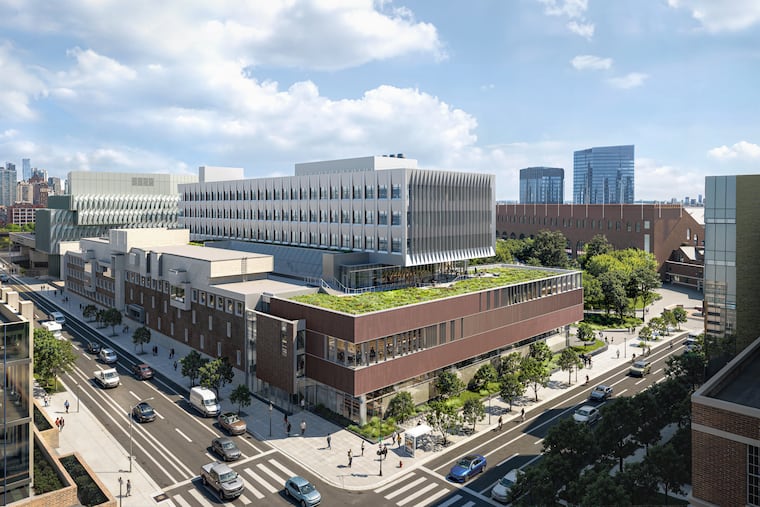
Plans call for it to include a water feature, skating rink, amphitheater, sprawling playground with custom equipment, and a mass timber building designed by architect Kieran Timberlake.
“The vast majority of the park is open green space, but there is a building we call it right now, the pavilion and cafe,” said Lizzie Woods, senior vice president of planning and development at DRWC.
“It’ll be a net zero carbon building … [and it evokes] the natural systems that we know and love along the waterfront and that warm and welcoming spirit that we want the whole park to have,” Woods said at a meeting of the Center City District on Thursday.
Woods said that some of the features planned for the park are influenced by Center City District’s success at Dilworth Park at City Hall, which offers a water feature in the summer and an ice skating rink in the winter.
But when the new Penn’s Landing park is completed, it will be far larger and offer more unplanned space.
“You see those beautiful gardens there, too, with little nooks for gathering and community programming,” Woods said.
“Those nooks actually came out of a lot of our community engagement process where people were looking for spaces that were not the giant amphitheater for programming, but smaller ones that community groups could use and talk with,” Woods said.
The park’s completion is still many years in the future. Next year, in addition to PennDot’s continuing progress on the cap, a new bridge will go up over South Street as part of this project.
It will be built in a parking lot this spring, and then Columbus Boulevard will be closed for one night and it will be swung into place with plans for opening it at the end of next year.
Over the seven years of the project, PennDot has been doing most of the heavy lifting — spending a year and a half relocating utilities alone— and that will continue to be the case for the near term.
Project costs have shot up since it was originally proposed in 2017, as the first sustained bout of inflation in a generation took hold. Construction costs have soared.
Original cost estimates for Penndot’s portion of the project were $229 million, which increased to $329 million two years ago at the groundbreaking. DRWC’s portion of the project has so far gone up less, and is estimated at $130 million including $20 million for the Delaware River trail.
Planners and political leaders see the project as transformative and project that it will boost investment and valuation along the Delaware Riverfront by at least three times the cost.
“The opportunity of Penn’s Landing is really the proof of a concept that redevelopment of the waterfront, which is an old idea, can be done in such a way that puts the public and the civic resource of the waterfront at the forefront,” Woods said.
“Then that yields the opportunity for high-quality private investment rather than relying on those private areas to set the tone,” Woods said.
Editor’s note: This story has been updated to clarify the total cost of the project.