20-year tax abatement to help turn schools and offices into homes may soon be legal in Philly
Buried in the state budget is a provision allowing for the new abatement. It is now up to City Council and Mayor Parker to craft city legislation to support it.
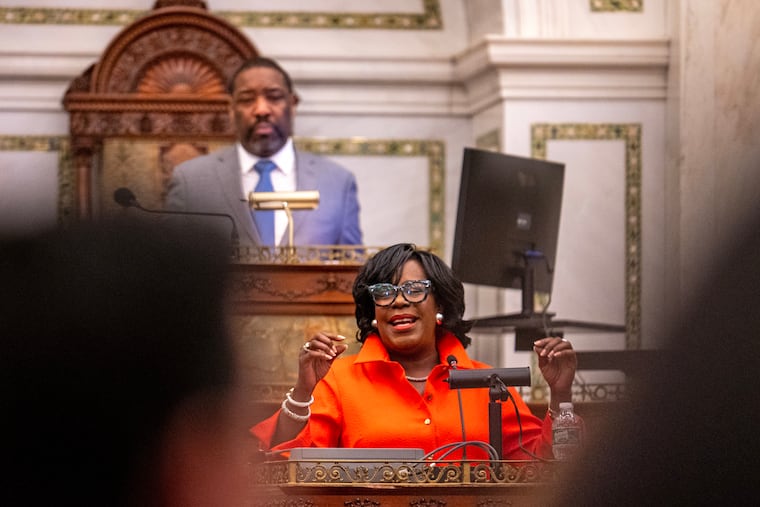
Philadelphia developers may soon benefit from a 20-year property tax abatement to convert large, underutilized properties into residences.
Buried among the litany of provisions in the state budget and fiscal code in Harrisburg, which both passed last week, new language was included that allows Philadelphia to exempt “improvements that convert deteriorated property into residential housing units” from property taxes for up to 20 years.
If a building is deemed too difficult to convert to housing, the new legal language will allow a developer to demolish a building and still get the abatement.
The legislation defines “deteriorated property” as “any industrial, commercial or other business property, or property previously used for government purposes, including a school” that is located in what the legislation calls “a deteriorating area.”
Mayor Cherelle L. Parker’s administration has been eyeing such legislation as a means to incentivize new housing — a key priority for the mayor — and to find new uses for underutilized office and school buildings.
It is now up to City Council and Parker’s administration to craft a local law within the confines of what the state government newly allows. According to state law, local officials must also define what geographic areas under their purview qualify as “a deteriorating area.” Council President Kenyatta Johnson says he supports the 20-year abatement.
The abatements would “ensure that there are no vacant office buildings here in the city, and … incentivize the building of affordable housing,” said Parker in an interview. “That’s where I think it’s going to matter the most.”
Shuttered schools and the Roundhouse
Currently, the city has a 10-year abatement that applies to all residential properties for renovations — which includes conversions — and a half-strength abatement for new construction that begins with a 100% break on a project’s property taxes and then tapers by 10% annually over a 10-year period.
Parker said that her administration worked with State Sen. Vincent Hughes (D., Philadelphia), State Rep. Jordan Harris (D., Philadelphia), and State Sen. Joe Picozzi (R., Philadelphia) to get the new language into the contentious Harrisburg budget.
The administration is now working on crafting legislation to present to Council early next year. She sees it as a crucial incentive in her H.O.M.E. effort to build or preserve 30,000 units of housing.
Parker emphasized that while the new legislation is meant to help solve the office market crisis in Center City, she is most excited for it to be applied to shuttered public schools and other large, underused buildings in outlying neighborhoods.
“We have a menu of options, and this tool, this puts our efforts on steroids to build affordable housing in the city of Philadelphia,” Parker said. It is a “public good [that is] underproduced and has to be incentivized, and not just in Center City.”
Lewis Rosman, the city’s chief deputy solicitor, pointed to the architecturally unique former police headquarters known as the Roundhouse as a property that could possibly benefit from the 20-year abatement as a way to demolish the existing structure and build a new one.
“If you have a property like the Roundhouse that you can’t directly turn into housing, you got to take it down,” said Rosman, who helped write the state legislation. “It will be a new development, but presumably under enabling legislation from Council that will be implemented, it would be subject to the abatement.”
Impact on affordable housing?
Real estate groups in the city hailed the new legislation out of Harrisburg as a tool to fight blight and reactivate historic buildings.
“For years, [we have] advocated for tools that make it possible to convert blighted, deteriorated properties into vibrant residential communities, and this expanded abatement authority does exactly that,” said Sarah Maginnis, executive director of the Commercial Real Estate Development Association’s (NAIOP) Philadelphia chapter.
Mayor Parker said she plans to include provisions in the city’s abatement legislation to support affordable homes.
“This is not a blanket windfall for billionaires,” Parker said.
Councilmember Jamie Gauthier, who chairs City Council’s housing committee and has been a champion of affordable housing, said she also supported the concept of a 20-year property tax abatement for residential conversion with the proviso that the city require some housing for lower-income residents in exchange for the tax incentive.
“Construction costs are really high right now, and we need more housing, so I’m not against an abatement that would generate more housing,” said Gauthier. “At the same time, if we’re going to incentivize developers through a vehicle like this, it needs to have an affordability component.”
But developers with expertise in residential conversions warned against adding additional requirements, saying that the incentive is not generous enough to support below-market-rate rents.
“A 20-year abatement without any strings attached will make a difference in Philadelphia,” said Leo Addimando, managing partner with Alterra Property Group, which has successfully executed many office-to-residential conversions in the city. “But if you attach any strings to it, you neuter it.”
Addimando said a 20-year tax abatement could make some conversion projects viable by allowing developers to qualify for better financing, lowering their borrowing costs. But he argues those cost savings are not enough to pay for housing that would be affordable to low-income renters.
Addimando said the subsidy could probably allow for developers to create lower-priced units for households who earn 120% to 80% of area median income — less than $123,000 to $85,000 for a family of three — but he assumed city policy would want to help lower-income families.
“In that scenario, a 20-year tax abatement is not enough subsidy to move the needle,” said Addimando, who is a partner in the conversion of the Wanamaker building from offices to residential apartments.