Temple professor delves into America’s long and troubled history with public bathrooms
This Temple University professor argues that public bathroom policy has contributed to inequality.
The first public bathroom in the United States opened in 1869 in New York City. The controversies began not long after that.
Since then, the debate over the government’s role in providing public accommodations has reflected America’s political movements and controversies.
In the Progressive Era of the early 20th century, “comfort stations” were opened as an example of what good government could do. In the Jim Crow South, they were racially segregated. During the rise of the modern conservative movement in the 1980s, they were branded a typical failure of big government and closed.
More recently, opinions of public restrooms have ranged from fear of disease during the COVID-19 pandemic to a sanitary necessity for people living on the streets to targets of the backlash against trans rights.
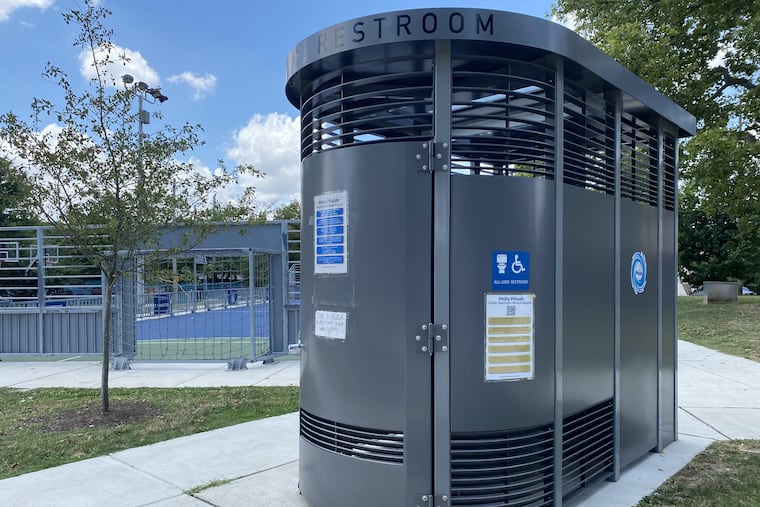
Cities like Philadelphia are experimenting with bringing public toilets back in the form of the Philly Phlush: stainless steel contraptions that are easily cleaned but have limited privacy to keep people from sleeping or using drugs in them.
The Inquirer talked with Temple University history professor Bryant Simon about his new book For Customers Only: Public Bathrooms and the Making of American Inequality and the debate over government’s responsibility to provide accommodation.
This conversation has been edited and condensed for space.
When did public bathrooms first emerge?
What we understand as public bathrooms happened in the late 19th century, as privacy gets redefined and the scale of cities gets bigger. There’s a technology question here, too. You get the development of flush toilets and a really extensive sewer system.
The other important thing is there’s a shifting notion of government built around the Progressive Era. There were public-ish bathrooms before fully public bathrooms, but they were all maintained by private structures [mostly taverns]. They want to solve a problem that they think is both personal, scientific, and social, and they recognize that the private sector can’t handle it.
How long did it take for public bathrooms to become controversial?
That is the part of the story that surprised me the most. The answer is: almost immediately.
They offered privacy away from home. The public bathroom is seen by the middle and upper classes as an extension of the home. But privacy at home was exactly what working people, for the most part, didn’t have. Many working people lived in tenements with two or three brothers and sisters, their parents, and maybe their grandparents.
This is an opportunity. And they immediately seize it to drink, do drugs, sleep, do their hair. Most ominously, for those in control, they seize on it to have sex, particularly men.
As early as 1899, people in New York are complaining about men having sex in public bathrooms.
By 1905, Long Beach hires two out-of-work actors to entrap men in public bathrooms.
But [the authorities] can’t arrest their way out of it, and as early as the 1930s, public officials are beginning to advocate closing public bathrooms to scrub queer sex. The closing of public bathrooms becomes a way to edit people out of the public.
Later, when segregation breaks down, southern leaders close public bathrooms. When mass homelessness first appeared, almost every single city closed public bathrooms. That’s what’s happening in the current moment with trans people.
But that leads to our current problem, where now no one really has access to public facilities away from home.
Why do public bathrooms seem to reflect major pressure points of our society?
I would slightly reframe it and say they help to make these inequalities.
Segregation is the most clear example. [White policymakers] are using the bathroom to not just divide people up but to really make them feel unequal.
There was one other story I found that blew me away, where a Black janitor [in the Jim Crow era] is told to deliberately not clean Black bathrooms in the Atlanta bus station. It makes [Black Americans] feel the neglect of the state, but it also creates a smell that they know white segregationists will read as Black inferiority, which they are manufacturing.
More recently, with the homeless, taking away public bathrooms is essentially denying their entire existence, their bodily needs. There’s a part in the book where I talk about Washington Square 20 years ago [where the public restroom was deliberately kept in a state of bad repair].
We want them to feel their inequality in a profound sort of way. This is insulting; it’s humiliating; it’s uncomfortable; it’s cruel. There is an element of cruelty that runs through the book.
Are paid toilets a policy solution?
If I were building an ideal society, I wouldn’t want paid toilets, but we’re so far from an ideal that the question is would it be able to provide more people with more access? And would pay toilets also guarantee maintenance along the way?
In a political fight, you have to know what you ultimately want and then what you’re willing to accept. [In Europe often] they’re just putting paid toilets in places where there’s wealthier people, or they’re servicing travelers only. They’re not really in service of the larger community.
This is why what’s happening in Philly is interesting. Of the first Philly Phlush toilets, two of them are in neighborhoods. There are not a lot of parallels to that. It helps to build them in parks.
What the past has taught us, and I think we know this in Philly really well, given the Starbucks incident downtown [where two Black men were arrested while sitting in a Starbucks and not purchasing anything] is that leaving things up to the private sector guarantees you inequality.
In fact, if I were a progressive candidate, I would redefine sewer socialism to bathroom socialism. There was a Progressive Era reformer who said that these things show people in the most intimate way that government can work, and it actually could probably provide us leverage to do more.
It seems like a hard idea for politicians to champion because by its very nature, it evokes shame and disgust.
You’re right for another reason. Bathrooms are better at creating inequality than equality. The conundrum for politicians is the lack of public bathrooms is a place in which some really deep policy failures come into view. The housing problem, addiction, the collapse of the state, the fear of others.
And public bathrooms are pretty expensive now. So when politicians invest in them and they don’t immediately yield results, then it’s hard to argue for [bathroom] funding over a new roof for a public school or a new clinic in a neighborhood or extended library hours.
The really hard sell of the public bathroom is it’s the place that makes visible so many other problems that can’t be solved even with an investment of $300,000 for a public toilet.
But if you don’t solve them, you become San Diego [which had a major hepatitis an outbreak in 2017] or San Francisco, which is dealing with problems of open defecation and health problems for everyone.
It has the potential to affect all of us because of the health issues implied in not having enough public facilities.