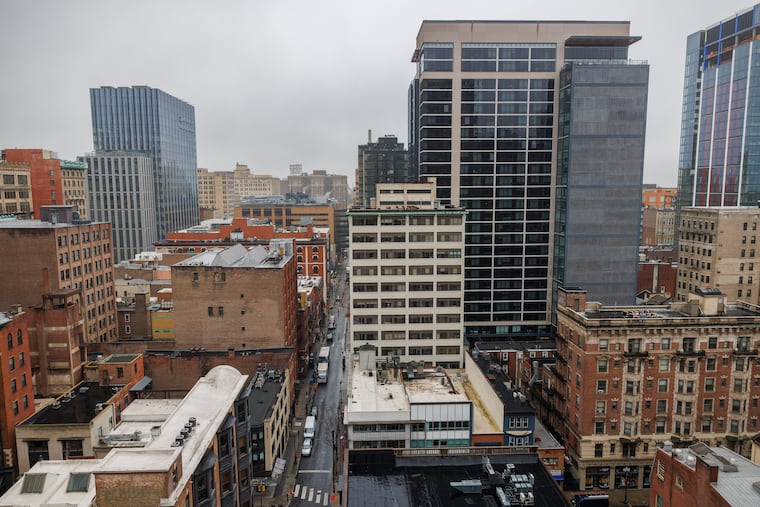
Here’s what the Wanamaker Building’s new retail space could look like
The former Macy’s will probably be carved up into multiple retail spaces like ‘a jigsaw puzzle.’
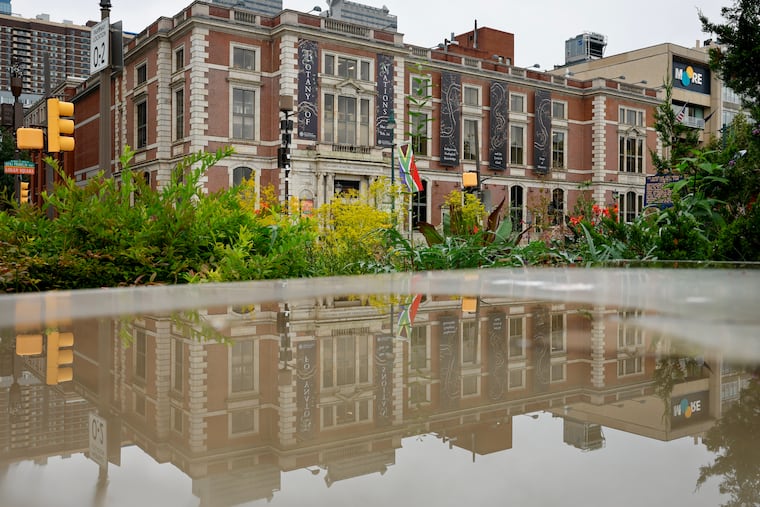
The former Macy’s space and 88,000 square feet on the 12th floor of the Wanamaker Building is now available for lease through the retail brokerage MSC.
With architects from Philadelphia’s JKRP and New York’s Practice for Architecture and Urbanism (PAU), the team is gaming out possibilities for carving the space into multiple uses.
The listing offers spaces from 10,000 to 100,000 square feet, as it is not expected that a future tenant would fill the exact 435,000 square feet that Macy’s once occupied — few users want that much urban retail space. But the exact configuration of the new layout will be based on tenant interest.
“It would be impossible for us to forecast all of the potential plans, because there are countless variations,” said MSC’s Douglas Green. “But it will be quite some time before we start to think about tenants smaller than, say, 10,000 square feet. This is a big jigsaw puzzle and we need to get the big puzzle pieces set first.”
Building owner TF Cornerstone, a New York-based developer, plans 621 loft-style apartments on floors 6 to 12 and continued office space use on the fourth and fifth floors.
In partnership with Philadelphia-based Alterra Property Group, construction on the redevelopment is expected to commence in 2025, and MSC plans to start signing retail leases by year’s end.
The higher levels of the building are less likely to be traditional retail. The 12th floor is a vast, column-free space with vaulted ceiling and skylights that could be used for entertainment or athletic purposes, such as a soccer academy, a gym, pickleball courts, or a swimming pool. (Part of the 12th floor will also house apartments.)
In a June news release, TF Cornerstone said the third floor of the former Macy’s would be earmarked as event space. But MSC says that idea is still up in the air, although it, too, is unlikely to be traditional retail.
“Once you get above [floor] two, then you start to have some real optionality,” said Green. “You start to get into some of these categories where the lines blur between retail, entertainment, cultural, museum and event space.”
MSC believes the first two floors could be a good fit for larger tenants like a grocery store, a furniture or apparel retailer, or a food court.
Some similar businesses have closed around East Market Street in recent years, including a West Elm that was across from Wanamaker’s on Chestnut Street and a Giant Heirloom Market that shuttered at 801 Market St.
Green says the space is particularly well outfitted for a grocery store, despite nearby competitors like Trader Joe’s at 1324 Arch St. and Mom’s Organic Market at 34 S. 11th St.
Unlike those stores, Green argues, Wanamaker’s can offer almost 100,000 square feet per floor with high ceilings. It also comes with helpful infrastructure, including six raised loading docks and hundreds of underground parking spaces.
“There is proximity to a dense residential population in the immediate area in virtually every direction, including the 620 apartments that we’re going to add [on the upper floors],” said MSC’s Jacob Cooper. “There are a lot more people that live in this particular location compared to all those other [grocery] locations.”
The MSC team sees the south side of the building, on Chestnut Street, as more likely to host restaurants, bars, cafés, or the kind of experiential retail that’s become popular in spaces like the West Elm-turned F1-racing simulator across from Wanamaker’s.
The north side of the building on Market Street is more likely to host traditional retail. The MSC team also stresses that the beloved Eagle statue and the organ will still be accessible, and that the grand court area — one of the rare interior historic designations in Philadelphia — is a unique prize for any retailer or restaurateur.
“That central atrium is one of the most iconic retail spaces in the country,” said Cooper.