Bathrooms can be dangerous. Here’s how aging homeowners can make them safer.
Typical bathroom tasks can become more dangerous for seniors, and safety additions such as grab bars, low-curb showers, nonslip flooring, and bright lighting can lessen the risk of injury.
After more than 55 years in her two-story Colonial in Maple Glen, Mary Riker realized she needed to downsize.
“I wasn’t ready to give up my nice, great big yard where my grandchildren, great-grandchildren, and grand-dogs play,” recalled Riker. In her early 80s, she also wanted to remain living independently.
The solution was to build a one-story addition that she would move into, connected to the main house where her family would live. In 2024, she hired Lower Gwynedd-based Harth Builders to build the 1,000-square-foot addition, a place where she could safely and comfortably live as she got older.
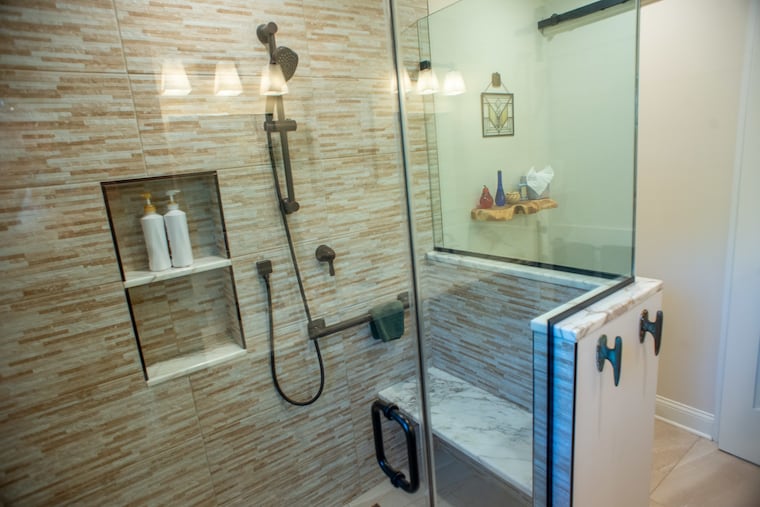
Its bathroom includes grab bars by the toilet and shower and a curbless shower, “so I don’t stumble over the lip getting in,” Riker said. There is a seat in the shower, a hand-held showerhead, and the water is set to a controlled temperature to prevent it from being too hot or cold.
Layers of lighting brighten the room overhead, at the sinks, and in the shower. U-shaped handles on the drawers and cabinets are easy to pull.
More than two-thirds of homeowners surveyed for the 2025 U.S. Houzz Bathroom Trends Study said they renovated their homes to accommodate special needs, and aging household members were the top priority. Features mentioned in the survey included grab bars, nonslip flooring, low-curb showers, additional lighting, ADA-compliant toilets, and wheelchair accessible doorways.
“Bathrooms are generally smaller, tight spaces, so maneuvering in there can be tricky,” said Amy Goyer, a caregiving expert with AARP. An environment filled with soap and water, typically with a tiled floor, “can be slippery and present a fall hazard.”
Challenges of aging
“A variety of conditions can make it challenging to navigate a bathroom routine,” said Alyson Michener, medical director of the Truman Schnabel Geriatrics Home-Based Primary Care Program at the University of Pennsylvania.
Visual impairments, difficulty standing for prolonged periods of time, mobility issues, decreased flexibility, balance or gait problems, and difficulty bending or reaching, can make typical bathroom tasks more difficult and more dangerous.
Incontinence in older adults can pose nighttime safety risks due to urgent trips to the bathroom in the dark. Maintaining independence and privacy is important, even when things become more difficult, Goyer said. Setting up safe measures to extend someone’s ability for self-care is crucial.
Philadelphia rowhouses can be especially challenging if there isn’t a bathroom on the first floor.
“Before you even get to the bathroom, you have to face a flight of stairs,” Michener said. “To maintain independence, make sure there’s a bathroom on the first level.”
She encourages her patients to meet with an occupational therapist to perform a home safety evaluation, going through their routine in their own space for personally tailored recommendations.
» READ MORE: How homeowners are renovating their kitchens so they can age in place
Modifications for a safe bathroom
Experts recommend thinking ahead during a renovation to ensure you are prepared for your needs as you get older.
“You can get a lot of extra features for minimal additional costs,” said Andrew Pellak, owner of Pellak Construction in Springfield, Delaware County.
Don’t limit yourself to the bathroom’s original footprint in an effort to avoid moving plumbing.
“We often have to modify the plumbing and drains to accommodate the new design or layout, which requires pulling the subfloor,” said Gregory Harth, president and chief visionary officer of Harth Builders.
In any bathroom renovation with aging in place in mind, consider these guidelines.
Doorways and pathways should be larger than they would be in traditional bathrooms to allow enough space for a possible walker, wheelchair, or room for an aide.
Low-threshold or curbless showers minimize tripping risk when stepping into the shower. Installing fixed-glass splashguard panels or a curtain instead of a glass door makes it easier to enter and maneuver in the shower without having to physically open or close a door.
Grab bars can be installed in high-slip areas, including the entrance to the tub and shower, inside the shower, and beside the toilet. If grab bars aren’t needed at the time of a bathroom renovation, installing wooden blocks behind the shower tile where grab bars can be attached in the future will save money later.
Install an adjustable hand-held shower arm within easy reach.
Flooring selections like textured porcelain, cushioned vinyl, and non-slip ceramic tiles are less slippery.
Toilets at comfort height — 17 to 19 inches high — reduce strain on knees and hips when sitting and standing.
Layered lighting combines overhead illumination with targeted lighting at the toilet, sink, and in the shower. Nighttime stumbling — especially when you’re half-awake — can lead to bumps or falls. Motion-sensor lighting that activates automatically may also be helpful.
Extra heating, whether overhead or radiant heating in the floor, can be a comfort as skin thins, making us colder through the aging process.
Shelving and storage should allow for items to be placed within easy reach of where they will be used most. For example, have incontinence supplies next to the toilet.
Keep throw rugs to a minimum. A bathmat is necessary but also presents a tripping risk, so opt for a non-slip rug that won’t move when stepped on.
Make the bathroom easy to clean. Large tiles with minimal grout, a fixed-panel shower door, and proper ventilation to reduce mold are all helpful.
Thinking ahead
When Margaret Rostron moved into a two-bedroom Cape Cod in Media, the only bathroom was on the second floor.
“My goal is to live here till I die,” said Rostron, 72. “So I wanted to make the first floor totally accessible.”
In 2023 she hired Pellak Construction to build a first-floor addition with a bathroom that would accommodate all of her needs as she got older. That included a wide doorway into the bathroom, grab bars, easily accessible storage, a comfort-height toilet, and a bench she can sit on to slide into the soaking tub.
“The bathroom is right across from my bedroom so it’s easy for me to get up in the middle of the night,” Rostron said.
It’s never too early to start conversations about ways to safely stay in your home as you get older, Goyer said. Aging is something that creeps up on us, so it’s important to be prepared.