How Philly homeowners are using pocket doors to make their homes more versatile
They’re not the cheapest or easiest option, but pocket doors can solve tricky space problems without sacrificing privacy.
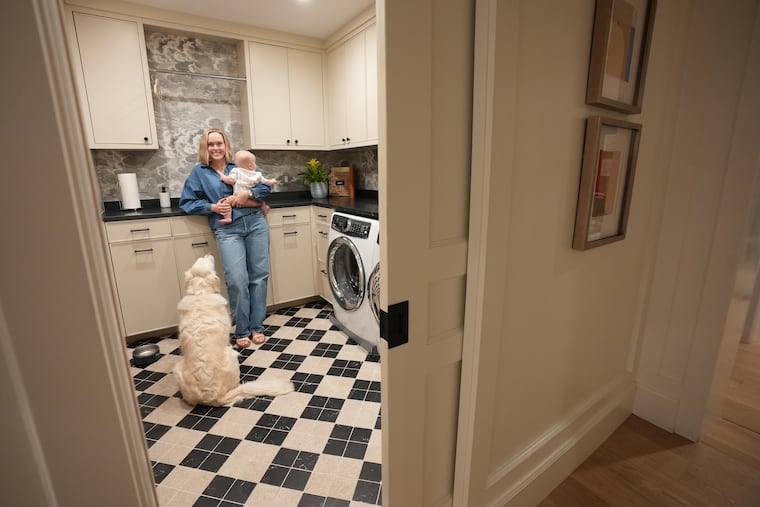
When Nicole and Taylor Gerlinger gutted their 4,000-square-foot carriage house in 2024, they needed to maximize space.
With small hallways and tight spaces between rooms, pocket doors — sliding doors that disappear into a cavity inside a wall rather than swinging open on hinges — became a practical solution.
With the help of Taylor’s mother, Eleanor Halff, an architect and principal designer at E.H. & Co. in Texas, and custom home remodeler Buckminster Green in Northern Liberties, they created a four-bedroom, 4½-bathroom house with six pocket doors. They have one each in the first-floor laundry room and second-floor powder room, and four within the primary bedroom suite.
Pocket doors leading into the bedroom, closet, bathroom, and toilet give the space a clean, open look.
“We wanted to use every inch of space,” Nicole said. “In our primary bedroom suite, the doors were positioned so closely that standard doors weren’t feasible. Because privacy between the bathroom and bedroom was a top priority, pocket doors became the only logical solution.”
The global pocket door market size was valued at about $9 billion in 2024 and is expected to reach more than $14 billion by 2032, according to Maximize Market Research.
These sneaky portals are more popular than ever and are finding applications both within the house and as connections to the outside.
Where to use a pocket door
When deciding whether a pocket door makes sense, there are several questions to consider.
Where is it going?
The door slides along a track on rollers and disappears into a reinforced wall cavity when opened. So if a wall is already covering pipes or wires, there won’t be space for the door.
Who will be using the door?
A pocket door requires a flat handle that is operated with a small recessed pull, which may be challenging for children or people with limited strength or finger agility.
How will it be used?
“If it’s a door you’re going to leave open most of the time, that’s where the pocket door really shines,” said Kenny Grono, president of Buckminster Green. For example, the Gerlingers keep their laundry room door open most of the time, but close it when guests are visiting.
Generally, Grono doesn’t recommend using a pocket door for a powder room that will need to be opened and closed often. If something breaks, it happens inside the wall and fixing it can be challenging and costly.
But for the Gerlingers, a pocket door was the perfect solution given their bathroom’s space limitations. To prevent issues from overuse, they installed an upgraded track system with a soft close feature. It is quiet and designed so the door can’t be slammed shut. It was more expensive, but a safer option.
Grono warns homeowners to be wary of inexpensive tracks, which, over time, can squeak, catch, or break.
Pocket doors are a good option during a new build or renovation, when empty wall space can be planned. It’s generally more expensive to install than a typical door, with the price varying by the type of door and hardware.
It’s much more challenging and expensive to convert an existing hinged door into a pocket door. The wall will need to be demolished and rebuilt with a cavity to create the pocket, and electrical wires and plumbing may need to be moved.
Creative applications
Pocket doors are available in lavish materials, including frosted or fluted glass, textured and natural wood, mirrored surfaces, metal panels, and high-gloss lacquer.
The heavier the door, the more challenging the installation.
“Historically, pocket doors are all over Philadelphia,” Grono said. “Maybe a parlor has two huge two-inch-thick French doors that come together. I’ve walked into so many houses where that door is broken and is in the wall but it can’t come out.”
If a pocket door isn’t feasible, a barn door may be a practical alternative. It operates on a similar track-and-roller system, but the hardware is mounted above the door, allowing the door to slide along the face of the wall instead of disappearing into it. However, it’s not ideal for a bathroom due to gaps along the sides that compromise privacy and tend to be noisy.
Outer door applications
When Regina and Mark Turner built a barn on their Coatesville property in 2016, they chose pocket doors for the entrance.
The large wood and glass doors complement the majestic stone building, and the Turners appreciate their functionality. They were designed by Archer & Buchanan Architecture and built by McComsey Builders.
“Because the doors aren’t on hinges, they take up so much less space,” Regina said. “When you have a large door on a barn and you have to open it, it swings really wide and you have to latch it to the wall so the wind doesn’t blow it. These doors just roll right into their pockets.”
During the recent snowy winter the doors were especially helpful. Had the 6-by-10 foot doors been on hinges, major shoveling would have been required to open the doors for access to the four horses and two goats inside.
A decade later, the doors remain sturdy and have been maintenance free.
“We didn’t want doors swinging outside or inside into the barn, and because it’s a stone barn, we wanted an actual stone arch to support a stone wall, which is the charm and drama of a building like that,” said Richard Buchanan, partner at Archer & Buchanan Architecture based in West Chester.
The doors have a glass window sash curved at the top to match the opening, while remaining completely out of the way. Small doors inside the barn provide access to the “pocket” to sweep hay and dirt out of the slider cavity.
Pocket doors are also gaining popularity on rear exterior walls to merge indoor living areas with backyard patios and decks and in home extensions to connect kitchens or living rooms directly to the garden.
“It’s taking the idea of sliding and pocket doors and applying a lot of technology and money to them,” Buchanan said. “There’s so much interest now that manufacturers are doing a very good job providing solutions to use them effectively.”