In Philly homes, wallpapering is back and the rules have changed
Online and in stores, a range of wallpaper products abound, and for nervous decorators, removal has become less tricky.
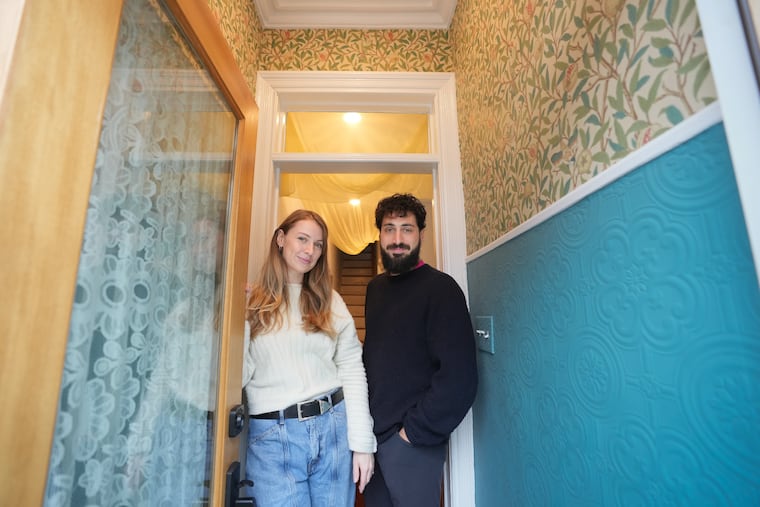
When decorating their circa-1920 townhouse, Eli Steiker-Ginzberg and Sarah Schrading wanted their vestibule to represent the home’s history. They chose a classic William Morris wallpaper called Bird and Pomegranate for above the chair rail and a textured Anaglypta paper painted in Benjamin Moore Baltic Sea below.
“Colonial Wallcoverings had so many options it was overwhelming,” recalled Steiker-Ginzberg, who lives in the Fairmount area. “The leaves and birds and colors of this one really jumped out.”
The William Morris paper was a splurge, so to stay on budget, they matched it with a less expensive paintable wallpaper. In total they spent about $2,000 on the materials and installation “for the smallest room in my house,” he joked.
Wallpaper is showing up in unique ways and in new places. Bold patterns on the ceiling, colorful oversized florals on an accent wall, custom murals in the living room, and funky patterns in the closet and mudroom that add pizzazz and make a statement.
More homeowners are embracing bold wall coverings, according to the 2026 U.S. Houzz Fall Design Trends Report. The shift reflects a move toward deeply personal designs, with homeowners opting for vivid, expressive details that make their spaces feel unique and emotionally resonant, the report found.
“Wallpaper has character and brings out the life and beauty of a room,” said Paul Sperling, owner of Colonial Wallcoverings in Queen Village. “It shows off your personality.”
Modern wallpapers are also easier to hang and strip than older versions, with paste-the-wall and self-adhesive DIY options.
“A lot of people are afraid of wallpaper because it used to be a nightmare to take off,” Sperling said. “But most wallpapers now are easier to remove because of changes in how the papers are printed.”
Making a statement
When Jessica Maiuro moved into her Rittenhouse apartment in 2024, she wanted a wow factor as soon as she came through the front door. After a couple months of searching, she discovered a bold patterned wallpaper featuring Ben Franklin within a gilded picture frame blowing a bubble gum bubble, surrounded by a tiger and flowers.
“I wanted something that would really make a bold statement and be a conversation starter when I hosted,” she recalled. “I had never seen any design like this, and I was instantly sold and in love. What could be more Philly?”
Maiuro spent about $500 on the peel-and-stick wallpaper from the online seller Spoonflower and corralled her husband, John Jeong, and a friend to help her hang it. Her apartment is a rental, but she tested the paper and knows it will easily strip off when it’s time to take it down.
When investing in wallpaper, consider where and how it will make the most impact. Wallpapers with small, repeating patterns work best in a smaller space, such as a powder room or vestibule.
For larger spaces, wallpaper murals can serve as a focal point on the wall behind the bed or sofa, or continuing across several walls. They often feature grand designs or landscapes, including big, bold flowers and jungle scenes. Murals are more popular than ever, said Sperling, with brands like Rebel Walls and Glamora that specialize in custom sizes.
For a more personal design, Rich Art Graphics in Center City will take your artwork and create a custom wallpaper to fit your dimensions.
“Most of the time, a designer or artist will come to us with a fine art interpretation to be printed and installed in homes,” said Michael Antner, the print shop’s owner. “It’s something personal that they are very passionate about.”
For example, a client may have a favorite painting or photograph they want to reimagine on an entire wall. Cityscapes and naturescapes are especially popular. Rich Art will create a digital file with the picture and manipulate it to the exact size of the wall.
They offer traditional wallpaper adhered with paste or peel-and-stick adhesive. The average cost is $8 per square foot to create the paper, plus installation.
The fifth wall
The ceiling has become the fifth wall of the room, where wallpaper can make a bold statement and add a new dimension. Options include very intricate designs where viewers can spot new details to simpler patterns like clouds or green tree canopies.
“It’s much more dramatic and brings more attention to the room,” Sperling said. “It takes vision.”
Parents are even wallpapering nursery ceilings as a stimulating focal point for their babies.
“Wallpapered ceilings have been a design staple for centuries in Europe, especially in homes where pattern and ornamentation played an important role in creating atmosphere and storytelling,” said Krystal Reinhard, founder and principal designer at Old Soul Design Studio in downtown West Chester.
She’s seen a noticeable uptick in the past five years as homeowners look for more expressive, layered interiors. Papered ceilings work in smaller, contained spaces like powder rooms, nurseries, and offices. But they can also make sense on larger ceilings in bedrooms, dining rooms, and kitchens.
When papering the ceiling, it’s important to consider the scale of the pattern — motifs or tonal textures often work beautifully overhead, Reinhard said. It’s best to hire an experienced installer because ceilings require precision and strong adhesive knowledge. Before committing to a pattern, one should test how it interacts with overhead lighting — fixtures can cast shadows that change the effect.
“A wallpapered ceiling is one of the most effective ways to give a room soul,” Reinhard said. “It’s a detail that feels thoughtful and intentional.”
Especially in the Philadelphia region, where so many homes have architectural character worth celebrating, treating the ceiling as a design opportunity can elevate the entire space, she said.
It’s a way to honor historic craftsmanship while embracing a very current, expressive design moment.
How much does wallpapering cost?
Wallpaper costs vary widely, starting at about $40 per 50-square-foot roll for peel-and-stick options from online sellers such as Wayfair. Textured materials from brands like Arte or historical luxury design houses like de Gourney or Zuber can reach several hundred dollars per individual square foot, Sperling said.
Many companies provide a measuring calculator to determine exactly how much is needed for your project. It’s essential to take pattern repeat into account and add an extra 10% for mistakes and future repairs.
Most companies sell samples. It’s helpful to hang those in various spots and observe over a few days to see how the pattern looks in the light at different times of day and night.
For Steiker-Ginzberg, the wallpaper investment was worthwhile.
“There’s something important and meaningful about the portal into your house and there being an intentional transition,” he said. “It makes a difference in the impression people get.”