The historic Conkling-Armstrong House in North Philly is poised for affordable redevelopment
One of Philadelphia’s unique buildings will be renovated and expanded to offer 24 apartments in North Philadelphia.
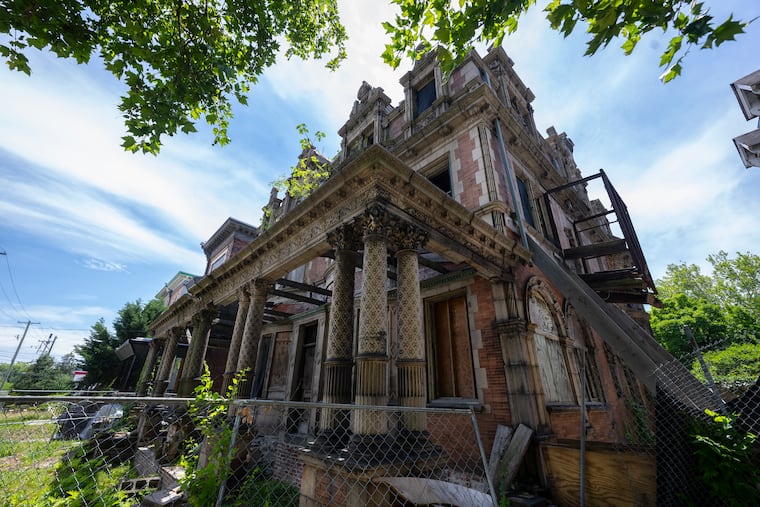
They don’t make them like the Conkling-Armstrong House anymore. They never really did — except this once.
Located at 2224-26 W. Tioga St., each of the two roughly 5,000-square-foot houses in this twin mansion are encrusted with terra-cotta flourishes that set them apart from their neighbors and from pretty much any other building in the city.
That’s because this almost 130-year-old mansion in North Philadelphia was built as a towering advertisement for what the Conkling-Armstrong Terra Cotta Co. could offer late-19th-century developers and architects.
They studded it with beautiful decorations and elaborate details to demonstrate what their products could look like on future buildings.
When this one-of-a-kind house was built in 1898, the company’s factory stood mere blocks away. Now it is gone, demolished in 2011, and the house itself hasn’t been occupied in even longer.
That period of vacancy will end soon, if local affordable housing developer Brian Wise gets his way. He’s already invested almost $1 million in bringing the Conkling-Armstrong house back from the brink of demolition.
“When we first had the property, we could not even walk through it,” said Wise, managing partner of Wise Holding Group LLC. “There was so much deterioration from the roof all the way down to the basement.”
Wise plans to build 12 apartments in the twin buildings and another 12 in two additions behind the twins, each over 4,000 square feet. They will extend into the vacant lot behind the Conkling-Armstrong house, fronting on Estaugh Street.
The plan is to lease most of the units to tenants who use rent vouchers from the Philadelphia Housing Authority.
“It’s a pretty ambitious job to do and something that will be a challenge, but sometimes we like challenges,” Wise said. “We’ll do everything we can to keep the building stabilized and bring it back to its original form, especially the exterior.”
Earlier this month, the city’s Zoning Board of Adjustment gave Wise the go-ahead to begin the project.
“This is one of these projects that you’ll remember over the course of your career,” Wise’s attorney, Alan Nochumson, said in his pitch to board members to preserve the building.
Wise needed permission to build beyond the allowable density on the site, arguing that the rents from additional units were the only way to make the project economically feasible.
His case was supported by two local community groups, the Allegheny West Civic Association and the Swampoodle Neighborhood Parcels Association.
Wise anticipates an 18-month to two-year timeline, given the final Historical Commission approvals he needs.
Wise originally came to this block of West Tioga Street to try to buy one of the other venerable, if less ornamented, stone twin houses on the block.
He decided against that purchase, but while he was in the neighborhood, he noticed the intricate design and decoration of the Conkling-Armstrong House, as well as its dilapidated state.
After acquiring the building, Wise considered demolishing it. But the Conkling-Armstrong House is on the Philadelphia Register of Historic Places, which makes razing it a challenge. Instead, the developer decided to embark on his first adaptive reuse proposal. He needs a final Historical Commission approval to begin construction.
“My first impression, obviously, was that the architectural nature of the property was unique,” Wise said. “It was something that we weren’t used to seeing … so instead of knocking it down, we said let’s try to bring this building back to life.”
At the zoning board, Wise faced questions from commissioners who wanted him to add a porch to the new addition facing Estaugh Street, which he promised to do.
The new buildings behind the Conkling-Armstrong house will be more modest, with a design that echoes other houses in the neighborhood.
“We decided that trying to match all of these ornate features of the front building is not a tenable solution,” said Matt Masterpasqua of the Mass Architecture Studio, which is designing the project.
“So we tried to take context from the rear street, as well as some of the more modest neighboring buildings to inspire our new design,” Masterpasqua said. “It’s a little more feasible for us to construct.”
He anticipates the redevelopment of the Conkling-Armstrong Terra Cotta Co.’s house-and-showroom will cost at least $3 million, but he could be aided by federal Historic Preservation Tax Credits.
The company’s historical legacy in Philadelphia includes ornamenting such structures as the Witherspoon building and the former Curtis publishing house. Like many historically protected gems, those buildings are in Center City, not residential North Philadelphia.
“It was a showcase for the capabilities of their company, but it’s also just really an incredible building,” Masterpasqua said. “It’s really great to be part of something that’s going to be able to salvage the neighborhood and this piece of architecture.”