Center City’s Mole Street is getting redeveloped and losing its affordable houses
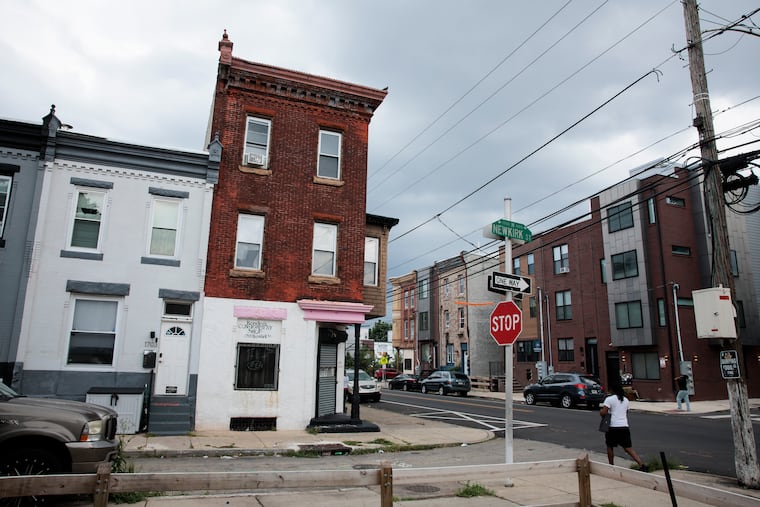
A beloved cluster of almost 200-year-old rowhouses in the midst of a high-rise corner of Center City is being redeveloped and its tenants displaced.
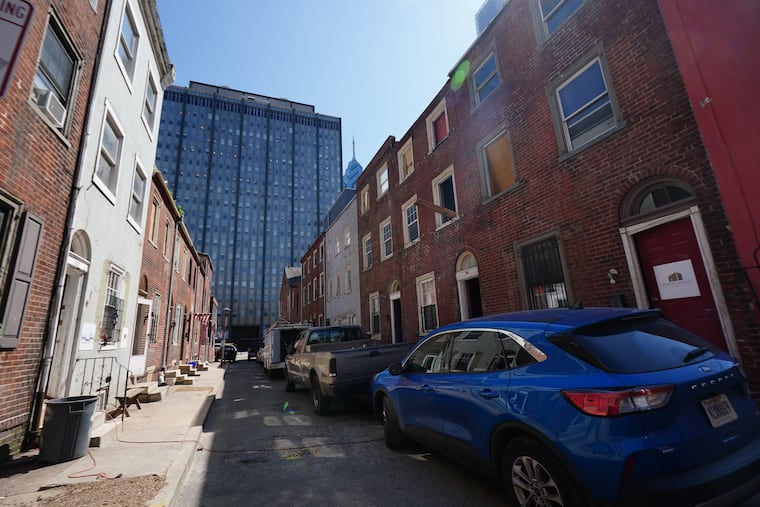
The tree-lined 100 block of North Mole Street seems to cast a spell on everyone who lives there.
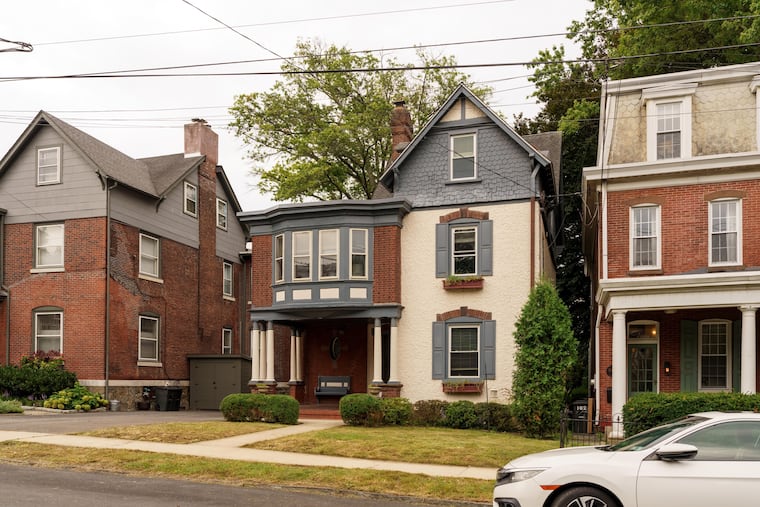
This cluster of 30 two-story brick houses dates to the mid-19th century — some are close to 200 years old — and has long turned residents into devotees of its artsy parties and communal life.
The street stands out from the surrounding blocks of high-rise buildings and surface parking lots, a lone historical holdout in the heart of Center City, where most rowhouses have been erased. Affordable rents two blocks from City Hall have attracted a mix of artists, students, and — for some reason — airline flight attendants.
Except, now, almost all the trees have been cut down and the mid-block pocket park torn up. Many of the homes are being redeveloped, and leases are not being renewed for the motley assortment of renters who have long populated the block.
“I’m pretty close with most people on the block, and, I mean, this sucks,” said Teddy Powell, 34, a musician who has lived on this stretch of North Mole since 2020 and can reel off the names and occupations of most people on the block.
“We’re all being forced out of the houses that we love living in,” he said.
The 100 block of North Mole Street managed to stand apart for so long because it is owned by a family trust, which also dates to the 1800s, and belongs to descendants of founding father Robert Morris. The homes on Mole Street were given historic preservation protections in 1960.
It neighbors the Central Friends Meeting, which lies just to the east and dates to the 19th century as well.
Until last year, the trust owned 25 of the 30 homes. Rents were kept low: well under $2,000 for four-bedroom homes, mostly hosting roommates, a stone’s throw from City Hall. Individual renters would often pay just hundreds of dollars a month.
That’s a deal that cannot be found in most other parts of Center City, where new buildings have an average rent of over $2,600 and median household incomes are among the highest in Philadelphia.
And the group houses on this block of Mole Street tended to be tight knit, with parties spilling into the shaded street.
From the 1980s until the COVID-19 pandemic, the block hosted the Molestice Festival, with live music, food trucks, and a pop-up bar in the pocket park tucked into the block. In 2018, cheerful chalk graffiti daubed frontages with phrases like “The Mole Hole” and “We R Sky Trash Kappa Mole.”
“We had a lot of fun here; we’ve carried on the tradition,” Powell said. “It’s all over now, though, man. The party’s over.”
Last year, a developer bought eight of the North Mole Street homes for $3.1 million.
The new owner is Purity Homes Inc. Some of the zoning documents filed with the city are signed by real estate investor Armando Ahmad, with the owner’s mailing address listed in either Arlington, Texas, or a Point Breeze rowhouse that hosts seven other real estate-related LLCs.
Ahmad did not respond to a request for comment, and the architect for the project, Carey Jackson-Yonce of Canno Design, declined to comment.
But at a meeting last September of the city’s Historical Commission reviewing Purity Homes’ plans for eight of the homes, Jackson-Yonce said his client planned to acquire most of the block.
“They are heavily investing on the entire block, and I think in the end they will probably be able to acquire approximately 80% of the block,” Jackson-Yonce said. “This is just probably Phase One of what will probably be at least one more, if not two, more phases.”
Jackson-Yonce noted that the family trust that has owned North Mole Street for the better part of two centuries is selling the properties in batches, perhaps to see how the developer does with the first eight.
He assured commission members that his client was “100% committed to the faithful restoration of these homes.”
The plans displayed at that meeting centered on adding square footage to the rear of the homes, while the interiors are being gutted to create more space. The Historical Commission regulates only the exteriors that can be seen from the street. Currently several of the homes lack roofs.
The exception to the plan to supersize the block is the three homes at 1527, 1525, and 1523 Cherry St., on the south end of the block, which are being demolished.
They are not protected by historic regulations. Paul Steinke of the advocacy group Preservation Alliance says the developer wants to build an eight-unit apartment block in the place of those 19th-century rowhouses.
Purity Homes’ plans for Mole Street will necessarily entail sharp rent increases due to the amount of money being spent to acquire and redevelop the homes.
Powell and two other tenants on the block say that they were recently told their leases won’t be renewed.
“Everybody that I know over here is pretty sad and disappointed about the whole thing,” said Joshua McIntyre, a more recent resident of the 100 block of Mole.
“It’s a lot of different kinds of young people, artists, and there were several bands that practice over here, but now it’s going to be like the rest of Center City, I guess,” McIntyre said.
Canno Architects’ designs promise that the exteriors of the buildings on this stretch of Mole Street will remain — as preservationists watch closely.
“This block is really a magical one,” David Traub of the preservation group Save Our Sites said at last September’s Historical Commission meeting. “It’s really a miracle that it still exists in the context in which it is situated, immediately adjacent to the very center of the city … [it’s an] extremely important remnant of Old Philadelphia in Center City.”