Apartment tower planned for Columbus Boulevard could be the first of three
The proposal is the latest for a parcel that has seen multiple failed development plans in the last decade.

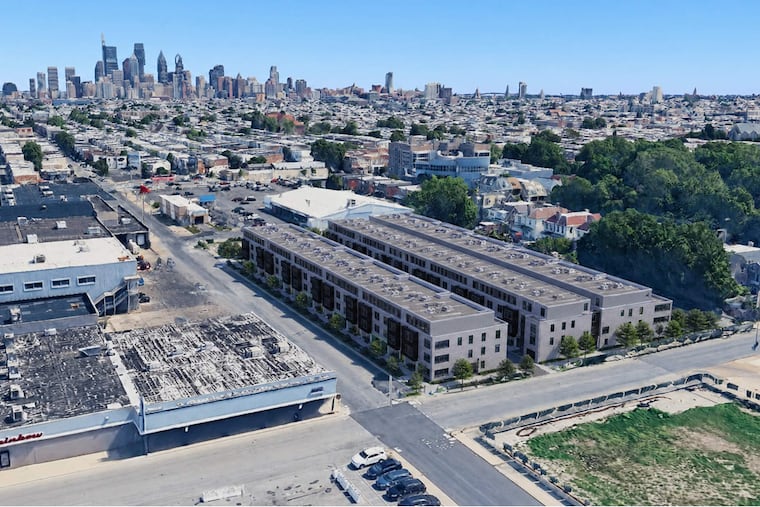
New York’s Brevet Capital Management revealed its vision for 1341 S. Christopher Columbus Blvd. to the Pennsport Civic Association on Wednesday night, showing a soaring tower on Delaware River with 620 units and promising a dramatic revision of public space in the area.
In addition to the tower and small retail building just to its west, the developer’s representatives outlined possible future phases that could include two additional towers.
“The retail building is constructed as a placeholder,” Meredith Trego, a zoning lawyer with Ballard Spahr, said at the Pennsport Civic Association meeting. “But the idea is in a future phase that a one-story building would go away, and a new tower could go in its place.”
The towering project, with its limited parking, is legally possible due to the unique zoning incentives available along the central Delaware riverfront.
In exchange for building as high as they want, the developers must meet a variety of requirements including paying into the city’s housing trust fund, providing public space, and upgrading, maintaining, and extending a rundown stretch of the Delaware River Trail down to Reed Street.
The first tower would be more than 380 feet tall, and renderings show possible future towers that would be even taller. To be allowed to build that high for future buildings, the developer would have to meet the city’s exacting requirements again, including by paying more into the housing trust fund (and they could not encroach on trail space).
Conditions on the pedestrian- and bike-friendly river trail have deteriorated below Washington Avenue. The infrastructure has not been maintained to the level it is farther north.
An encampment of homeless people has settled along this portion of the trail, although its residents have been moved around several times in sweeps orchestrated by the city, Delaware River Waterfront Corp., and property owners.
Another sweep is planned for Tuesday, the developer’s representatives said at the Pennsport meeting, and additional signage and fencing are planned to limit access to the property.
But currently the encampment is largely along the public access bike and pedestrian trail itself, not private property.
“Everyone knows that’s only going to last so long until we get density back there, people [will probably be] living back there,” said Matt McClure, a zoning lawyer representing Brevet. “That’s why we need an active use.”
Brevet’s team said they would provide additional public space with the initial tower, including on disused piers that jut into the river. Currently they do not plan to build structures on the piers but turn them into publicly accessible green space.
Residents also asked that the developer address traffic conditions on Columbus Boulevard, which is a high-speed roadway that is unsafe for pedestrians.
“Big projects generate focus on improvements,” McClure said. “Hopefully it generates dialogue on making things better” on the boulevard.
The biggest applause of the night came when an attendee urged the developer to add more parking than the 187 spaces currently proposed within the tower. Another 100 spaces are available in an existing surface lot, although that is also the site for a possible third future residential tower.
The developer’s representatives tempered hopes for a greater share of parking in future development, while not ruling it out.
“So for future phases, if there’s a need for additional parking, we could incorporate that,” Trego said. Based on what they’re seeing in developments throughout the city, she added, garages are not as full as expected.
Plans for the first tower have mostly smaller units — 50% one-bedroom units and 35% studios — but the developer said that could change.
“As we study this further, if there is desire for larger units, we can always make room for that,” said Milton Lau, a project architect with the firm Perkins Eastman.
Brevet expects to begin building in summer 2026, with an 18- to 24-month construction timeline for the first tower.
This is Brevet’s first real estate project in Philadelphia, although the company has built other developments in Florida, Texas, and California.